
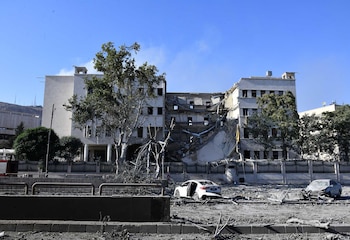
Events in Syria have recently taken a dramatic turn, prompting serious international concern . On a day marked by violence and turmoil , the Iranian Foreign Minister Abbas Araqchi voiced strong criticism of Israel’s military actions in the region. Following an Israeli strike on the Syrian capital of Damascus , Araqchi issued a stark warning concerning the ongoing threats to sovereignty and stability in the Middle East.
“Unfortunately, all this was too predictable. What will be the next capital?” he questioned on the social media platform X . Accompanying his statement was a video showcasing the aftermath of the Israeli bombings, which particularly targeted the Syrian Army’s headquarters and a nearby presidential complex, resulting in at least three fatalities and approximately twenty injuries.
The Iranian diplomat characterized the Israeli government under Prime Minister Benjamin Netanyahu as one that “knows no limits,” emphasizing Israel’s disregard for global diplomatic norms. He called for the international community , especially regional allies, to unite against what he labeled a “deranged aggression” by Israel. Araqchi reaffirmed Tehran’s unwavering support for “Syria’s sovereignty and territorial integrity,” emphasizing that Iran will always align itself with the Syrian people’s struggles for peace and stability.
Echoing Araqchi’s sentiments, Esmaeil Baqaei , the spokesperson for Iran’s diplomatic ministry, condemned Israel’s recent military offensives. He branded the Zionist regime as the “greatest threat” to both peace and stability in the region. His statements added further complexity to the strained Iran-Israel relations, which have been increasingly volatile in light of ongoing conflict.
The latest round of accusations toward the Israeli government in relation to human rights violations was furthered by Baqaei, who urged accountability not just for Israel but also for Western nations that have supported Israel through military and political means. He specifically cited Germany, the United Kingdom , and France as complicit parties in what he referred to as “dangerous military engagements” that undermine the prospects for peace and international security.
The current situation in Syria can be viewed as a result of the “excessive silence and inaction” from the global community regarding the “killing, war, and control” imposed by the Zionist regime . Baqaei highlighted that these repercussions are not confined to Syria but extend to threaten the overall stability of the entire region. This positioning underlines Iran’s claims of a broader geopolitical strategy aimed at counteracting perceived injustices inflicted by Israel.
In response to these escalating tensions, Baqaei called for joint responsibility among nations in the region to foster stability and peace. He urged the United Nations and the Organization of Islamic Cooperation to take immediate action, emphasizing that inaction would only exacerbate the growing threat of Israeli expansionism.
Israel’s history of military interventions in various Middle Eastern nations, including Gaza , has long raised the stakes of international diplomacy. Recent statistics reveal a staggering human toll, with over 58,000 Palestinians reported deceased since October 2023 in the ongoing conflict. These statistics provoke discussions on the international community’s role and responsibility regarding humanitarian efforts in war-stricken areas.
With the ongoing strife in the Middle East, there are calls for a multilateral dialogue that can truly engage all the stakeholders involved. As tensions rise in Syria and surrounding nations, exploring pathways for peace becomes essential. Iran’s vocal stance against Israeli actions marks a critical pivot in regional dynamics, one that could either escalate matters further or push the international community toward constructive engagement .
The battle for Syria’s sovereignty and the regional political landscape is far from over, and the challenges ahead require courageous dialogue and actionable international commitments to establish a framework for lasting peace. Amidst this backdrop of uncertainty and tension, the potential for transformative change rests upon a collective effort to address the underlying issues fueling the conflict.