

It was the year 1950 . In Los Alamos , New Mexico, the best cafeteria conversation of all time took place. The physicist Enrico Fermi , eating with his colleagues Emil Konopinski , Edward Teller , and Herbert York , asked: “Where is everyone?” The Fermi paradox was born.
What Does Fermi’s Paradox Say?
If our galaxy, the Milky Way , contains between 100,000 and 400,000 million stars , many of them thousands of years older than the Sun , it stands to reason that we are surrounded by a massive number of exoplanets . Today, rocky planets are common in the habitable zones of other solar systems. So, why have we not found any evidence of extraterrestrial life ?
This is the essence of one of the most disturbing problems in modern science: Fermi’s paradox . Given the abundance of worlds, intelligence and technology should have emerged capable of colonizing the galaxy or at least sending detectable signals . This creates a flagrant contradiction between the high probability that there is intelligent life in other places and the absolute lack of evidence: a cosmic silence that persists in our telescopes and explorations.
To date, we have not seen convincing proof of visits or artificial signals from other civilizations. The Milky Way is old, approximately 13 billion years old. A species capable of making interstellar “slow” trips would suffice to colonize it in less than 100 million years. But we still don’t see their mega-structures or detect their radio transmissions. They are either extraordinarily rare civilizations or they do not exist at all.
What Is the Difference with Drake’s Equation?
Fermi’s paradox is an empirical observation that arose from an informal conversation. In contrast, astronomer Frank Drake proposed a mathematical structure for it in 1961 : the Drake equation , a probabilistic formula that tries to estimate the number of technologically advanced civilizations capable of communication in our galaxy.
The equation multiplies several factors, such as the rate of stars, the number of planets per star, and the fraction of planets that could develop life. The statistics are overwhelmingly favorable. Drake’s formula gives meaning to our search for extraterrestrial life, feeding our statistical hope. However, while Drake’s equation suggests that there should be someone out there, Fermi’s paradox questions why we have not found anyone.
This contradiction is at the core of Fermi’s question. It is not a formal theory but a line of reasoning urging us to contemplate why the universe seems so empty. As a tribute to Enrico Fermi, astronomers are still seeking answers to his question 75 years later .
Who Was Enrico Fermi?
Known as the “Architect of the Atomic Bomb ,” Fermi was an Italo-American physicist who received the Nobel Prize in Physics in 1938 for his works on induced radioactivity.
He played a crucial role in the Manhattan Project , the program that developed the first nuclear bomb during World War II. Fermi directed the construction of the Chicago Pile-1 , the world’s first artificial nuclear reactor, achieving the first self-sustained nuclear reaction in 1942 .
Born in 1901 , he passed away from cancer at the age of 53 , shortly after formulating Fermi’s paradox. The question “Where is everyone?” emerged during a lunch with his colleagues in the National Laboratory of Los Alamos. Despite the informal nature of the conversation, the depth of the question, along with Fermi’s authority, gave it lasting significance, becoming a cornerstone of thought regarding extraterrestrial life.
Responses to Fermi’s Paradox
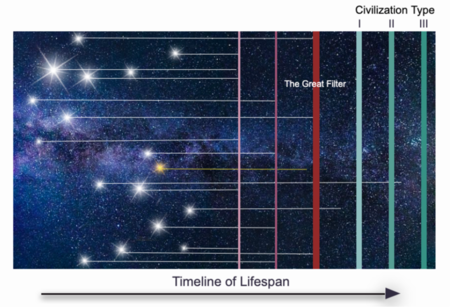
Image | Jiang et al. (CC By-C-SA 4.0)
Over the decades, scientists, philosophers, and astronomers have proposed numerous hypotheses to address Fermi’s paradox. The responses can be grouped into three main categories.
Intelligent life is extremely rare. This is perhaps the simplest and bleakest solution, proposing that there exists a “great filter” —a barrier or series of barriers exceedingly difficult for living beings to surpass, either in their appearance, evolution, or capacity to expand throughout the galaxy.
It might be that the conditions for life to emerge are so incredibly specific that they only transpired once—here on Earth. The leap from simple microorganisms to complex, multicellular organisms might be the true bottleneck. Moreover, intelligence like ours may not be an inevitable product of evolution.
Alternatively, as suggested by the Apocalypse Clock of the Bulletin of Atomic Scientists , technological civilizations may tend to self-destruct before they can expand into the galaxy—either through nuclear warfare, climate change, or pandemics.
They exist, but we cannot detect them. Numerous hypotheses attempt to explain our lack of contact. A recent study by NASA revealed a simpler explanation: space is so vast and we have observed so little of it that it’s normal for us to have no clues:
“Fermi’s paradox is a very large extrapolation from a very local observation. You could look out the window and conclude that bears do not exist because you don’t see any.”
Perhaps extraterrestrial technology is simply undetectable. They might not need to construct mega-structures like Dyson spheres that would be visible to us, relying instead on energy sources we don’t even comprehend. They may have opted for hibernation , waiting for the cosmos to cool over billions of years to optimize their computational abilities.
When it comes to communications, as astrophysicist Amri Wandel postulates, our radio signals have only traveled about 100 light-years . Any response would require the same amount of time to return. We might need between 400 to 50,000 years for contact, assuming someone listening chooses to respond. But first, they would need to locate our signal amid the cosmic vastness.
They exist, but they deliberately avoid us. The more disturbing hypothesis suggests that advanced civilizations are aware of our existence but have chosen not to interfere with us, treating Earth as a nature reserve or a “zoo.” They observe us from a distance to prevent altering our natural development, akin to our animal welfare laws.
Even more troubling than the zoo hypothesis is the “dark forest” hypothesis, popularized by science fiction novelist Liu Cixin . It suggests the universe is a dangerous place—a dark forest full of hunters.
Here, the most rational survival strategy is to remain absolutely silent. Any civilization that reveals its location may risk annihilation by more paranoid and advanced civilizations. The great silence might not indicate the absence of life but rather that everyone is hiding.
Regardless of the answer, Fermi’s paradox continues to be a significant engine for scientific inquiry . It urges us to enhance our telescopes, refine our search techniques, and, most importantly, reflect upon our own place in the cosmos and our civilization’s future.
Whether we are alone, anticipating first contact, or hiding in a dark forest, Enrico Fermi’s question, “Where is everyone?” , continues to resonate through the vast silence of the observable universe, waiting for an answer.
Image | NASA
In Xataka | If we want to find extraterrestrial life, we already know where in space we must look: the “Terminator.”