
The Revolutionary Leap in Energy Transmission
What are 800 watts ? It is approximately what a microwave consumes while operating at medium power. Similarly, 8.6 kilometers is the approximate distance between the Atocha and Chamartín stations in Madrid . These figures serve to illustrate the scale of the recent breakthrough by DARPA: a system capable of transmitting real energy via a laser , straight through the air, without wires, and equipped with a receiver that converts the light into usable electricity. While 800 watts may seem modest, the significance lies in the achievement of transmitting energy , which had not been accomplished before.
Understanding DARPA’s Achievement. The United States Advanced Defense Research Projects Agency (DARPA) has successfully completed the first phase of a program named Power , aiming to investigate innovative methods for transmitting energy over long distances. During its most recent test in New Mexico , they successfully delivered a laser beam that transmitted around 800 watts for 30 seconds to a receiver located 8.6 kilometers away—surpassing previous records where only 230 watts could be achieved over 1.7 kilometers .
Although the agency has not disclosed the initial power output , it is known that the system sustained energy flow for periods exceeding those officially documented. As stated by project leaders, the objective was not to demonstrate maximum efficiency but to ascertain viability . Remarkably, the system was developed and executed within a mere three months.
The receiver, crafted by Technc Technologies , employs commercial solar cells that are readily available in the market. The emphasis here was neither on achieving peak performance nor on using complex manufacturing but on proving that this technology can be built using accessible components.
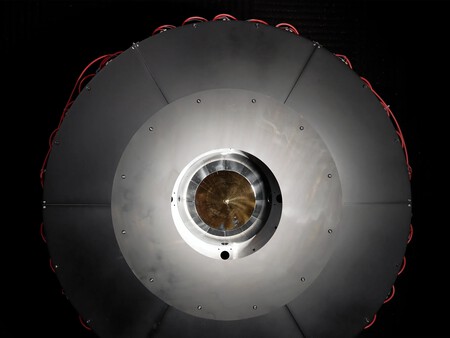
How the Technology Functions. The principle behind the experiment is straightforward: transmit energy through the air using a beam of light, which can then be converted into electricity upon reaching its destination. The DARPA system utilizes an infrared laser aimed at a receiver composed of a conical mirror and solar cells. The mirror captures the laser beam and redirects it toward the solar panels, which convert the light into electric energy .
Part of the equipment used during the test
The compelling aspect of this development is the use of commercial cells , highlighting the feasibility of this technology beyond theoretical applications. Receiver efficiency stands at around 20% , showcasing substantial potential for future applications.
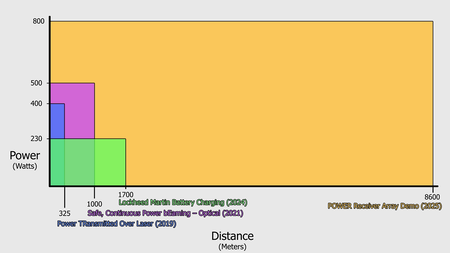
The Power Receiver Array Demo system achieved a new record by transmitting laser energy with more power and greater scope than ever
During the tests, diffractive optics were employed along with an integrated cooling system in the optical components, produced via additive printing techniques . These innovations were not part of the initial plan but emerged as necessary solutions throughout the experiment.
Why Opt for Lasers Over Radio Waves?. The concept of transmitting energy over long distances isn’t new; for decades, scientists have examined how to achieve this through radio or microwave waves. However, these methods face inherent physical limitations regarding efficacy. As noted by IEEE , they rely on large transmitters which limit the effectiveness of energy transmission, necessitating complex beamforming techniques to concentrate the signal directionally.
When compared to radio waves, lasers can provide a tighter focus: a narrow beam can be produced with minimal dispersion under ideal conditions. According to Eric Yeatman , Vice President at the University of Glasgow , this offers superior advantages for specific applications.

However, lasers have their downsides, being sensitive to atmospheric conditions such as fog, clouds, or dust. In these scenarios, microwave technology remains more reliable. Nonetheless, for applications in aerial networks, laser technology brings unparalleled efficiency. As noted by project leader Paul Jaffe , a successful outcome will depend on optical methods.
Implications of the DARPA Experiment. While the DARPA experiment did not resolve all challenges linked to wireless energy transmission , it demonstrated the technology’s potential to work in real-world scenarios using accessible components. Efficiency still requires improvement, and the system is not yet adaptable to adverse environmental conditions. Nonetheless, this groundbreaking test has laid the groundwork for further innovations in energy transmission technology.
Images courtesy of DARPA. The main image shows an earlier test conducted in 2019 at a lesser distance.