
Japan Sets New Milestone in Fiber Optic Data Transmission
Japan has achieved a groundbreaking world record for data transmission via fiber optic technology. This remarkable feat involved sending data at an astonishing speed of 1.02 Petabits per second over a distance of 1,808 kilometers . The record was established by a collaborative effort between Sumitomo Electric Industries and the National Institute of Information and Communication Technologies (NICT) in Japan, marking a significant milestone in the realm of long-distance optical communications. An exciting aspect of this achievement is that it utilizes fiber optics that are compatible with existing devices, paving the way for broader applications.
The Key Technological Leap
The breakthrough is not just about speed; it also involves the impressive distance achieved without increasing the cable diameter. Previous records for pure speed reached 1.7 Petabits per second , but these only covered 63.7 kilometers . In comparison, this new record increases the distance by 28 times without any increase in the thickness of the fiber, marking a potential shift toward real-world commercial usage of this technology.
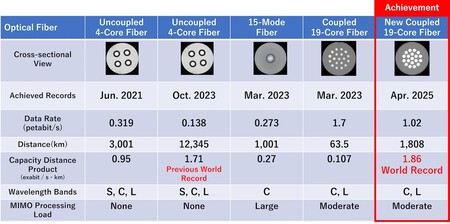
Image: Ispreview
How It Works
The technology utilizes an optical fiber composed of 19 nuclei within a cable maintaining a standard coating diameter of 0.125 millimeters , the same as current fibers. Instead of relying on a single light beam, this innovative fiber can transport 19 parallel signals by leveraging both the C and L bands of the optical spectrum. Sumitomo Electric optimized the structure and arrangement of the nuclei to minimize transmission losses, while NICT developed advanced amplifiers capable of enhancing signals from all nuclei simultaneously.
Dimensional Achievement
To put the magnitude of this achievement into perspective: 1 Petabit equals 1,000 terabits or 1 million gigabits per second. When compared to the average broadband speed in countries like Spain, which generally lingers around 250 Mbps , this record speed is nearly 4 million times faster. This theoretical capacity could facilitate the simultaneous transmission of 10 million 8K video channels or even allow downloading the entire Netflix library in mere seconds.

Practical Implications
This record establishes a new benchmark in terms of “capacity-duty,” quantified at 1.86 exabits per second-kilometer using standard diameter fiber. This breakthrough implies that future network infrastructures could exponentially enhance their capacity without necessitating alterations to existing physical frameworks. Notably, intercontinental submarine cables , which currently link Europe to America, could leverage this technology. However, as distances surpass 5,000 kilometers , the achievable speeds may decrease, although they would still remain impressive.
Path to Commercialization
While these advancements may not immediately translate to improved domestic connections, they certainly whet the appetite for the future of long-distance communications. The research team is currently focused on further enhancing the efficiency of amplifiers and signal processing to facilitate the technology’s real-world implementation. Given the ever-increasing global internet traffic, it is promising to consider that the optical fiber and cable designs we currently utilize are still adaptable for future evolution in this field.
In conclusion, Japan’s remarkable achievement in fiber optic data transmission not only sets a new record but also opens doors to a future where high-speed connectivity becomes increasingly accessible. As technology continues to evolve, the possibilities of enhanced digital communication grow, promising exciting advancements for both commercial and personal use.
Cover image | Kirill Sh
In Xataka | Mobile’s internet is going wrong: what can you do when you don’t have a connection