
Microsoft stands at a pivotal juncture in its history, showcasing the complexities and contradictions of the current tech landscape. The company led by Satya Nadella is experiencing substantial financial growth while simultaneously implementing significant layoffs across various divisions, including its Xbox sector and some European studios. This raises a curious paradox: major corporations are increasingly generating greater revenues with a reduced workforce.
The Layoffs
Microsoft’s recent layoffs are not isolated incidents; rather, they reflect a broader trend in the technology industry . In May, the company announced it would part ways with over 6,000 employees , roughly 3% of its global workforce. By July, an additional 9,000 workers had received notices. According to company spokespeople, these layoffs are “ organizational changes necessary to better position the company in a dynamic market” 1.
Microsoft’s corporate restructuring has been ongoing since January 2023, which has been compounded by salary freezes and reductions in bonuses and incentives. It’s clear the company is taking a hard look at its operational structure in light of current market conditions.
The Figures
Despite the layoffs, Microsoft’s fiscal strength is evident. The company reported $64.7 billion in revenue for the last fiscal quarter, marking a year-on-year growth of 15% . At the time of this article, Microsoft boasts a stock capitalization exceeding $3.7 trillion , rivaling tech giants like Nvidia for the top spot in market valuation.
The Paradox
As of 2023, the total number of layoffs at Microsoft has exceeded 30,000 . This is occurring amid:
- Record quarterly income.
- Record net benefits.
- Record stock prices per share.
- Record stock market capitalization.
Microsoft’s situation highlights a growing trend in the tech sector: higher revenues and increased efficiency through a leaner workforce . This model is increasingly seen as the norm.
The Context
Since 2022, layoffs in the tech industry have become almost routine. These exits are transpiring not in a context of economic recession but rather amid escalating valuations in tech stocks. In many cases, the decision to reduce staff is becoming a systematic component of the quarterly planning for companies like Microsoft.
The current financial climate starkly contrasts with the post-2008 financial crisis era. In the wake of the pandemic, interest rates have remained low, fueling significant investments in Big Tech. This trend was further exacerbated by a talent war that saw tech companies aggressively hiring. However, as market dynamics evolve, many firms are reassessing their staffing approaches.
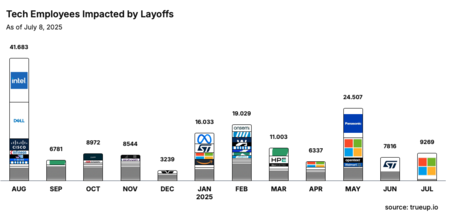
<span>Image | Trueup.io</span>Where Are We Going?
Since 2022, major tech companies have shifted from aggressive hiring strategies to a more cautious approach. Forecasts suggest that around 200,000 technology jobs may be lost by 2025—a figure that, while lower than the 400,000 layoffs recorded in 2023, still points to a persistent trend towards workforce reductions. This shift can be attributed to several key factors.
Because
In the years following the pandemic, tech companies adopted aggressive hiring policies, leading to workforce expansions that far exceeded their operational needs. High-profile executives, such as Andy Jassy of Amazon, have publicly acknowledged that their firms had hired too many employees. As companies streamline their operations, specialists in high-demand areas like artificial intelligence are becoming significantly sought after.

Superstar
While the wave of layoffs may sound dire, it has also created opportunities for specialized roles in burgeoning fields like AI . Despite thousands losing their jobs, the most talented engineers are quickly securing positions with staggering salaries, often in the seven-figure range. This duality—mass layoffs along with record corporate profits—creates a complex narrative within the tech sector, illustrating a significant shift in how companies operate.
Overall, Microsoft’s recent actions highlight a broader industry shift, underscoring the complexities of modern corporate strategies. The landscape of employment within the technology sector continues to evolve, presenting a unique set of challenges and opportunities for workers and companies alike.