
Microsoft’s Layoff Strategy: A Shift Towards AI
Microsoft is making headlines once again with the recent announcement of 9,000 employee layoffs worldwide. This decision has sent shockwaves through the company’s core departments, including Xbox and its associated studios. Interestingly, the layoffs are not attributed to economic difficulties; rather, they stem from Microsoft’s strategic initiative to become more agile in the increasingly competitive landscape of artificial intelligence (AI) development and implementation.
In light of this situation, Matt Turnbull, the executive producer of Xbox Game Studios Publishing, took to LinkedIn to address those who lost their jobs. In his statement, Turnbull urged his former colleagues to leverage AI in coping with the emotional and mental toll of their dismissal. However, this message did not sit well with many.
These layoffs contrast sharply with previous mass layoffs that were often linked to economic downturns. Today’s workforce reductions in large tech companies like Microsoft are largely strategic moves aimed at flattening organizational structures, enabling quicker adaptation to the evolving AI landscape. Consequently, many employees are finding themselves affected, not because they are being replaced by AI, but as collateral damage in the race to develop it.
The timing of the layoffs is particularly notable given Microsoft’s commitment to invest a staggering $80 billion in AI. This investment has sparked further debate regarding the priorities of the company and the implications of automation on employment. Those who have been laid off, especially from Xbox Game Studios and other pivotal areas, are now left to navigate a labor market marked by significant cuts and unrest.
<img alt="Microsoft's AI initiatives" width="375" height="142" src="https://i.blogs.es/56f195/microsoft-ia-/375_142.jpeg"/>Utilizing AI for Emotional Support. Amidst the reorganization, Turnbull offered a series of recommendations claiming that these were “really difficult times.” He further stated, “If you are going through a dismissal or preparing for one, you are not alone and don’t have to do it alone.” Rather than offering direct support from Microsoft, he suggested that affected employees consider AI tools such as ChatGPT to help mitigate the trauma associated with job loss.
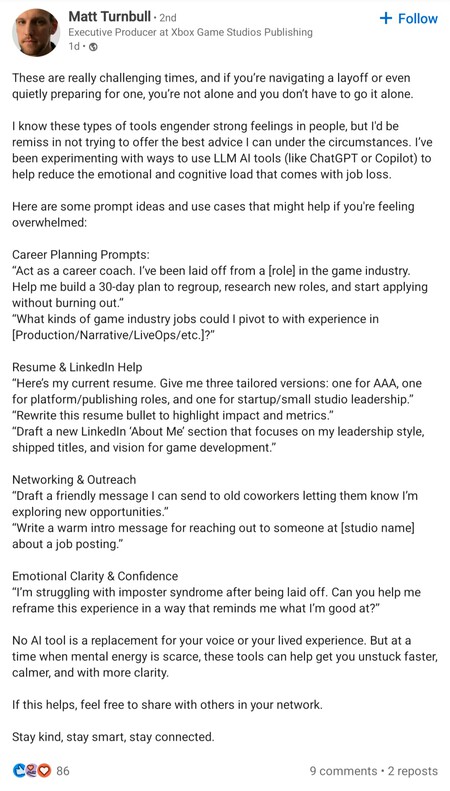
<span>Matt Turnbull's original message capture</span>In his post, Turnbull remarked, “I have been experimenting with ways to use AI tools to help reduce the emotional and cognitive load that comes with job loss.” This statement generated considerable pushback, as many perceived it as ironic and out of touch with the reality of those being let go.
Social Media Reactions and Controversy. The backlash on social media was swift. Reactions on platforms like X and Reddit suggested that Turnbull’s proposal echoed a dystopian narrative similar to that of the show “Severance,” where employees undergo corporate “separations.” Critics voiced their discontent, arguing that recommending a chatbot for emotional support reflects a profound lack of empathy for the experiences of those who have just lost their jobs.

<span>Touch the image to go to the original message</span>Comments under Turnbull’s post highlighted that while he recognized AI’s limitations, his suggestion was seen as callous. Following the torrent of criticism, he eventually retracted his original comment, indicating a recognition of the disconnection between AI and the emotional needs of displaced workers.
The Role of AI in Mental Health. Turnbull’s recommendatory stance on AI as a form of emotional support raises further questions. As more individuals turn to AI models designed for psychological assistance, it is crucial to recognize that these technologies can often lack the empathy needed to address human suffering effectively. Several documented cases illustrate how AI interactions can exacerbate emotional distress rather than alleviate it, which raises caution against its implementation in such sensitive contexts.
Nonetheless, Turnbull did share practical ways that AI can assist job seekers, suggesting its use as a personal assistant for resume updates and job applications. As the recruitment landscape increasingly relies on algorithm-based selections, leveraging AI to enhance resumes and cover letters may prove to be invaluable for those navigating job transitions.
This series of events has opened a broader discussion on the implications of AI initiatives within major corporations and their responsibilities towards their employees. As the line between technological advancement and ethical considerations becomes increasingly blurred, companies like Microsoft must balance innovation with employee welfare—ensuring that the tools they promote do not become replacements for the human touch essential in moments of vulnerability.