
In 2020, a video went viral showcasing the Caspian Sea , revealing one of the most fascinating creations of Soviet aviation: the ekranoplan . Known as the “marine monster,” these unique hovercraft never saw mass production due to prohibitive costs, but their legacy lives on. Fast forward five years, and a new player has emerged on the scene: China . The country has resurrected the concept of the ekranoplan, signifying a new chapter in the evolution of hybrid vehicles that blend features of both aircraft and ships.
Emerging Silhouette
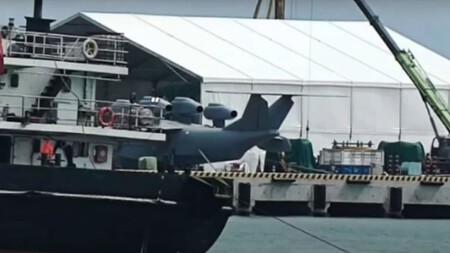
Recent images have surfaced of a new ground effect vehicle (GEV) developed by China. This aircraft hovers over water, harnessing what’s known as “air mattress efficiency” to maximize lift while minimizing drag. This design allows the vehicle to cruise at low altitudes, creating a unique operational niche. Naval analyst Hi Sutton first identified the vehicle’s presence in the Bohai Sea , northeast of the Yellow Sea, and initial photographs only hinted at its structure. New shots have since revealed its full silhouette, displaying characteristics similar to earlier ekranoplan designs.
Amazing Design
This new GEV bears a resemblance to the AG600 , an amphibious aircraft designed for rescue and logistic missions. However, the latest floating monster signifies a growing trend to revive ground effect technology. While the Soviet Union extensively researched this technology during the Cold War, it never entered the mainstream. The Chinese adaptation could potentially change the game.
Between Shadow and Radar
The operational principle of an ekranoplan is straightforward yet effective: by flying just above the water surface, it can exploit a dense layer of compressed air. This design not only enhances lift but also reduces drag. Moreover, because it operates below the radar horizon, these vehicles are significantly harder to detect and track. Unlike conventional ships, which can fall prey to mines and submarines, ekranoplans can navigate semi-permissive environments more effectively.
Potential Utility in Military Scenarios
In a hypothetical scenario involving conflict between China and the United States , the ekranoplan could serve a crucial role. It would function as a logistics platform, capable of delivering supplies to remote coastal areas, conducting evacuations, or engaging in limited maritime control functions. Its ability to operate in shallow waters without requiring port infrastructure offers strategic advantages in a rapidly changing military landscape.
Propulsion, Design, and Doubts
One of the unanswered questions surrounding this new vehicle is its propulsion system. Current images suggest large rear turbines, but whether these represent jet engines, propellers, or a hybrid-electric system remains speculative. The nacelles on top could imply a twin-engine design utilizing turbojet engines. However, various structures on the front hint at the potential for powerful thrust propellers, adding another layer of intrigue to its design.
Unconfirmed Versions
The existing variants of this device could either be prototypes for technological demonstrations or operational models undergoing stealth testing. There is potential for using advanced composite materials to enhance performance, thin out weight, and decrease radar signatures. Such advancements would contribute to a highly specialized and effective vehicle.
New Mobility Paradigm
The profile of this new Chinese ekranoplan draws clear parallels with the Liberty Lifter , a visionary project aimed at heavy payload transportation without relying on traditional airport or port infrastructure. Featuring a V-tail design, stabilizing floats on the wings, and a spacious side door, it is poised for effectively transporting personnel and materials, especially in coastal areas.

What Lies Ahead
The public unveiling of this ekranoplan, dubbed the “Monster of the Bohai Sea” by naval analysts, has sparked intense scrutiny from experts and Western intelligence agencies. As more images and possibly video footage surface, the vehicle’s capabilities will transition from speculative analysis to serious assessment. This emerging technology indicates a commitment by China to invest in asymmetric capabilities that challenge traditional logistics. While the ekranoplan itself may not represent a direct threat, it is a clear indication of Beijing’s ambition in military and technological domains.
In conclusion, the re-emergence of ekranoplans symbolizes China’s shift towards advanced military technologies that could reshape maritime conflict dynamics. As nations scrutinize developments, the implications for both regional and global security will become increasingly significant.