The Battle for the Cradle of Spanish Football
In the world of football , not all matches take place on the pitch. The origins of the sport we passionately follow today find themselves embroiled in a historical debate situated within the archives and local chronicles of late 19th-century Spain. The most popular narrative—often endorsed by the Royal Spanish Football Federation (RFEF)—places the birthplace of Spanish football in Huelva with the Recreativo de Huelva, an esteemed club often heralded as the oldest in the country.
However, an intriguing theory suggests that the true birthplace of Spanish football may lie at the opposite end of the Iberian Peninsula, in Galicia , specifically at the docks of Vigo .
The Genesis of Football
To fully appreciate the story, we must first understand the underpinnings of the sport. Kicking a ball has long been a source of joy across civilizations. In ancient Greece, a game called Episkyros was played. The peoples of pre-Columbian Mesoamerica engaged in the sport of Pok-a-tok. Even the Vikings were known for Knattleikr. However, when discussing modern football, we must pinpoint its inception in 19th-century England .
In Mortlake , a district on the outskirts of London, history took a pivotal turn when, in December 1863, a match was held between Barnes Football Club and Richmond Football Club. This match was critical; it was the first to be governed by the rules of the newly formed Football Association (FA), which was established only months earlier.
The Arrival in Spain
So when did football leap onto Spanish soil? The prevailing theory suggests that the sport reached Spain in the 1870s , arriving via Huelva. The motivation behind this was less about sport and more aligned with economic interests. The Rio Tinto Company , established in 1873, brought British workers to exploit the region’s mineral resources. It was within this environment that football began to take root.
Significant events unfolded on August 16, 1873 , when a match was reportedly played during the local celebrations of San Roque. This occasion has been dubbed “the first football match in Spain.” The work titled “Mines and Riotinto, cradle of football in Spain,” published with the support of the Diputación de Huelva , lends credence to the claim that the first goal in Spain was celebrated in this small town.
First Football Club
The landscape evolved further in 1878 when the Riotinto English Club was established. This club was a sanctuary for British engineers and sailors, allowing them to partake in various sports, including football. Documented evidence suggests that a football match took place in Huelva on September 10, 1874, between workers from the railway linking Huelva and the mines.
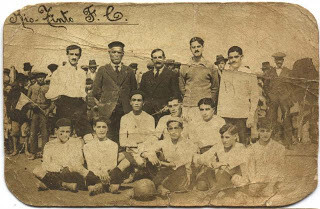
Riotinto FC 1918.