
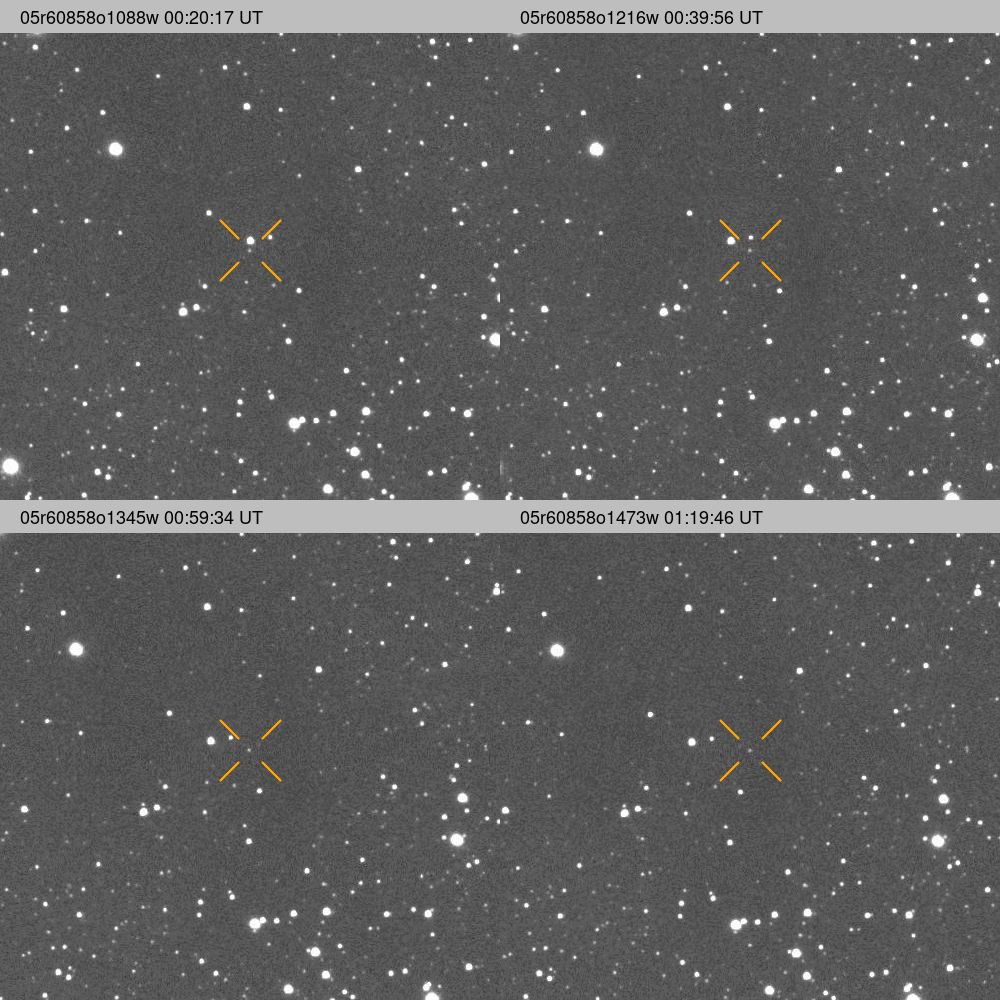
The Discovery of Comet 3I/ATLAS: A Glimpse into the Cosmic Unknown
On July 1st, astronomers made a groundbreaking discovery: Comet 3I/ATLAS is an interstellar comet, marking the third confirmed visit from an object originating outside our solar system. This astonishing find was made in less than three days, following the detection of two previous interstellar visitors, thus shining a light on the mysteries of our cosmos.
The discovery occurred in Chile using one of the telescopes from the ATLAS early warning network, which is primarily designed to detect asteroids that may pose a risk to Earth. However, since it scans the sky, it picks up a variety of celestial objects. According to Julia de León , a researcher at the Institute of Astrophysics of Canary Islands (IAC) and the head of its Solar System group, “It was a very rapid discovery. The comet has generated significant interest among scientists.” This enthusiasm is fueled by the comet’s remarkable trajectory and potential for new insights into the origins of our solar system .
Images captured during the night of July 2 with the ATLAS-Teide telescope
In the past few days, several telescopes at the Tenerife Observatory have also been tracking this interstellar object. The team utilized the ATLAS-Teide , along with a 1-meter telescope named TST and a 2-meter telescope called TTT to collect data. These recent observations have helped to determine the orbit of the comet and confirmed the existence of an extended coma—an outward envelope that is typically associated with comets.
According to Julia de León, “Currently, the comet is heading towards the Sun. It will reach its closest approach to our star on October 30 , positioning itself approximately 1.354 astronomical units from the Sun, equivalent to about 200 million kilometers .” She emphasizes that this comet poses no threat to Earth. “When it makes its closest approach to our planet between December 18 and 19 , it will be around 270 million kilometers away , which is about 1.8 astronomical units ,” she added.
Initial size estimates suggest that 3I/ATLAS could have a diameter ranging from 10 to 30 kilometers . However, de León cautions that this is merely an estimate. “The object reflects sunlight but does not emit any light of its own; its brightness depends on a number of factors such as size, distance, and composition,” she explained. The variability in a comet’s brightness can complicate accurate size measurements.
Furthermore, Julia points out the unique characteristics of comets. “Comets contain ice, and as they approach the Sun, this ice transforms from solid to gaseous state, causing the comet to emit additional material that can obscure the nucleus.” As a result of this behavior, scientists will continue to monitor 3I/ATLAS closely.
Understanding Interstellar Visitors
In the realm of interstellar objects, 3I/ATLAS joins an exclusive group that includes the well-known Oumuamua , discovered in 2017, and the comet 2I/Borisov , identified in 2019. According to de León, these objects enter our solar system, traverse it, and then depart. For Oumuamua , its early detection happened just as it was exiting the solar system, limiting detailed observation opportunities. This led to various speculative theories, including suggestions of it being an alien spacecraft ; based on available data, de León asserts that these claims are unfounded.
Conversely, with Borisov , astronomers had the chance to study an incoming celestial body in detail. Julia de León was among the first to capture its spectrum. “What we found indicated that Borisov was very similar to the majority of comets present in our own solar system,” she said. This comparison helps astronomers understand the diversity of cometary bodies across the universe.
Looking ahead, the team at the Institute of Astrophysics of Canary Islands will continue monitoring 3I/ATLAS using the ATLAS-Teide telescope. Additional observations with two-meter and 80 cm telescopes, and the Gran Telescopio Canarias (GTC) , the largest optical and infrared telescope in the world, are also being scheduled.
In summary, the discovery of Comet 3I/ATLAS is not just a significant scientific achievement; it opens doors to deeper inquiry about the origins of our solar system and the nature of comets as they travel between the stars. As astronomers continue to gather and analyze data, we may uncover truths that have long eluded us, thereby enriching our understanding of the universe. The ongoing monitoring of this comet will hopefully provide more insights and perhaps even set the stage for understanding other interstellar visitors in the future.