
The Great Dinner Dilemma: How to Split the Bill
You have probably experienced it countless times. You gather with friends at a restaurant for dinner, enjoying the first course , second course , dessert , and then coffees and chupitos . However, when the bill arrives, you face the unavoidable dilemma: how to pay? Should everyone pay their own share or should the total be split evenly? Should you use cash, a card, or a combination of both? And if someone covers the bill in advance, how do you settle up later, especially if it’s a hefty amount? This dilemma can be a stressful cap on an otherwise enjoyable evening.
In Spain, many bars have opted for a straightforward solution to save their customers from this clingy problem: no divided payments . The mantra is simple: one table, one bill .
The golden rule that is emerging in many Spanish establishments is clear: if you dine together, you pay together . An increasing number of bars and restaurants across Spain are adopting this guideline, particularly when it comes to group bookings. This policy has found favor in places like Malaga and Catalonia , and various outlets, including Lasexta, have highlighted the rise of this trend.
It’s interesting to note that even social media platforms are buzzing about it. Platforms like TikTok and Reddit have seen lively discussions regarding whether it’s legal or fair for a restaurant to refuse splitting checks. It has become a hot topic, attracting opinions from various perspectives.
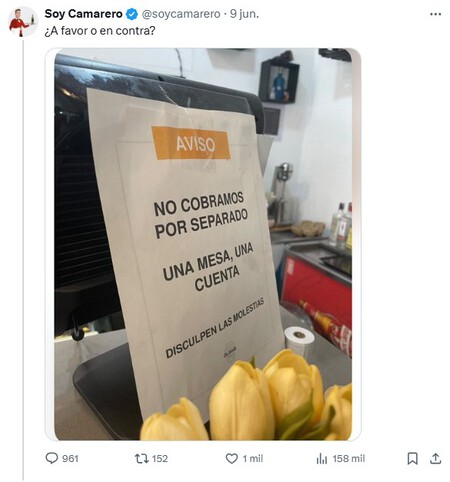
<span>Click on the image to go to Tweet.</span>But why this policy? While some establishments risk losing customers by enforcing this rule, the reality is that it increases efficiency for the staff. A waiter can handle a single transaction much quicker than managing several splits, which may involve multiple cards and cash payments. A waiter from Malaga put it succinctly: “It is incredibly complicated to charge separately, especially for larger groups.”
Efforts to split large tabs may drastically slow down service, potentially leading to dissatisfied customers and a negative impact on the establishment’s revenue. Imagine a group of twenty individuals wanting to pay their own way; this could take an inordinate amount of time.
So, is this even legal? It’s a gray area. According to experts, there’s no law explicitly mandating that a restaurant must accommodate requests to split bills. Each establishment has the right to set its policies, whether it’s accepting or refusing to split the tab. If a restaurant advertises that it accepts card payments, it cannot later refuse to process those payments for any part of the check. However, the law doesn’t specifically grant customers the right to request a split check—it’s more a matter of common sense .
The million-dollar question arises: Are separate payment supplements legitimate? Recent discussions led by Xavi Abat, known online as “TikTok’s lawyer,” highlight a growing trend where bars charge a “separate account supplement.” Some establishments impose fees—anywhere from €1 to €3 —for customers who wish to pay separately. This is framed as a way to recover some costs associated with managing complex transactions.
So how can customers protect themselves? Knowledge is key. If a restaurant communicates its policy regarding payments before the meal begins, customers implicitly accept and agree to those terms. Conversely, if they don’t disclose such a policy, customers may legally dispute the refusal of separate payments.
This issue cuts both ways. Businesses argue that splitting checks lengthens service times, requiring additional resources. Others point out that it’s common elsewhere in Europe and facilitates smoother experiences for larger groups. On the customer side, the discomfort of having to gather payment from friends can be a significant source of frustration. “Why should I have to chase after a friend for their part of the bill?” one user on social media lamented.
As dining experiences evolve, the debate over payment policies continues. The crux lies in finding a balance that respects both customer convenience and operational efficiency . Ensuring that both parties understand the terms before they sit down can alleviate many of these dilemmas.
Image | VITALY GARIEV (UNSPLASH)
The question remains: will this trend of one-table, one-payment policies continue to gain traction or will customers demand more flexibility? Only time will tell, but the growing conversations around this topic indicate that payment methods may be one of the next big battles in the culinary world.