
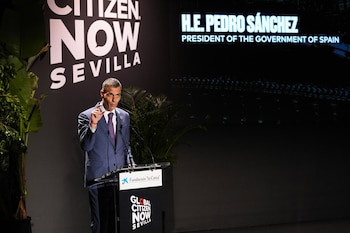
The president of the Government , Pedro Sánchez, has recently highlighted a pressing matter that affects global sustainable development —the critical lack of financing. In his address at an event held in Seville , which precedes the IV International Summit for UN Development Financing , he called on the international community to take decisive action against poverty and the escalating climate crisis . Sanchez, however, chose not to directly criticize the United States and its president, Donald Trump , for these funding cuts. According to sources from Moncloa, Sánchez intends to maintain a low profile in the days leading up to the summit, opting to avoid confrontational remarks regarding Washington’s withdrawal of support.
Sánchez’s warning about the repercussions of severe cuts to official development aid was stark. Although he refrained from mentioning the absence of the United States at the conference—often recognized as a major world donor —the implications of such reductions are significant. Moncloa officials clarified that the president aims to tread carefully to prevent any escalation of tensions with Washington, especially following a recent spat with Trump. Tensions ran high after Spain’s resistance to providing 5% of NATO’s defense expenditure, a disagreement that nearly resulted in threatened tariffs from the U.S. president.
Despite the friction, government officials maintain that Sánchez did not initiate the clash with Trump. Nevertheless, they view it as a potentially beneficial distraction from recent domestic issues, including the ongoing corruption case surrounding Santos Cerdán .
Addressing the Current Crisis with Hope
In his speech on Sunday, which also featured Ursula von der Leyen , the president of the European Commission , Sánchez struck a hopeful tone. He emphasized the dire situation the world faces but married it with optimism regarding the possibility of ending poverty , achieving sustainable goals, and confronting climate emergencies . “We can build fairer societies together,” he declared emphatically. He outlined Spain’s priorities for the Seville Conference , advocating for countries to take the lead in crafting their financing strategies. Furthermore, he proposed relieving the debt burden on developing nations through measures such as debt suspension clauses for countries facing catastrophes .
Sánchez stressed the need for a more equitable tax system , with a particular focus on ensuring that significant fortunes and large corporations contribute their fair share. He also highlighted the importance of enhancing opportunities for women, asserting that improved access to financing is crucial for empowering them in the realm of sustainable development.
“I am confident that we can reach these objectives. In a time of deep uncertainty and escalating geopolitical stress, it is essential that we reaffirm our dedication to multilateralism , cooperation, and shared responsibility,” he asserted. Sánchez reiterated Spain’s commitment to allocating 0.7% of GDP towards development assistance , signaling a long-standing promise that has yet to be fully realized.
As the conference approaches, Sánchez insists that this gathering must serve as more than just another forum; it is a pivotal moment that could define the future of global development financing . “This conference is not just another meeting; it represents a moment of truth ,” he concluded, calling upon fellow nations to not only participate but actively work towards meaningful change in global funding dynamics.
In conclusion, the challenges posed by limited funding for sustainable initiatives are not just national issues; they carry far-reaching implications for the international community. Sánchez’s approach could serve as a vital rallying call, urging nations to come together, renew their commitments, and take responsibility for the shared challenges of poverty and climate change that affect us all.