
Joel Meyerowitz (New York, 1938) gracefully walks through the opulent lobby of the Rosewood Villa Magna in Madrid. Sporting a felt trilby hat and a black knit jacket, with a digital Leica camera slung over his shoulder, he greets the assembled crowd in almost a whisper. It feels as if he is a man out of time, surrounded by modern luxury yet oddly unaffected by it. This iconic street photographer is encapsulated within four walls, but that doesn’t seem to bother him.
He strides down the hallway and settles into a room with translucent walls. Placing his hat and camera on the table, he politely requests that the music volume be lowered to facilitate a fluid conversation, allowing him to hear better with his hearing aid. “Now we can start,” he states with calm authority. At 87 years old, this man represents living history in the world of photography. Many of the iconic images capturing the streets of New York during the 1960s and 70s belong to him, from his native Bronx to Lower Manhattan. He was there to document the tragedy of the September 11 attacks in 2001, being one of the few professionals granted access to capture the events unfolding before him. Additionally, his collection of 200 photographs taken during an extensive road trip through ten European countries in the 1960s will soon be on display.
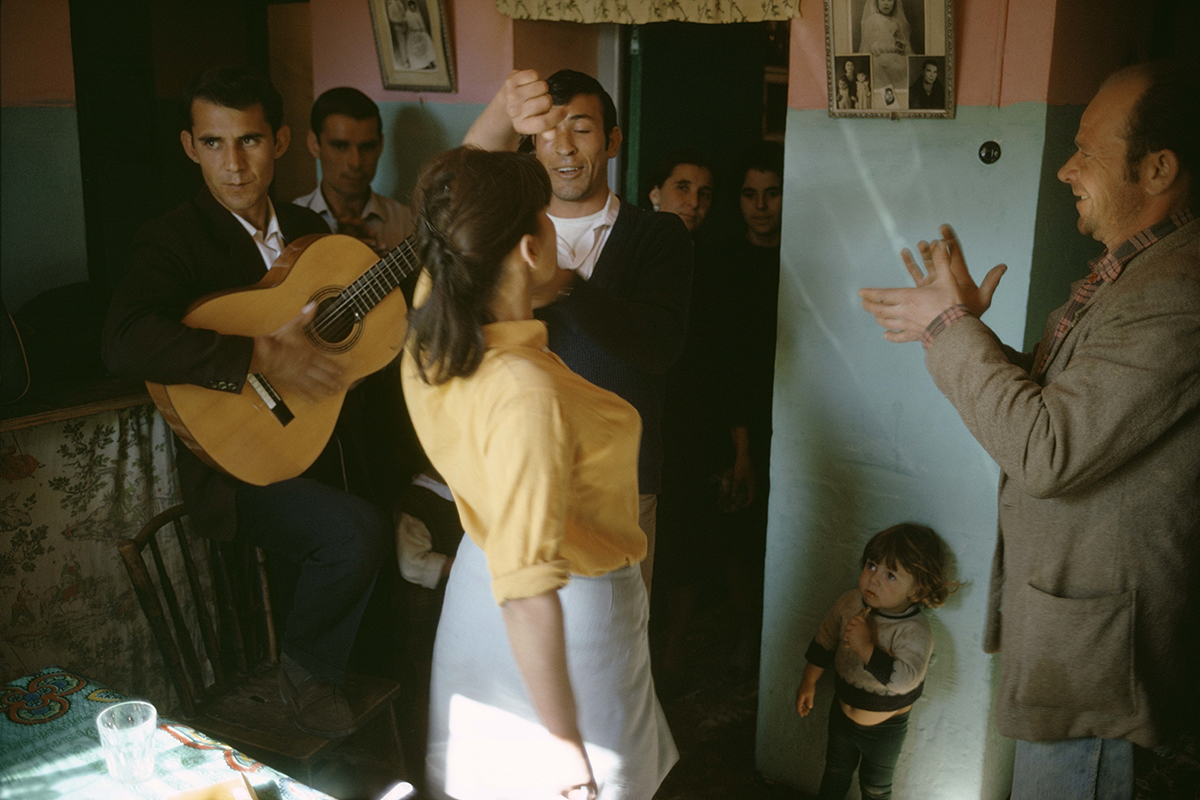
This collection, titled *Europe 1966-1967*, is currently featured at Madrid’s Centro Cultural de la Villa as part of PHotoEspaña 2025 , which has awarded Meyerowitz with a prestigious prize for his extensive career. During his European journey, he spent several months in Málaga , deeply embedded in local families and uncovering the lives of ordinary people during Franco’s regime.
“That’s where I discovered myself as an artist. At just 28 years old, I began to understand my own temper.” He explains his solitary existence during that time, where he shot 750 rolls of film , half in color and half in black and white, without reviewing them for the entire year. “So in a way, I was working out of a kind of trust , and in that understanding, I learned who I was.”
A photograph of Málaga in the 1960s
In those snapshots of tablaos and cafes, community life is palpable; color begins to seep through, showcasing one of the American’s significant contributions to photographic history. Meyerowitz was among the pioneers of color photography when black and white was the dominant format. His vibrant colors serve as a nostalgic reminder of streets that today have altered in both character and appearance. “There is still life in the street, but attitudes have changed, just as clothing and values have,” he observes. This rich life is now interrupted by human interaction with virtual reality .
Sidewalks, once gathering places, have turned into mere transit spots. People now walk with their eyes glued to their phones, focused on news, photos, or social media. “The human exchanges that once filled the streets are now overshadowed by distractions. People only look up to check for oncoming cars and then return to their screens,” Meyerowitz laments. He pauses to add, “With the internet, everyone wants to showcase their face, body, writings, or photographs in hopes of gaining followers and monetary rewards. When I started taking pictures, I wasn’t seeking recognition. I was drawn to capture moments of beauty that would soon fade. Now, that quiet conversation with the street feels broken.”
Meyerowitz recalls the first time he realized this disconnect in 1976 while working on an advertising campaign for a scientific magazine. In Colorado, an engineer warned him that one day, everyone would be connected instantaneously. “In 1976, Apple didn’t even exist,” he recalls.
- Did this foresight signal a sociological shift in the streets?
- There are multiple layers to it. If people don’t engage with one another, we lose social unity. Instead of being open to conversation, we resort to Google for quick answers. This isolates us from genuine human connection. New York used to be a vibrant city, and now it feels like walking through an endless tunnel of advertising. Public exchanges have collapsed; we’ve disconnected by fixating on our phones or the oversized images in store windows of scantily clad models.
- Has this led to increased political control or oversight?
- The less human capacity we have to determine our desires, the more control there will be. That’s why the U.S. is failing under Trump’s leadership. People do not study the Constitution, the Bill of Rights, or ethics anymore. We were taught about responsibility as Americans in school. When that declines, dictators can rise to power. Trump has filled that void and is committing an affront to democracy. I fear for the future of the United States; it may be falling apart or on the brink of collapse. Ignorance is shaping our society.
According to Meyerowitz, today’s issues mirror those from five decades ago. While wars may have shifted in scope, racial segregation has resurged as a pressing social concern, particularly after Trump’s election. “We just have different players and different needs,” he states, now residing in London, where he has also participated in protests against Brexit . Just as he did in New York during Trump’s re-election campaign. The street remains a constant theme. “My wife and I protested not just to photograph; we wanted to be part of something bigger. It’s essential to risk involvement in historical moments. It’s a delicate balance: you support a cause you believe in and might capture some photographs in the process.”
Sixty years later and at 87 years old, photography continues to anchor his life. The Leica resting on the table still accompanies him daily whenever he steps out. Without exception. Looking ahead, he has plans for a new project unfolding. “It will be something entirely different, distorted, but I can’t share any more because I have been instructed not to,” he hints, revealing a glimmer of mystery. Additionally, his publisher desires that he develop a book featuring his unpublished photographs from the 1960s. “It’s fascinating to revisit your work, but even more intriguing to observe the person you once were and the person you’ve become.”
- Who is Joel Meyerowitz? How has he changed over the years?
- I often reflect on whether I am the same person, just older, broader, and deeper. I think I engage in this reflection to see if I have been true to myself. All artists wrestle with whether to remain faithful to their essence or compromise for commercial success. I had a good friend who was a famous commercial photographer in New York, making a million dollars a year. I never made anywhere near that. One day, after his 50th, he called me upset because he was exhibiting at MoMA. I pointed out that he had sold out; he opted for commercial projects for financial gain.
- Is it challenging to choose between prestige and that million dollars?
- Right now, a million dollars would be nice, but life didn’t unfold that way. From where I stand, I believe I have remained true to myself and have arrived where I wanted to be. Perhaps the truth lies within that.
- Have you considered retirement?
- I don’t think of retirement, but I recognize that the end is near. When you’re young, mortality seems distant and irrelevant. Yet, as I age, I feel its proximity, as if death is welcoming me. It’s inevitable. My wife and I discuss death frequently, not in a morbid way, but with acceptance. Everything around me appears magical because I know I might never see it again. I feel like I am absorbing all the joy in the world.
Before he departs, Meyerowitz bids farewell with a hopeful “I hope to see you again,” and once more, he disappears into an ecosystem that doesn’t fully belong to him, like a photograph that has yet to be captured.