
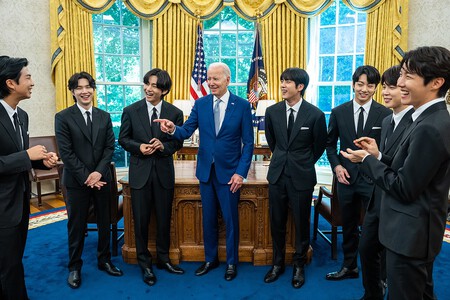
The story of BTS , one of the most popular K-pop groups in the world, has been nothing short of remarkable. At their peak, their sales continued to soar, and their fan base, known as the ARMY , grew exponentially both in South Korea and internationally. This septet broke barriers, topping charts like the Billboard 200 and even getting photographed with President Joe Biden at the White House. However, in 2022, the dynamics changed dramatically when the group announced a temporary hiatus due to mandatory military service in South Korea.
As BTS’s seven members completed their military obligations, talks of a reunion began to circulate. But this left fans pondering a significant question: what will this mean for the K-pop industry, a cultural phenomenon currently undergoing transformations ?
The Moment of Service
In South Korea, all men aged 18 to 28 are required to undertake military service for 18 to 21 months. While certain exemptions apply to top athletes and award-winning individuals, the same does not hold for K-pop singers, who can only delay enlistment until the age of 30 under a law passed in 2020. Thus, in 2022, BTS made the unusual decision to pause their activities at the height of their fame to fulfill their military duties.
The Countdown to Reunification
The oldest member, Jin , enlisted in December 2022 and completed his service in June 2024. This allowed him to return to solo activities. Recently, members RM , V , Jimin , and Jung Kook have also been discharged, with Suga completing his duties just days ago. Experts suggest that, barring surprises, all members will be available to resume group activities by July 2025, igniting excitement among fans and media.
BTS’s agency confirmed to The New York Times that they have no specific plans to announce yet, but leaked information indicates that the band might return to the stage in about nine months, possibly around March 2026. However, a clearer picture suggests that a sooner return is unlikely.
More than Just Music
The buzz surrounding BTS’s potential comeback has garnered headlines in BBC , CNN , and The New York Times , highlighting that BTS’s significance exceeds just musical popularity. The group is a central figure in Hallyu , or the “Korean Wave,” promoting Korean culture, music, and cinema across global borders.
According to Asia Fund Managers , the Korean Wave counted around 225 million fans worldwide in 2024, a massive increase from previous years. The growth of K-pop has also driven interest in various aspects of South Korean culture, such as language, cuisine, tourism, and fashion, creating measurable economic impacts.

Cultural and Economic Powerhouses
The influence of K-pop transcends the music industry, with the estimated global export value of K-pop-related goods and services surpassing $5 billion in 2018. This achievement marks a significant rise from mere millions two decades earlier. Some estimates indicate that K-pop contributed 1.7% to South Korea’s GDP in 2018, demonstrating its cultural significance and economic potential.
BTS has played a pivotal role in this phenomenon. Research published in 2022 indicated that the “BTS Effect” boosted South Korea’s consumer goods exports by an astonishing $1.1 billion . Industry reports suggest that BTS generates hundreds of millions of dollars annually for the South Korean economy, paralleling the influence of American artists like Taylor Swift .

The K-pop Landscape: Challenges and Opportunities
As anticipation grows around BTS’s reunion, questions arise about the state of the K-pop industry as a whole. The K-pop scene has notable names like Blackpink , Seventeen , and NewJeans keeping the spotlight, but recent years have seen whispers of a K-pop crisis due to stagnation and changes in listener habits.
While not everyone believes the genre is in crisis, many agree it is undergoing a transformation that affects consumption patterns. The commercial album sales witnessed a decline of 17% last year, ringing alarms about potential struggles for newer artists aiming for the same success that BTS once had.
The evolving landscape also reflects a shift in the types of music gaining traction, as K-pop artists adapt to global audiences while navigating a competitive environment. BTS , while influential, may find themself in an industry that has changed during their hiatus, with the potential challenge of reintegrating into a vastly different musical milieu.
Despite anxieties about diminishing luster following the long break, the interest surrounding BTS’s return remains high. Whether the group can once again break records and redefine K-pop for a new generation remains to be seen.