
The Battle for AI Talent: A New Era in Silicon Valley
Imagine if a company offered you $100 million to join their team. That’s precisely what Meta has proposed to several engineers at OpenAI, exemplifying a unique phenomenon : in today’s Silicon Valley, AI engineers are almost as revered as sports superstars.
The Superstars of Tech. Sam Altman, the CEO of OpenAI, discussed this on the podcast “Uncapped,” revealing how Meta has extended these ” huge job offers ,” with bonuses up to $100 million to lure talent away. “I’m very happy that, at least for now, none of our top engineers have accepted,” Altman remarked, indicating that even such an obscene amount of money hasn’t swayed these experts to switch sides.
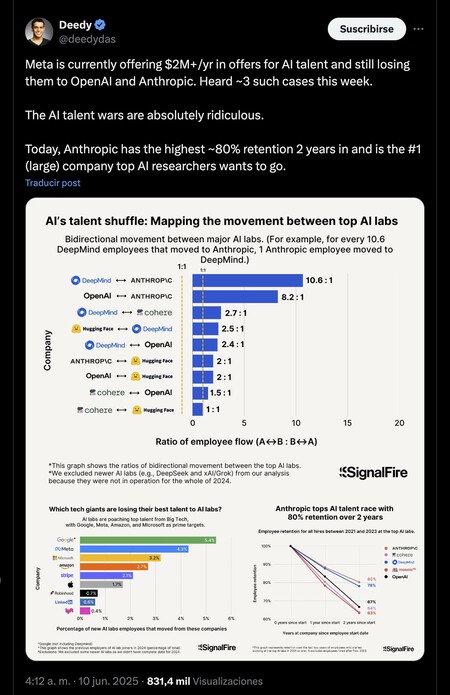
The AI Talent War. The company led by Mark Zuckerberg appears desperate to acquire talent at any cost. Deedy Das of Menlo Park Ventures explained that despite offering annual salaries of $2 million for AI engineers, “we continue to lose them to OpenAI or Anthropic. The AI talent war is absolutely ridiculous.”
Desperate Measures? Alberto Romero, author of the newsletter The Algorithmic Bridge, called these offers an obscenity , analyzing Meta’s situation, which has shown serious issues in maintaining its position in AI . The recent launch of Llama 4 was a small disaster, and MetaAI does not seem to be fully integrated into platforms like WhatsApp or Instagram.
Restructuring and Risky Investments. Zuckerberg’s anxiety over his AI projects has triggered a major restructuring at Meta. He has activated his “founder mode” to lead this effort. Notably, Zuckerberg has made an extraordinary decision to pay $14.3 billion for a 49% stake in the relatively obscure Scale AI, primarily to secure its CEO, Alexandr Wang, to head Meta’s AI division. As Romero noted, Wang now becomes “the most expensive spy in history,” with ScaleAI primarily focused on tagging data for companies like OpenAI and Anthropic. The valuable knowledge Wang possesses raises questions about whether it will benefit Meta in the long run.
Beyond Money. The intense competition for AI talent has turned top experts into highly sought-after assets for companies. Notably, OpenAI has been offering $2 million bonuses along with stock options worth over $20 million to retain its engineers. Reports indicate that some employees showed interest in working for Ilya Sutskever’s new venture, Safe Superintelligence. The top researchers at OpenAI often have bonus packages that reach up to $10 million annually, significantly outpacing competitors like DeepMind, where packages can soar to $20 million a year.
High Demand, Low Supply. Research by Fortune estimated that there are only about 1,000 truly outstanding AI researchers in the world, making it incredibly difficult for companies to entice them. As the publication emphasizes, the money and the significance of the projects matter, but personal connections also play a critical role. A striking example is Mira Murati, who, when leaving OpenAI to start her own firm, took 19 employees with her, including one of the co-founders, John Schulman.

The New Superstars of Sports in Silicon Valley. This phenomenon is being fueled by all tech companies, large or small. Apple has successfully recruited several employees from Google, even though some, like Ian Goodfellow, returned to DeepMind. Those who don’t move to a big company often create their own startups. This has been seen with Sutskever and Murati, both of whom have already received multimillion-dollar investment rounds. They are becoming the new superstars of a different kind of sport: artificial intelligence .
With the rising stakes in the battle for AI talent, it is becoming increasingly clear that Silicon Valley is reshaping itself. This situation is driven not only by the pursuit of financial gain but also by the ambition to push the boundaries of technology. As companies vie for the brightest minds in AI, the landscape will continue to evolve, and with it, the future of technology as we know it.