
Iran’s Strategic Advancement Through Hypersonic Technology
In recent developments of the ongoing conflict between Iran and Israel, Iranian forces have identified vulnerabilities in Israeli defense systems. Their strategy has shifted toward utilizing unconventional threats , primarily through swarms of Shahed drones . The resources required to combat these drones, particularly in terms of missile interceptions, are significantly greater than the operating costs of the drones themselves. In response to these drone incursions, Israel deployed the Saraf combat helicopters , marking a new phase in this conflict that can be described as “hypersonic.”
The Launch of the Fattah Hypersonic Missile
On June 18, 2023, Iran made headlines by launching its first hypersonic ballistic missile , the Fattah , achieving speeds of at least Mach 5 —with Iranian estimates suggesting speeds of up to Mach 15 . This solid-fuel projectile, equipped with a movable nozzle in its second stage , has the capability to penetrate Israeli missile defense systems. The Islamic Revolutionary Guard Corps (IRGC) heralded this launch as a “turning point” in its “True Promise III” operation, now in its eleventh stage.
Notable Achievements. Iran presented the Fattah as a representation of the end of Israeli aerial invulnerability , asserting that its deployment signifies a direct blow to the deterrent capabilities of Tel Aviv. Initial reports indicated fires and structural damages in central Israel, directly linked to the missile’s impact. The Fattah’s success has amplified tensions, posing new questions about geopolitical stability in the region.
Technical Characteristics of the Fattah
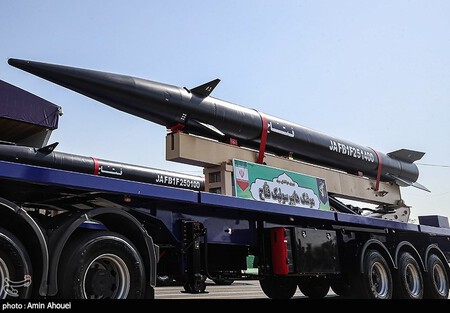
The Fattah missile represents one of the most ambitious ventures of Iran’s aerospace military program. Officially unveiled in 2023, it boasts a range of 1,400 kilometers and employs advanced maneuvering capabilities both within and outside the atmosphere. This design innovation effectively negates conventional defensive systems by integrating a maneuverable reentry vehicle (MaRV) , allowing it to change direction during its final flight phases to evade aerial defenses.
Its solid fuel motor facilitates an immediate launch response, and the advanced guidance system, combined with an adjustable thrust nozzle , enables the Fattah to execute unpredictable maneuvers, complicating interception efforts. Unlike traditional missiles, its trajectory can dynamically fluctuate during flight, making it nearly unreachable for defense systems relying on predictable flight paths.
A Fattah missile showcased during the Sacred Defence Week Parade 2023 in Tehran
A National Symbol
The Fattah missile transcends mere military application; it has become a symbol of national pride . Ayatollah Ali Khamenei , the Supreme Leader, has used it to convey a propaganda message, famously stating, “ 400 seconds to Tel Aviv ,” which has been displayed in Hebrew across Tehran. As of October 1, 2024, numerous Fattah-1 missiles were reportedly launched towards Jerusalem , marking their tactical debut in the ongoing conflict.
Israel’s Response
Reacting promptly, Israel initiated a series of bombings targeting Iranian military assets shortly after the hypersonic missile launch. The escalating cycle of retaliation has now continued for a week, with targets including five military helicopters in Kermanshah and missile production facilities. These actions illustrate Israel’s intent to weaken not only Iran’s conventional military capacity but also its nuclear infrastructure. The repercussions of these strikes have resonated within Iranian territory, revealing an expansion in Israel’s operational scope and ambitions to undermine the Iranian military power structure.
Strategic Implications
The emergence of the Fattah missile complicates the already intricate geopolitical landscape. Its operationalization undermines confidence in Israeli defense systems, historically regarded as among the most advanced globally. This vulnerability may compel Israel to reevaluate its air defense architecture and encourage regional players to reconsider their military strategies. The ability of Iran to launch hypersonic missiles from its own territory reduces its dependency on regional allies for executing long-range attacks, thereby enhancing its operational flexibility.
Conclusion
The interplay of missile technology and strategic military maneuvers in the Iran-Israel conflict underscores a shift toward more sophisticated and technological warfare. As Iran compensates for its conventional air force limitations by investing in advanced ballistic missiles and drones, strategies are continuously adapted. The True Promise III operation isn’t just about immediate retaliation; it suggests a broader embrace of new military doctrines emphasizing speed, precision, and unforeseen penetration . The future may hold significant changes, not only for Iran and Israel but across the entire region as modern conflicts evolve.
Image credits: Heute, Hossein Zohrevand, Amin Ahouei
For more insights on this evolving conflict, explore recent articles discussing how warfare is changing in the 21st century.