

The Antartic Enigma: Strange Radio Signals from Beneath the Ice
On Earth, there have always been enigmas that challenge our understanding. While some mysteries have been unraveled, such as deciphering the peculiar television signals from the sky, others remain as tantalizing puzzles. One such enigma involves a high-altitude scientific balloon that has captured radio signals appearing to originate from deep within Antarctica.
This remarkable story dates back two decades.
A Signal from the Ice. For nearly 20 years, a series of scientific balloons have traversed the vast desolation of Antarctica , flying at altitudes greater than 40 kilometers, equipped with instruments designed to detect distant echoes from the universe. This initiative, known as the ANITA experiment, is a collaborative effort among physicists aiming to detect neutrinos— neutral particles that pass through matter nearly undetected.
Trillions of neutrinos continuously traverse our bodies without us ever feeling them. Yet, their detection is a significant accomplishment. When a neutrino interacts with a molecule of ice, it can trigger a cascade of secondary particles that emit brief radio wave pulses. This is precisely what ANITA was designed to observe. However, since its launch, it has inadvertently captured something else entirely.
Mysterious Signals. In 2006, and again in 2014, ANITA detected radio pulses that seemed to come not from above, as one would expect from cosmic rays, but from below—from within the ice. The waves emerged at very steep angles of up to 30 degrees below the surface and exhibited no signs of reflection.
The Problem? According to the known laws of physics, such a phenomenon shouldn’t be possible. For a particle to emerge from such depths, it would need to traverse thousands of kilometers of solid rock before releasing a detectable signal—something even neutrinos struggle to accomplish. Nevertheless, the data was there. Comparisons with other neutrino detection projects revealed no matches. What ANITA was capturing was real… but inexplicable.
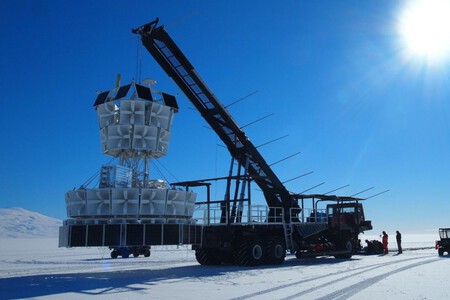
Anita
The Frontier of the Known. Initially, scientists speculated that they might be detecting tau neutrinos, a variant that can generate tau leptons and trigger the so-called “air showers.” However, the angles, intensities, and frequencies of the signals did not align with the predictions of the standard model.
Stephanie Wissel, an astrophysicist from Penn State and one of the authors of a recent study, acknowledged that while these signals might resemble neutrino events, the evidence points otherwise. If they were conventional neutrinos, they would have had to travel through the entire planet without interacting with anything, which, while technically feasible, would be statistically miraculous.
Beyond the Standard. The most intriguing hypothesis suggests that these signals originate from particles not accounted for in current theories. Some experts propose that they could be related to dark matter or unexplained interactions. Other theories point to unknown effects of radio wave propagation in polar ice, potentially influenced by unique atmospheric, topographic, or electromagnetic conditions in Antarctica.
Alternative theories indicate possible unknown propagation effects of radio waves in the polar ice. Thus far, none of these ideas have been experimentally reproduced nor established as parallel evidence. The silence from other detectors and the absence of compatible patterns reinforce the anomalous nature of these pulses.
The Promise of the Successor. With ANITA retired since 2016, the scientific community now focuses its hopes on PUEO (Payload for Ultrahigh Energy Observations), a new airborne experiment more sensitive and robust than its predecessor. Designed by the same team, PUEO will feature enhanced angular resolution and will be capable of detecting even weaker signals , potentially confirming whether the detected anomalies are recurring events or mere random errors .
Wissel and her team hope that PUEO can not only capture similar new events but also elucidate their nature and, in the best case, expand the boundaries of our understanding of particle physics.

A Persistent Enigma. One thing is abundantly clear: the mystery remains. The signals detected by ANITA do not fit the profile of neutrinos, do not correspond to known phenomena, and have yet to be reproduced. In essence, we face a void of explanation , a series of data that challenge our most solid theories.
As Wissel herself stated, we might be observing a previously unknown radio propagation phenomenon , or perhaps we are not. The case of ANITA exemplifies a truly unique moment in science: when observation outpaces theory, and instruments detect something our minds have yet to comprehend. In the vast, icy silence of Antarctica, something seems to be speaking.
And we have no idea what it’s trying to tell us.
Image | Penn State