
“The stereotype has deflated at the speed of our sales”
These were the words of Charlie Zhang , vice president of Omoda and Jaecoo, in an interview my colleague Javier Lacort attended during the Beijing Auto Show . These sales figures in Spain are particularly striking. Omoda has registered 4,737 sales within the first five months of the year, with just a single model. While it might be argued that all direct competitors combined exceed this figure, a different perspective emerges when we consider brands like Jaecoo and Ebro, which have an extremely limited vehicle offering in the market.
The three brands, representing the investment that the Chery Group has made in Spain, together account for over 11,000 units sold. These are respectable figures, especially considering that Omoda entered the European market with 2024 already underway, Jaecoo only launched in the latter half of the year, and Ebro has merely been trading its vehicles for a few months.
Before the introduction of the Ebro S800 or the Omoda 9 SHS , the trio collectively had only three models available. Yet, collectively they boast the same registration numbers as established names like Opel or Cupra , and they are starting to look closely at Ford or Citroën , whose sales hover between 3,000 and 4,000 units above them.
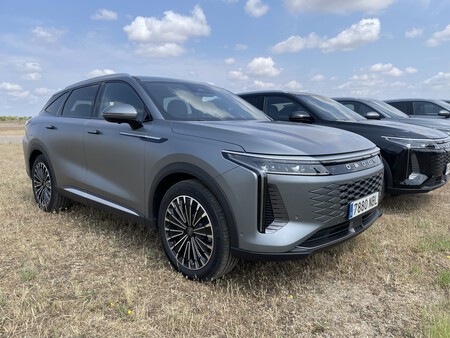
The Omoda 9 SHS arrives not just to broaden the catalog, but primarily to attract a wider range of potential clients. This model targets a wealthier clientele seeking everything—including a car with a Zero emissions sticker —but tired of spending a fortune on traditional car brands.
Technical Specifications of the Omoda 9 SHS
Omoda 9 SHS | |
|---|---|
Body Type | D-SUV, five seats |
Dimensions and Weight | 4.77 meters long, 1.92 meters wide, 1.67 meters high. Wheelbase and weight to be confirmed. |
Trunk | 471 liters |
Maximum Power | 537 HP |
WLTP Consumption | 1.7 l/100 km |
Environmental Label | Zero emissions |
Driving Aids (ADAS) | 19 ADAS driving aids, including adaptive cruise control |
Other Features | Proprietary software compatible with Android Auto and Apple CarPlay. Wireless phone charging at 50W. Electric, heated, ventilated seats with massage function. Sony sound system with 14 speakers (two in the front headrests). |
Electric Hybrid | No |
Plug-in Hybrid | Yes One 1.5 turbo combustion engine with 143 HP and three electric motors. Two electric motors in the front axle with 102 and 129 HP, and one rear motor with 238 HP. Together, they provide 537 HP. |
Electric | No |
Price and Launch | Available from 49,777 euros before MOVES III aid. |
I Want It All
The feeling that Chery is offering much more than Western competitors for less money is a sentiment voiced by owners of Ebro and Omoda vehicles. These customers do not seek the cheapest car on the market; instead, they wish to feel they are getting a great deal for their investment.
Aside from the Omoda 5, which impressed with its dynamic capabilities, neither the Jaecoo 7 nor the Ebro S700 convinced us during our drive. Upon entering the Omoda 9 SHS , however, it is easy to understand why it has attracted its audience and what those customers demand.
At the helm of the Omoda 9 SHS, it feels like a premier vehicle. The quality of materials is evident, with padded surfaces where hands typically rest, while the physical controls, although plastic, simulate aluminum convincingly and are well-fitted. The same can be said for the knobs and door buttons, including controls for electrically adjustable seats.
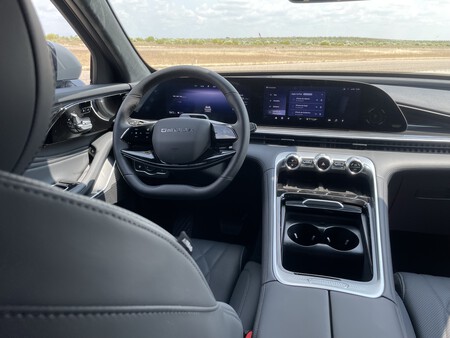
Before us lies a dashboard featuring two matching 12.3-inch screens. Above them is a high-quality Head-Up Display that provides real-time information. We found no essential data lacking on these screens.
The camera quality—front, rear, and side—was surprisingly high. Such details set the Omoda apart when customers sit in a dealership, as many European models have much poorer camera quality.
However, the infotainment system falls short in comparison. Unlike competitors like BYD , Omoda allows users to choose between Apple CarPlay and Android Auto , a decision that is generally beneficial for most users. Still, we noted a lack of fluidity in certain transitions and inconsistencies in refreshing information from mobile sources, particularly affecting navigation in specific situations.
The screen resolution could also benefit from improvement; a greater effort in this area would elevate the overall quality of the interior.
When it comes to cruising and comfort, the Omoda 9 SHS gives off positive impressions. Its extensive equipment includes heated and ventilated electrically adjustable seats, equipped with a massage function, and a Sony sound system with 14 speakers, two of which are in the front seat headrests. Additionally, an enormous panoramic sunroof measuring 1.3 meters is included as standard.
The only optional feature available is a matte green color, which adds 800 euros to the final bill.
On the move, the car impresses again with its extensive equipment. It comes with 19 ADAS driving assistance systems, along with a plug-in hybrid system that promises impressive results. It boasts a combined output of 537 HP and 650 Nm of torque, meaning no competitor offers such power and performance at this price point.
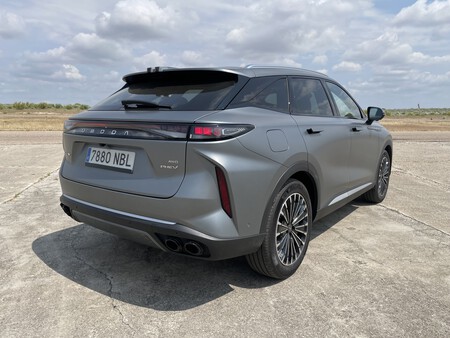
The vehicle utilizes a complex system consisting of a 1.5-liter gasoline engine providing 143 HP, working alongside two electric motors on the front axle with outputs of 102 and 129 HP. The Omoda 9 SHS employs a three-speed transmission equipped with three clutches.
One of these clutches allows for the independent engagement and disengagement of the 102 HP motor from the other electric motor and the gasoline engine. This feature enables the vehicle to operate using just one electric motor, both electric motors, or a combination of all of them (including gasoline) in up to 11 different configurations .
Additionally, there is a rear motor providing 238 HP, which is activated only when the vehicle loses traction or when in off-road mode. This means that while this power is ready to assist in challenging conditions, it conserves energy by primarily remaining inactive.
The electric motors are powered by a CATL LFP battery with a capacity of 34.46 kWh, which, according to homologation data, provides a range of 145 km of electric driving. In practice, this figure may be slightly reduced during highway driving, yet urban commuting makes meeting this range fairly manageable.
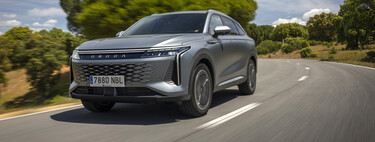
So, what does this translate to in practical terms? It means we have a vehicle that rolls quietly, is well-insulated, and has the presence of a larger car. Overall, the feel of the steering and brake pedal is good without reverting to the unnatural responsiveness found in other systems.
Such a complicated transmission and interaction among the motors do not produce discomfort when driving. The vehicle maintains smooth mobility, chiefly focused on prioritizing comfort—with a suspension system that some may find overly soft.
In urban environments, it glides over obstacles comfortably. On the highway, it remains pleasant; however, the body feels somewhat loose, leading to noticeable side-to-side movement on winding country roads, which can be exacerbated by its weight.
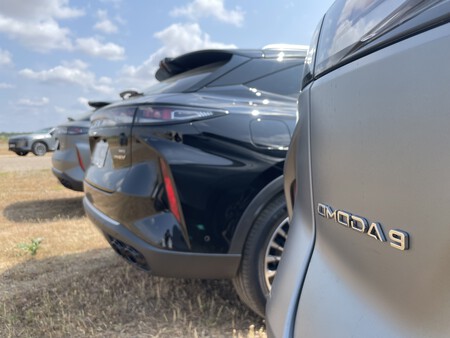
The sense of extreme comfort extends alongside its capable acceleration; however, it doesn’t feel as fast as the 537 HP would suggest. This is likely because the 238 HP rear motor is engaged only when maximum performance is required and remains in standby most of the time.
As for the driving assistance systems, we do not have many details to share, having not had the opportunity to test them extensively. We briefly experienced the adaptive cruise control and found it performed reasonably well, although further testing would be necessary for validation.

Similarly, we could not substantiate consumption figures, but we noted an electrical consumption of about 21-22 kWh/100 km , aligning with the 145 km estimated electric range. These findings would require confirmation under long-term testing conditions.
In conclusion, the Omoda 9 SHS has left us with a highly favorable impression, especially for those prioritizing comfort and an extensive suite of features in their vehicle. The starting price of 49,777 euros can be even lower for those who qualify for the Plan MOVES III aid, offering discounts of up to 7,000 euros when trading in an older vehicle and potential tax deductions of up to 3,000 euros on income tax.
When compared with competitors, no one offers as much equipment or power for a similar price, not to mention its 145 km electric range. For perspective, a BYD Seal U DM-i is priced significantly lower but does not qualify for similar subsidies. The Skoda Kodiaq with similar features matches the price but has only 200 HP. In terms of performance, the closest alternative is essentially a Porsche Cayenne , priced at over 120,000 euros .
Photos | Xataka
For further insights on Omoda and Jaecoo’s mission to provide feature-rich vehicles at competitive prices, see our article that explores their plans for hybrids and electric models.