
On a scorching hot day in Ahmedabad, few could have anticipated the tragic events that would soon unfold. A Air India plane took off from the Sardar Vallabhbhai Patel International Airport, aimed at London, only to lose altitude shortly after takeoff, crashing into a medical residence nearby. The tail section of the Boeing 787 Dreamliner was reportedly left embedded in the wreckage.
What initially appeared to be an absolute disaster soon took an unexpected turn. In the early hours following the crash, the statistics were stark: 242 individuals on board, with no signs of survivors. The scale of the tragedy left little to no room for hope.
Then, a video surfaced on social media depicting a bloodied man staggering towards an ambulance. Confirmed just hours later by the Indian Ministry of Home Affairs, the reality shocked many: one survivor had emerged from the wreckage of flight AI171.
The Man in Seat 11A
According to Hindustan Times, this lone survivor is Viswashkumar Ramesh, a 40-year-old British citizen returning to London with his brother on the same flight. He occupied seat 11A, located next to an emergency exit, and was rushed to the hospital with multiple injuries but was out of immediate danger.
His survival encounter was confirmed by Indian authorities and even Prime Minister Narendra Modi, who visited him in the hospital shortly after the incident.
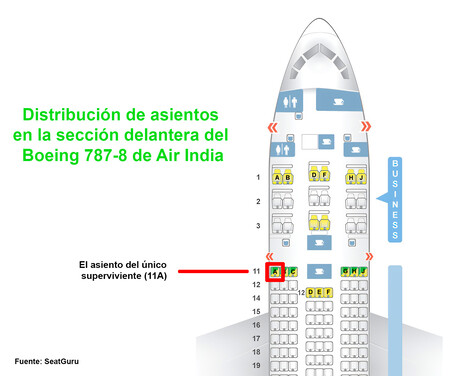
Seat layout of an Air India Boeing 787-8 Dreamliner
Speaking from his hospital room in Ahmedabad, Ramesh shared brief, chilling memories from within the airplane. His account serves as one of the few direct glimpses into the chaos aboard the flight until data can be retrieved from the recovered black box.
In an interview with DD News (reported by BBC), he recounted a moment where it felt as though the plane was “stuck in the air.” Ramesh described how “the lights started flickering green and white” just before the crash. “The [emergency] door was broken; I saw a gap. I tried to get out through it. And I did.”
He noted that he was on the side of the plane that made contact with the ground, while the other side struck the building wall, preventing escape for those aboard that section. “The other part was embedded in the wall. Nobody could have exited from there,” he added.
In another harrowing statement reported by Hindustan Times, he revealed: “When I got up, there were bodies around me. I was scared. I got up and ran. There were pieces of the plane everywhere.”
How Do You Survive Such an Impact?
The question remains unanswered. Currently, there is no official explanation for how Ramesh managed to survive. Whether his seat location played a pivotal role remains undetermined, along with other structural factors that might have influenced his escape. However, discussions about survival statistics in such tragedies provide some insights.
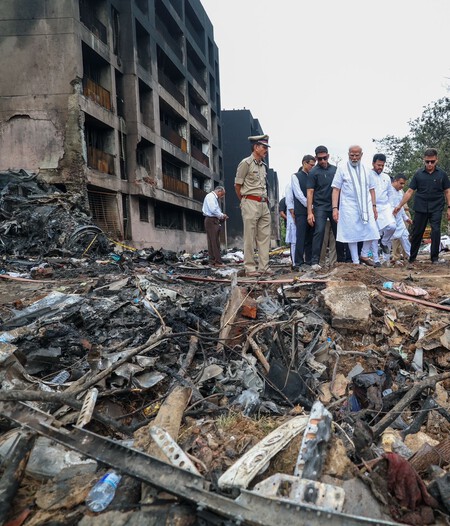
B.J. Medical College after the crash
According to The Washington Post, expert Anthony Brickhouse emphasizes three primary factors that investigators usually focus on:
- The level of G-force at the moment of impact.
- The structure surrounding the passenger within the aircraft.
- Post-crash conditions, such as fire or injury.
“This man survived something that shouldn’t be survivable. I cannot scientifically explain how he did it.”
When questioned about safer seating arrangements in planes, Graham Braithwaite, director in aviation at Cranfield University, described it as a complex issue. While acknowledging the unfortunate nature of the tragedy, he noted that technically, all seats on modern aircraft are incredibly safe.
Unprecedented Incident for the Dreamliner
Flight AI171 of Air India was bound for London. It took off from Ahmedabad on June 12th at 13:39 local time, carrying 242 individuals. Shortly thereafter, it crashed into a residence associated with B.J. Medical College situated near the airport. Tragically, at least 290 people lost their lives, including several students who were dining at the time.
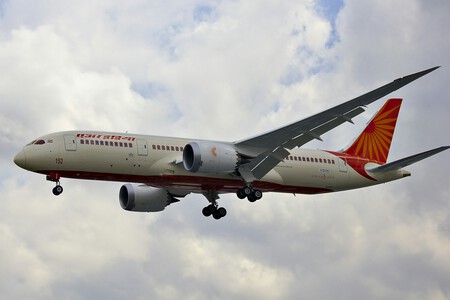
One of Air India’s Boeing 787 Dreamliners in flight
Surveillance cameras captured the heart-stopping moment: the plane initially gained altitude, stabilized briefly, and then rapidly descended, crashing and igniting into flames. The causes of this crash are still undetermined, and an investigation may extend for months to come.
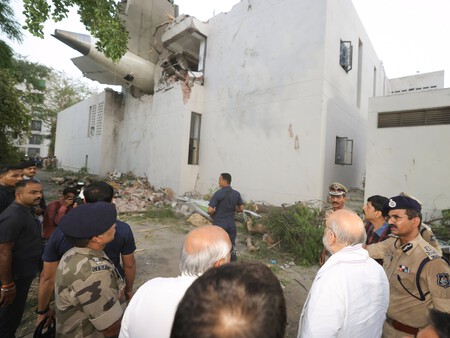
B.J. Medical College following the incident
The aircraft itself was a Boeing 787-8 Dreamliner introduced in 2009, renowned for its fuel efficiency and long range. Up until this incident, over 1,000 units had been delivered without any recorded fatalities in commercial operations.
The battered aircraft was delivered to Air India in 2014 and had completed over 8,000 takeoffs and landings, according to data from Cirium. The Directorate General of Civil Aviation of India confirmed that the pilots issued a mayday call mere seconds after takeoff but were unable to communicate further with the cockpit.
Images from the scene show the devastating impact of the incident, including the damage to both the aircraft and the medical residence. The collective grief and search for answers will dominate conversations as the investigation unfolds and the world reflects on this unprecedented tragedy.