

Wikimedia Foundation Halts AI-Generated Summaries Amid Editor Backlash
The Wikimedia Foundation has recently decided to pause an experiment showcasing AI-generated summaries at the top of Wikipedia articles. This decision comes after a significant backlash from its own editors, who expressed strong disapproval of the initiative.
Understanding the Importance of This Decision
Wikipedia stands as one of the last remaining bastions of *humans* contributing quality content on the internet, in stark contrast to the increasing automation that has affected other platforms negatively. The foundation’s commitment to a democratic governance model has recently put a halt on a significant technological advancement that could have altered the way information is curated on the site.
The Experiment: What Really Happened?
The initiative called the “Simple Article Summaries” aimed to make complex articles more accessible through automatically generated summaries labeled as “unverified.” These summaries utilized a model developed by Cohere, named Aya. However, the experiment backfired as editors voiced their opinions with comments such as “very bad idea,” “my strongest rejection,” and simply “yuck.”
Background of the Situation
Companies like OpenAI are increasingly pushing to establish themselves as the next Google, while Google itself has embraced generative AI technologies, even integrating them into its search capabilities. In this competitive landscape, Wikipedia has preserved the quality of its articles due to its *human-centered* approach.
The Role of Human Editors in Maintaining Quality
Indeed, Wikipedia editors are proactively filtering out AI-generated content. This active moderation transforms the platform into a trusted information haven, allowing users to access knowledge with the understanding that it won’t be filled with *garbage* information.
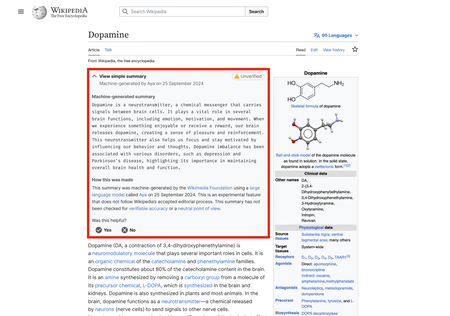
Marked in red, an example of the AI-generated summaries from Wikipedia. Image: 404 Media.
Implications of the Editor Response
These protests indicate a deeper issue beyond mere acceptance of synthetic content:
- Wikipedia must evolve to attract new generations…
- …but its editors fear that AI may jeopardize decades of collaborative work.
“No other community has mastered collaboration to such a wonderful extent, and this would ruin it,” stated an editor cited by 404 Media.
Future Considerations
While the Foundation has not dismissed the use of AI entirely, it indicates that any future implementation will necessitate “editor participation” and “human moderation workflows.” This sounds more like a tactical pause rather than a complete abandonment of the idea.
The Road Ahead for Wikipedia
Interestingly, the experiment was born out of discussions during Wikimania in 2024, where some editors did see potential in this format. The critical question now is whether Wikipedia can maintain its immense historical relevance, which has already been eroded since the advent of ChatGPT, without sacrificing the human judgment that distinguishes it.
The answer to this question won’t arrive overnight, and it will significantly impact whether Wikipedia continues to be a knowledge oasis of reasonably reliable information or merely blends into the ever-growing noise generated by automated sources on the internet.
Image credit | Oberon Copeland @veryinformed.com on Unsplash
In Xataka | Wikipedia is increasingly filled with AI-generated content. So much so that it now has a dedicated team working to identify it.