
New Treaty Promises a Transformed Relationship Between the EU and Gibraltar
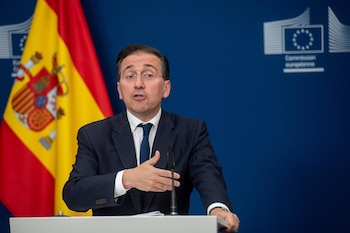
The Minister of Foreign Affairs , José Manuel Albares, has made a bold claim regarding the future relationship between the European Union (EU) and Gibraltar. He recently announced that a new treaty governing this relationship could be completed as early as ” autumn .” During an interview with Onda Cero, covered by Europa Press, Albares revealed that teams would begin drafting the agreement immediately following a significant political decision made between the EU and the UK in Brussels.
Drafting a New Chapter in Diplomacy
According to Albares, the initial timeline provided by the legal services of the Commission indicates that the entire treaty will be finalized “in writing” by autumn. However, he acknowledged that the month of August, characterized by reduced labor activity, could affect the speed of progress. Despite this, optimism remains high as Albares emphasized that the physical barrier, known as the Verja , is now a thing of the past.
“Starting yesterday, the Verja is history ,” Albares stated. “We are moving toward a new model of coexistence.” This declaration hints at a new era in which both Gibraltar and the Campo de Gibraltar will no longer face each other with hostility but rather look forward to a future marked by shared prosperity.
Benefits of the Treaty: Free Movement and Collaboration
Albares elaborated on the many implications of the potential treaty. He explained that the removal of the Verja—primarily a visual barrier —represents a multitude of deeper changes. Crucial among these changes are the free movement of people and goods, aiming to foster mutual growth between both regions.
He also highlighted the need for convergence in areas such as indirect taxation . Issues that have sparked tension, particularly concerning tobacco regulation , will now have mechanisms to resolve disagreements and work towards common standards, particularly in environmental matters.
A New Era of Relationship Between Spain and the UK
This treaty marks a “new page” in the history of both the Campo de Gibraltar and its relationship with Gibraltar, potentially opening “new avenues of possibilities” in Spain’s relationship with the UK. Albares emphasized how these changes are integral to moving forward collectively rather than remaining in a state of conflict.
Addressing concerns raised in the UK regarding Spanish police overseeing Schengen controls at Gibraltar’s port and airport , Albares called for a rational and cooperative approach. He underscored that this change would ensure safe and reliable movement of people and goods without compromising the integrity of the Schengen Zone and the Customs Union —goals that align with Spain’s national interests and the EU’s objectives.
Spain’s Stance on Sovereignty
In his closing remarks, Albares reaffirmed that Spain has not waived its claim to sovereignty over the Rock of Gibraltar. His statements reflect Spain’s delicate balancing act of pursuing mutual cooperation while retaining its claims over Gibraltar where sovereignty issues are concerned.
As the final treaty is anticipated to reshape the landscape between the EU and Gibraltar, there remains cautious optimism for the future. The extensive discussions indicate a clear commitment to collaboration and growth , suggesting a pivot away from historical confrontations to a future embracing cooperation and economic reciprocity.