
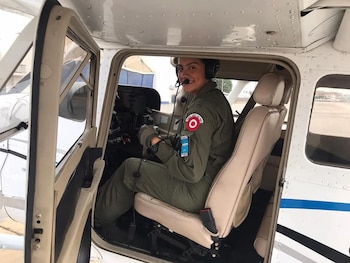
The Tragic Accident of Pilot Ashley Vargas: Investigating the Causes
On May 20, 2025, the aviation community was rocked by the tragic news of the disappearance of Lieutenant Ashley Vargas, a talented pilot with the Peruvian Air Force (FAP). Her aircraft, engaged in a military training mission, went down in the Pacific Ocean, near the Paracas National Reserve in Ica. The incident has raised numerous questions, triggering an investigation into the factors that may have led to this heartbreaking tragedy.
According to General Carlos Chávez, commander of the FAP, the investigation is looking into several possible scenarios. These include human error, mechanical malfunction, adverse weather conditions, and the possibility of a bird strike. In a conversation with the program Edición Especial, General Chávez outlined the various factors that can affect flight safety: “When an accident occurs, we investigate many factors. These include the weather—clouds, fog, and wind shear. The human factor is also critical; it can involve spatial disorientation or loss of situational awareness.”
Despite the concerns, General Chávez assured that the aircraft involved was relatively new and well-maintained. "This aircraft was purchased in 2016 and had only logged 1,200 flight hours. These airplanes are designed for a lifespan of 30 to 40 years, capable of reaching 10,000 hours of operation," he mentioned.
The risk of a bird strike, as noted by General Chávez, is an ever-present concern for pilots. He elaborated, “At a speed of 380 km/h, hitting a seagull weighing half a kilogram generates 36,000 kilograms of energy upon impact. If it strikes a wing, it could create a hole. But if it strikes the pilot, the force could be fatal.” These sentiments underline the reality that bird strikes happen globally and can lead to catastrophic consequences.
Following the accident, it was confirmed that the plane had crashed rather than attempting to ditch in the ocean. “If it had attempted to land on water, it would have sunk without breaking apart,” General Chávez explained, emphasizing the critical point that the physical dynamics of impact are severe.
In addition to the investigation, all remains of the aircraft are securely stored in a hangar at the Pisco Air Base. Access is strictly limited to fiscal investigators and members of the internal inquiry team, who are under a 60-day deadline to submit a conclusive report. “We are not looking to assign blame but to understand the cause of the accident so we can prevent it from happening in the future,” General Chávez stated.
The timeline of events leading to the accident provides further insight into the tragic situation. The flight plan included a takeoff from the base, a routing over Zárate Island, Laguna Grande, and a point referred to as Cerro Virgen. This specific training mission was to simulate an attack and conclude with a landing. Reports indicate that just six minutes after takeoff, Vargas communicated with the Peruvian Corporation of Airports and Commercial Aviation (Corpac), reporting her position. At that point, she did not mention any issues or abnormalities. However, contact was lost merely two minutes later.
The family of Ashley Vargas is understandably devastated. Her uncle, Anthony Vásquez, has revealed that her cellphone remained active until 3:00 a.m. on May 21, suggesting it remained operational even after the aircraft’s impact. Previously, General Chávez indicated that Vargas was equipped with a personal geolocator in her uniform; unfortunately, it did not activate.
Adding to the family’s concerns, their lawyer, José Ocampo, has raised serious questions about potential deficiencies in the aircraft’s ejection system and localization mechanisms. He is considering filing a criminal complaint against the FAP for assumed involuntary manslaughter. Additionally, two witnesses reportedly observed the aircraft emitting black smoke before they heard a loud bang over the ocean, followed by a visible column of smoke rising.
As the investigation continues, the tragic loss of Ashley Vargas serves as a poignant reminder of the risks that military pilots face in training and operational missions. Her dedication to serving her country and her potential as an aviator will not be forgotten. The recovery and analysis of the wreckage may hold vital insights, not only for the FAP but for aviation safety as a whole.