
While executing military operations in Ukraine, Russia is expanding its military presence in Africa by sending sophisticated weaponry to conflict zones in Sub-Saharan Africa. Reports indicate that Moscow is circumventing sanctions imposed by Western countries, sending tanks, armored vehicles, artillery, and other high-value equipment to West Africa utilizing cargo ships, according to findings by The Associated Press.
Using satellite imagery and radio signals, AP traced a convoy of Russian-flagged cargo ships over a nearly month-long journey from the Baltic Sea. The ships were confirmed to be transporting howitzers, radio jamming equipment, and other military gear, as monitored by military officials in Europe. These shipments could strengthen the burgeoning Russian African Corps in Moscow’s rivalry with the United States, Europe, and China for increased influence on the continent.
The African Corps, which is two years old with links to a covert branch of the Russian military, is a paramilitary group emerging at a time when U.S. and European troops have been forced to withdraw due to Sub-Saharan nations turning to Russia for security matters.
Mali, Burkina Faso, and Niger have faced combatants linked to Al-Qaeda and the Islamic State for over a decade.
Initially, mercenary groups tightly associated with the Kremlin entered the fray in Africa . However, increasingly, Russia is deploying its military might and intelligence services more directly .
“We intend to expand our cooperation with African countries in all areas, emphasizing economic cooperation and investments,” stated Dmitri Peskov, Kremlin spokesperson. “This cooperation includes confidential areas related to defense and security.”
The Baltic Leader , weighing 8,800 tons, and the Patria , at 5,800 tons, are among hundreds of ships that Western nations have sanctioned to restrict funding to the Russian war in Ukraine . These vessels docked and unloaded in Conakry, Guinea , at the end of May, as shown through satellite images by AP.
Other ships made deliveries to the same port in January, which included tanks, armored vehicles, and other equipment later transported overland to neighboring Mali, according to military officials in Europe and footage from a Malian blogger documenting the lengthy convoy.
Officials disclosed with the AP about Russian operations anonymously. The AP verified the blogger’s video and geolocated it on the RN5 road leading to Bamako, Mali’s capital.
After the most recent delivery in Conakry, trucks carrying armored vehicles, howitzers, and other Russian-manufactured equipment were again seen on the overland route to Mali.
The Malian broadcaster ORTM confirmed that the West African nation’s military received new military equipment. An analysis by the AP of the blogger’s video and footage taken at the same January delivery site helped identify a wide range of Russian-manufactured equipment , including 152 mm artillery guns and smaller variants.
The AP also identified a BTR-80 armored personnel carrier with equipment to jam radio signals, along with Spartak armored vehicles and other transports that were armored, some fitted with weapons. The shipment also included at least two small inflatable boats, one painted with a Russian flag on the hull, and fuel trucks, some marked with the word “flammable” in Russian on their sides.
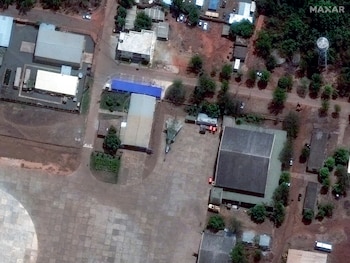
Military officials who spoke with AP expressed their belief that Russia is allocating the more powerful equipment —notably artillery pieces and jamming equipment—for its African Corps, rather than for the Malian armed forces. The African Corps also appears to have received air equipment, as satellites detected at least one Su-24 —a supersonic variable-geometry fighter-bomber—at an airbase in Bamako in recent months.
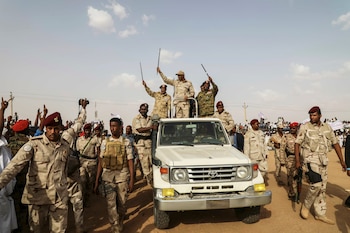
For years, French forces supported counterinsurgency operations in Mali and neighboring Burkina Faso and Niger. However, France withdrew its troops following coup d’états in Mali in 2020 and 2021, in Burkina Faso in 2022 , and in Niger in 2023 . Russian mercenaries filled the void.
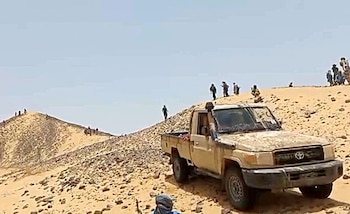
The Wagner Group , the most notable, was deployed to Sudan in 2017 and expanded into other African nations, often in exchange for mining concessions.
The group gained a reputation for brutality, and was accused by Western countries and UN experts of human rights abuses in countries such as Libya , Mali , and the Central African Republic .
Of the 33 African countries where Russian military contractors were active, most were controlled by the Wagner Group, according to a study by the RAND Corporation —a U.S. non-profit think tank focused on analysis and solutions to global security problems—backed by the U.S. government.
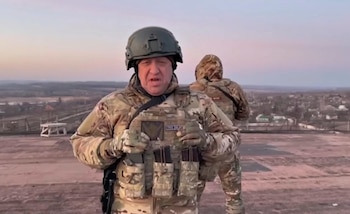
However, after Wagner forces mutinied in Russia in 2023 and its leader, Yevgeny Prigozhin , died two months later in a suspicious plane crash, Moscow reinforced its grip: restructured Russian military operations in Africa and the Kremlin took greater control through the African Corps.
This corps is overseen by the commander of Unit 29155 , one of the most notorious branches of the shadowy GRU , the Russian military intelligence service, according to the European Union. Unit 29155 has been accused of covertly attacking Western interests for years, including sabotage and assassination attempts.
In December, the EU imposed sanctions on Major General Andrey Averyanov of Unit 29155, arguing that he is in charge of the operations of the African Corps.
“In many African countries, Russian forces provide security to military juntas that have toppled legitimate democratic governments, which has severely undermined stability, security, and democracy in these countries,” reads the EU’s sanction judgment. These operations are financed through the exploitation of the continent’s natural resources, as added in the ruling.
The Russian Ministry of Defense has not responded to inquiries regarding Averyanov’s role in the African Corps.
Researchers and military officials claim that the flow of arms from Russia seems to accelerate the rise of the African Corps over the Wagner Group and assist in gaining the support of mercenaries who had remained loyal to the group. The African Corps is also recruiting in Russia , where it offers payments of up to 2.1 million rubles ($26,500), and even plots of land, for signing a contract with the Defense Ministry, in addition to bonuses when deployed.
Days after the most recent delivery of equipment, Wagner announced its withdrawal from Mali, declaring “mission accomplished” in a post on Telegram.
The African Corps posted in another announcement that it would remain there.
The shift from Wagner to the African Corps in Mali could herald similar transitions elsewhere on the continent, said Julia Stanyard, a researcher on Russian mercenary activity in Africa.
“ The introduction of this kind of completely new sophisticated weaponry and new armored vehicles is a significant change ,” stated Stanyard from the Global Initiative Against Transnational Organized Crime, based in Switzerland.
Armed groups in Mali have caused significant losses among Malian troops and Russian mercenaries. The group Jama’at Nasr al-Islam wal-Muslimin ( JNIM , or Support Group for Islam and Muslims ) linked to Al-Qaeda , killed dozens of soldiers this month in an attack on a military base. Insurgents also killed dozens of Wagner mercenaries in northern Mali last July.
Some of the more modern equipment may have been sent specifically in response to these types of attacks, military officials said. They explained that jamming equipment could help defend against improvised explosive devices detonated using phone signals.
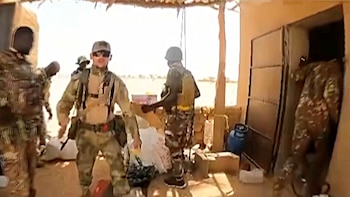
The recent convoy drew attention because the Boykiy , a Russian Navy warship, escorted the ships after departing in April from the Russian region of Kaliningrad , situated in the Baltic Sea.
In October, in what is seen as a hostile act, the radar systems of the Boykiy detected a French Navy maritime surveillance aircraft patrolling against alleged Russian attempts to sabotage underwater cables, according to military officials.
Also in the convoy was a third sanctioned Russian freighter, the Siyanie Severa , which continued its journey while the Baltic Leader and Patria unloaded in Conakry and docked in Bata, Equatorial Guinea.
Satellite images from May 29 show trucks lined up on the dock as the ship unloaded. The AP was unable to verify whether the cargo included weapons or the final destination of the shipment, although the Wagner Group has maintained a strong presence in neighboring Central African Republic.
(With information from AP)