

The race in the realm of artificial intelligence has intensified significantly over recent months. Gemini 2.5 Pro , Claude 4 Opus , and DeepSeek R1 have successfully narrowed the gap with OpenAI’s models, showcasing increasingly sophisticated reasoners . The overwhelming dominance of 2022, when ChatGPT left competitors flabbergasted and several steps behind, no longer defines the current landscape. Today, the competition is more direct and personal.
However, the company led by Sam Altman hasn’t been idle. OpenAI has just announced o3-pro , a new reasoning model which, at least on paper, aims to reaffirm its leadership position in the industry. This model is available as of today but exclusively for certain plans, excluding the ChatGPT Plus plan priced at 20 dollars per month. Access to the most advanced AI comes at a cost.
More tools and enhanced context. The o3-pro model is built from the same foundation as o3, but has undergone an additional stage of light reinforcement training and possesses more inference resources. It provides complete access to the tools that have made ChatGPT incredibly useful: web search, file analysis, reasoning about images, Python usage, and personalization through memory.
These functions allow the model to tailor its responses to the user’s history, access real-time external sources, and solve complex tasks over multiple steps. It features:
- Search, code, document analysis, and vision
- Customization based on active memory
- Context window of up to 200,000 tokens and a maximum output of 100,000 tokens
More precise, but not faster. However, o3-pro isn’t designed for speed. Responses often take longer compared to o1-pro, but it promises a greater degree of precision focused on complex tasks. OpenAI recommends using it when reliability takes precedence over speed.
Therefore, we could say that this model is specifically intended for those who need things to go right, even if that means waiting a few more seconds. In any case, we are discussing AI models, and therefore, hallucinations can still occur, which may result in incorrect information being presented.
Theoretically superior performance. According to OpenAI’s internal testing, human evaluators prefer o3-pro over o3 in all tested categories: science, education, programming, personal writing, and data analysis.
It also achieves better results in academic benchmarks: In competitive mathematics, it jumps from an 86% score in o1-pro to 93% in o3-pro; in programming, it exceeds an Elo score of 2,700 , compared to 2,517 for o3 and 1,707 for o1-pro.
Available now, but not for everyone. o3-pro is already available for Pro users ($200 per month) and Team plans, replacing o1-pro in the model selector. OpenAI has confirmed that users of Enterprise and educational accounts will gain access starting next week.
Currently, access to the most powerful models remains restricted to those who pay for the more advanced plans. The popular $20 monthly Plus plan for individual users is not mentioned, leading many to believe it will remain excluded from this update for now.
Also coming to the API. o3-pro is not only available within ChatGPT; it has also arrived on the OpenAI API. This is great news for those looking to integrate it into their own products or workflows. Additionally, Altman has announced that the price of o3 has decreased by 80%.
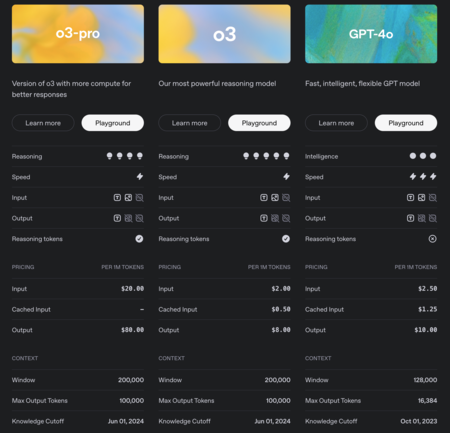
The API pricing for o3-pro is $20 per million tokens for input and $80 per million tokens for output. This is significantly higher than the $2.5 and $10 charged for CEO4, as well as the newly adjusted pricing for o3, which is now offered at $2 for input and $8 for output.
Images | OpenAI
In summary, with advancements in AI technology like o3-pro, OpenAI continues to demonstrate its commitment to leading the sector, while competing models are forcing it to innovate and adapt rapidly. The future of AI remains unpredictable but exciting, with each development promising to redefine what is possible.