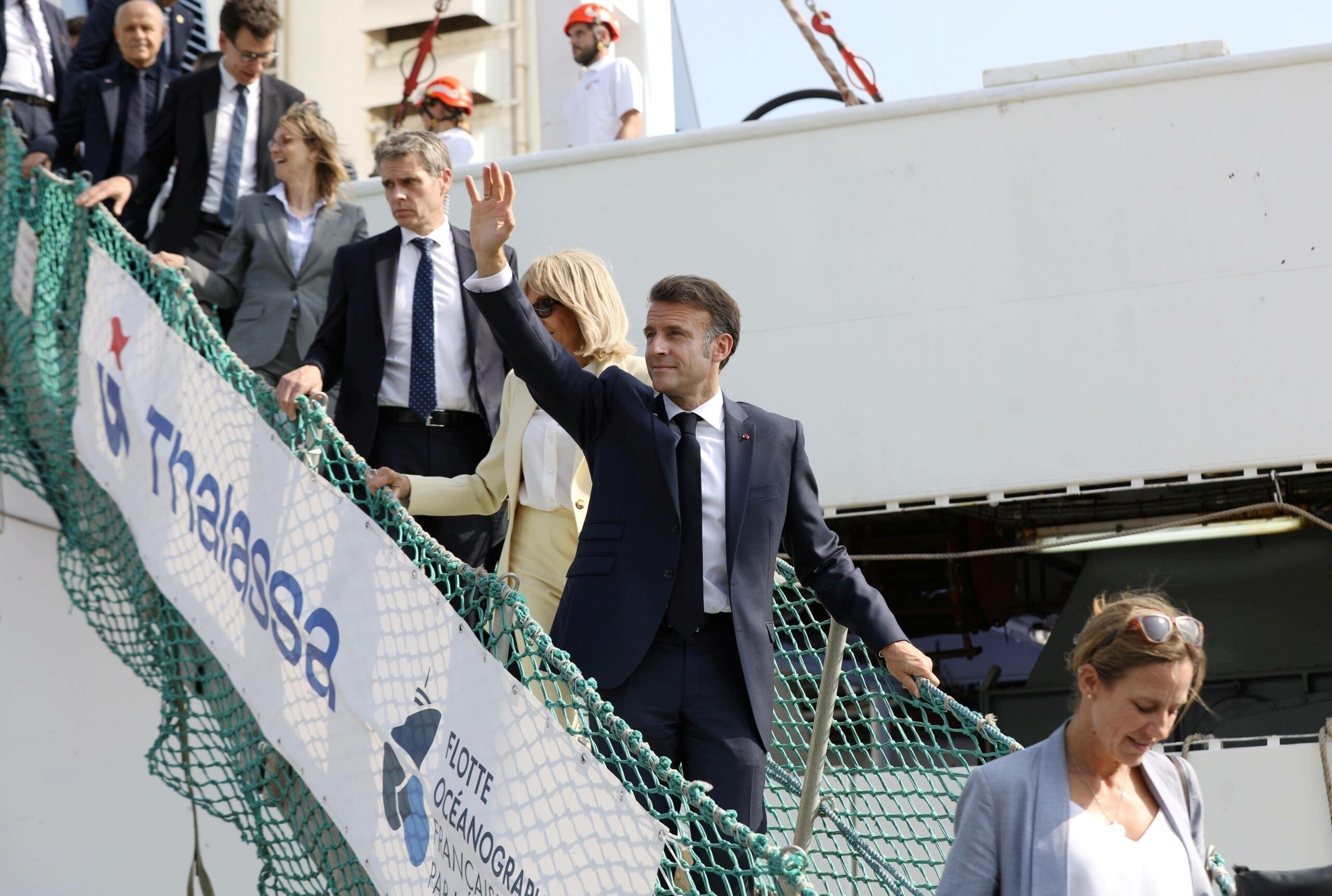
Sea Force 1, the Thalassa, the flagship of the French oceanographic fleet, transformed into a presidential vessel this past Sunday. It was by sea that Emmanuel Macron departed from Monaco after participating in the Blue Economy and Finance Forum, heading towards Nice, where he is set to inaugurate the 3rd United Nations Ocean Conference (UNOC) on Monday.
This maritime transition could not be more fitting. However, the departure of this exceptional maritime convoy, escorted by 200 boats that rallied on the azure waves for a grand parade, seemed to waver right up until the moment the ropes were cast off. Even the teams from the French Research Institute for Exploitation of the Sea (Ifremer), which owns the Thalassa, were left doubting the night before. Talks of a “Plan B” and even a “Plan C” were circulating among the security services responsible for the President’s close protection.
The Greenpeace Threat Taken Seriously
The Thalassa traversed under tight escort from the GIGN.Jean François Ottonello / Nice-matin.
The pressure escalated early Sunday when, around 8 AM, a tender boat drew a little too close to the Monegasque coast. This intruder was swiftly ousted from the exclusion zone. While the small vessel itself was not particularly concerning, it belonged to the TT Hémisphère, a yacht registered in the Cayman Islands, which had anchored in Beaulieu-sur-Mer after a brief journey from Villanova, Spain. Shortly after, another boat, the Arctic Sunrise, the vessel of Greenpeace, was also prevented from joining the Nice parade. Could this small yacht, poking around, be a decoy for the rainbow-flag organization?
This question was evidently taken very seriously. The resulting security measures proved reassuring enough for Emmanuel Macron to board as planned at 3:45 PM, albeit with a slight delay, from the quai de l’Hirondelle. Accompanied by his wife, Brigitte Macron, she sensibly opted to change her shoes before stepping onto the gangway. Prince Albert II seemed more concerned about the sun and waved to the crew while wearing his blue cap. Following them was Costa Rican President Rodrigo Chaves Robles, naturally, given Costa Rica’s co-hosting of the 3rd UNOC, along with Vietnam’s Prime Minister, Pham Minh Chinh.
French and Costa Rican presidents, along with the sovereign prince of Monaco, conversing with three American scientists concerned about budget cuts in the Trump administration.Jean François Ottonello / Nice Matin.
Three American Scientists in Exile
Everyone is aboard. “The scientists can come,” announces an advisor. There are three researchers: Joanna Post, an expert in ocean observations who has worked for the UNESCO Intergovernmental Oceanographic Commission; Joerg M. Schaefer, a climatologist and co-director of Columbia Earth Networks; and Kartik Sherth, a world-renowned astrophysicist.
Immediately, Sherth sets the tone: “We are very concerned about what is happening in the United States,” he whispers in English to the French president, who listens carefully, jotting notes. These three Americans, faced with severe budget cuts from the Trump administration that heavily impact academia, are eager to take Emmanuel Macron’s speech at the Sorbonne to heart, along with his motto, “Choose Europe for science.”
“Regaining Leadership” Lost by Trump
Prince Albert II greeting the crew of Thalassa as they depart from Monaco this Sunday.Jean François Ottonello / Nice Matin.
“And maybe the University of Aix-Marseille,” they hope, according to Maximilien Simon, Deputy Director of the Oceanographic Fleet at Ifremer. Yet, before discussing resources, French Minister of Higher Education Philippe Baptiste poses a fundamental question: “Since there’s no more leadership on the American side, how can we take over? Because that is our job!” This responsibility falls not only on France but also on Costa Rica and the Principality. The three heads of state in the Thalassa‘s cabin seem perfectly aligned on these environmental issues.
Mini-Summit Aboard During the Parade
The remainder of the crossing becomes more… bilateral. It is rumored that President Macron and the Vietnamese prime minister took the opportunity for a discussion. However, no comments were made on this, nor were there any photos of other guests who moved to the upper deck of the Thalassa as they passed Cap Ferrat to witness the maritime parade—maintained at a safe distance.
“Contact! Contact!” crackles from a walkie-talkie, and immediately one of the rigid-hulled inflatable boats flanking “Sea Force 1” accelerates. Onboard, GIGN commandos dressed in fatigues are vigilant, ensuring the tranquility of this mini-cruise as it nears its conclusion. The red lights of the lighthouse in Nice draw closer, and the rainbow threat dissipates.
At the Quai du Commerce, the same global issues await, but a new welcoming committee greets Emmanuel Macron. This time, there’s the prefect of the Alpes-Maritimes, Laurent Hottiaux, Foreign Minister Jean-Noël Barrot, Nice Mayor Christian Estrosi, and the Deputy of the First Constituency, Éric Ciotti, alongside former Secretary of State for the Sea, Hervé Berville. The President has a word for each, including a smile for Vice Admiral Didier Lallement, Maritime Prefect of the Mediterranean, whom Macron whispers, “Sorry, we put you under a bit of pressure…”
Emmanuel Macron welcomed by Nice Mayor Christian Estrosi, while “First Lady” Brigitte Macron is greeted by Foreign Minister Jean-Noël Barrot.Jean François Ottonello / Nice Matin.
In conclusion, the journey from Monaco to Nice not only marked a significant presidential event but also highlighted essential global dialogues surrounding oceanic sustainability and scientific collaboration. The interactions aboard the Thalassa reflected the broader challenges and opportunities of environmental leadership in an increasingly precarious geopolitical landscape.