
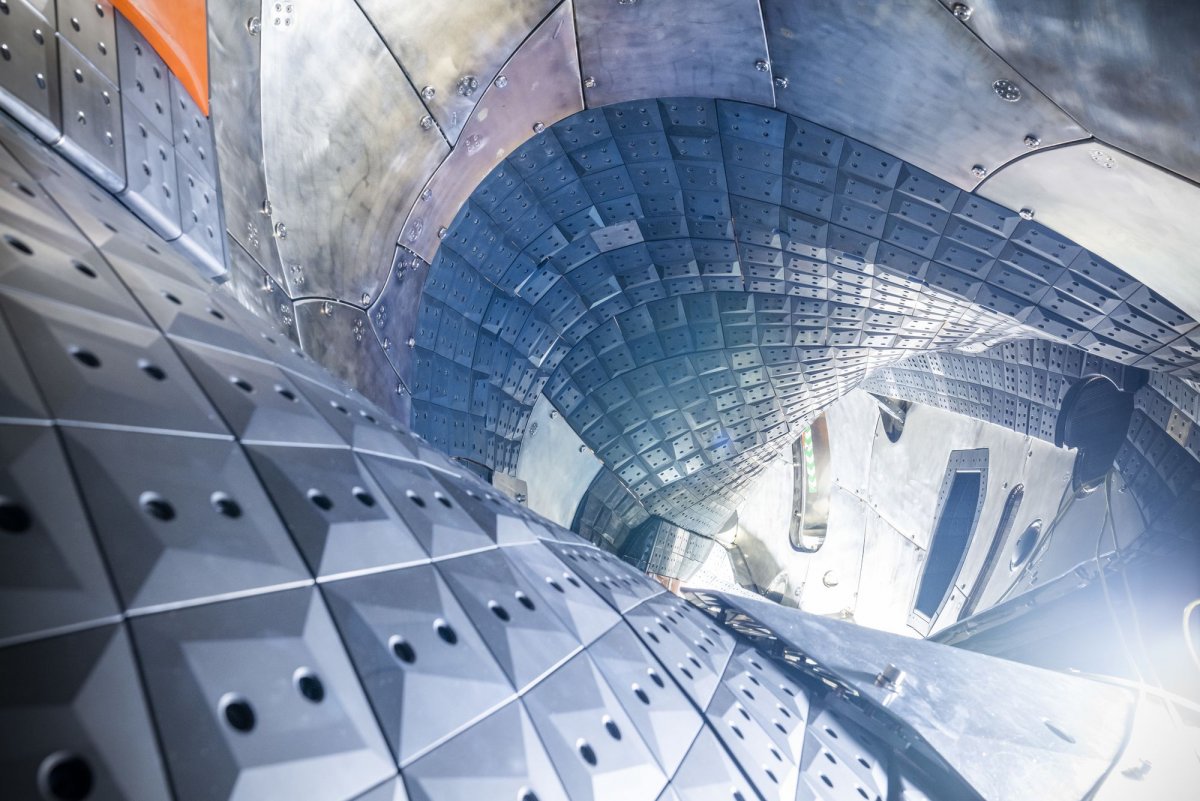
Record-Breaking Achievements of the Wendelstein 7-X Fusion Reactor
The Wendelstein 7-X fusion research reactor in Greifswald, Germany, has recently achieved a significant milestone in the field of nuclear fusion. The Max Planck Institute for Plasma Physics (IPP), which operates this advanced facility, announced that the reactor produced a new world record for the triple product during its latest experimental campaign, achieving a plasma duration of 43 seconds on May 22, 2025. This breakthrough marks a noteworthy step towards viable nuclear fusion energy.
Understanding the Triple Product
The triple product is a critical measure in the realm of nuclear fusion. It comprises three fundamental factors: the particle density of the plasma, the temperature of the ions involved in fusion reactions, and the energy confinement time, which refers to how long the heated energy remains within the plasma without dissipating. Achieving a specific threshold in these parameters is crucial, as it determines whether the fusion reaction can sustain itself without further heating, thereby generating a positive energy balance—meaning that the energy output exceeds the energy input.
Innovative Technology Propelling the Record
During this record-setting plasma run, approximately 90 fuel pellets were injected into the reactor over the 43 seconds, while powerful microwaves heated the plasma to over 20 million degrees Celsius, peaking at 30 million degrees Celsius. The seamless coordination of heating and fuel injection was vital for optimal performance, showcasing the importance of sophisticated technologies involved in nuclear fusion research.
At the center of this achievement was an innovative pellet injector, developed at the Oak Ridge National Laboratory in Tennessee. This device fires millimeter-sized pellets made of frozen hydrogen into the reactor. For the first time, the pellet injector operated at various predefined pulse rates, illustrating the flexibility and adaptability of this technology. This approach indicates that future fusion reactors could achieve plasma durations extending beyond several minutes, enhancing the feasibility of sustained fusion reactions.
The Visionary Leadership of Thomas Klinger
Thomas Klinger, the head of Wendelstein 7-X, expressed his enthusiasm about the record-breaking achievement, emphasizing that it demonstrates the immense potential of the Wendelstein 7-X reactor. According to Klinger, the ability to elevate the triple product levels to Tokamak-like standards during extended plasma durations illustrates a significant milestone in the pursuit of a functional stellarator for energy generation.
Stellarators Versus Tokamaks: A Comparative Insight
The Wendelstein 7-X system employs magnetic confinement to explore the possibility of nuclear fusion. In this setup, a 100 million degrees Celsius plasma is contained within a toroidal reactor chamber, held by a magnetic field cage. Such extreme temperatures are necessary to overcome the repulsion between positively charged hydrogen nuclei, enabling them to fuse into helium.
There are two main designs for these reactor chambers: the Tokamak and the stellarator. Tokamaks are generally simpler in construction but are limited to pulsed operation. On the other hand, stellarators like Wendelstein 7-X are more complex due to their intricately shaped magnetic fields and coil configurations, yet they allow for continuous operation—a crucial factor for practical energy generation.
Historical Context of Triple Product Records
Historically, the highest recorded values for the triple product came from the now-decommissioned JT60U in Japan and the Joint European Torus (JET) in the UK. While these Tokamaks excel in short plasma durations, the Wendelstein 7-X has emerged as a leader in longer plasma durations, critical for future power-generating fusion reactors. Notably, JET had a plasma volume three times larger than Wendelstein 7-X, making this achievement particularly impressive. A larger plasma volume typically simplifies reaching high temperatures, yet this recent record indicates Wendelstein’s promising direction.
Nuclear fusion represents a beacon of hope for sustainable and nearly inexhaustible energy. As projects like Wendelstein 7-X continue to break new ground, the dream of harnessing the same power that fuels the sun becomes a more tangible reality.
Advancements in technologies surrounding fusion energy not only enhance scientific understanding but also pave the way for a sustainable energy future. With international collaboration and innovation at the forefront, the potential for safer and cleaner energy sources is on the horizon.