
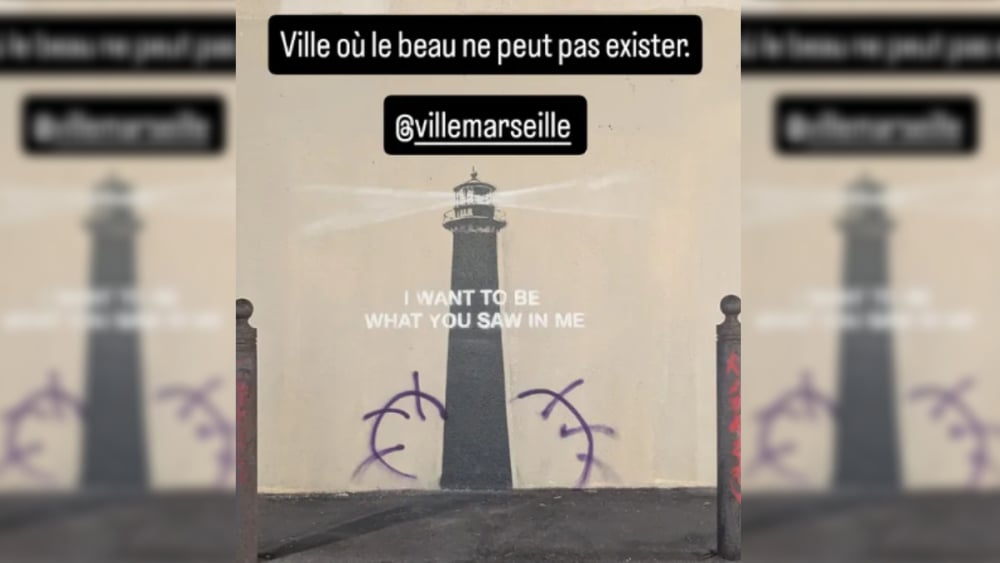
Situated in the Catalans district of Marseille, Banksy’s latest artwork features a lighthouse projecting its light, accompanied by the poignant message: “I want to be what you saw in me.” This intriguing piece draws attention not only for its artistic value but also for its thought-provoking implications.
Vandalism or Assumed Appropriation?
Banksy is known for creating art in public spaces without authorization , specifically so that everyone can see, interpret, photograph, and comment on it. He has frequently criticized the commodification of art and its confinement within museums. As a result, his works are designed to be viewed by all, free of charge. The artist hailing from Bristol advocates for a radical democratization of art , opening the door to symbolic appropriation by the public.
This raises an important question: does this mean that the fifty-something artist endorses the deterioration or alteration of his works? Only Banksy can provide that answer. However, the real question lies in whether he will respond in the forthcoming hours to this “Marseille-made appropriation.”
One undeniable fact is that Banksy embraces, and even claims , the ephemeral nature of his artworks. Several pieces have been removed by cities shortly after their appearance. In a striking act, he himself orchestrated the destruction of one of his pieces at an auction: “Girl with Balloon” was self-destructed live in 2018. This element of his work drives home the message: nothing is eternal, not even art, especially in the urban environment, which is subject to wear, conflict, and the ebb and flow of life.
The Power of Urban Art
The discussion surrounding Banksy’s works opens up a broader conversation about the role of urban art . Urban art serves not only as an aesthetic experience but also as social commentary and a platform for public engagement. It’s a form of expression that often reflects the feelings and realities of the local community. This is particularly true in a city like Marseille, known for its vibrant culture and diverse population. The new addition to the Catalans district provides a space for dialogue about the complexities of identity, belonging, and the struggles of urban life.
Banksy’s Impact on Modern Art
Banksy’s distinctive style, characterized by satirical and often political themes, has made a significant impact on modern art. His approach challenges traditional norms and encourages viewers to question what art can be and where it belongs. His works often incite a mix of emotions—from amusement to anger—prompting conversations that extend far beyond mere aesthetics.
Furthermore, the artist’s anonymity contributes significantly to his allure. By remaining faceless, Banksy compels us to focus on the message rather than the artist. This challenges the conventional art world, where artists often experience intense scrutiny based on their personal lives or previous acclaim.
Public Reaction and Community Involvement
As public discussions grow around Banksy’s works, so does the community’s engagement with art. People are empowered to take ownership of their environments through the dialogue sparked by such pieces. In Marseille, locals are inspired to not only appreciate the work but also interpret it in ways that resonate with their experiences. The idea that art is for everyone is fundamental to Banksy’s philosophy and is vividly illustrated in the excitement following new installations.
Future of Street Art
As the landscape of urban art continues to evolve, questions about preservation and appropriation will likely intensify. While some may view alterations as vandalism, others see them as a form of evolution that reflects the current state of society. Just as cities change over time, so too must art adapt to reflect those shifts.
Banksy’s contribution to this dialogue is invaluable, as he encourages the public to reflect on both the impermanence and the resilience of art . With every new piece, he invites viewers to engage, contemplate, and challenge accepted norms around art and its place in society.
In conclusion, the ongoing conversation about Banksy’s artwork encapsulates the dynamic nature of urban art. It reminds us that art is not just a visual experience but a critical commentary that holds the potential to transform public spaces and invite meaningful dialogue. The latest work in Marseille serves as a testament to this, encouraging both admiration and debate, reinforcing the idea that art, in its many forms, is meant to be shared and experienced by all.