
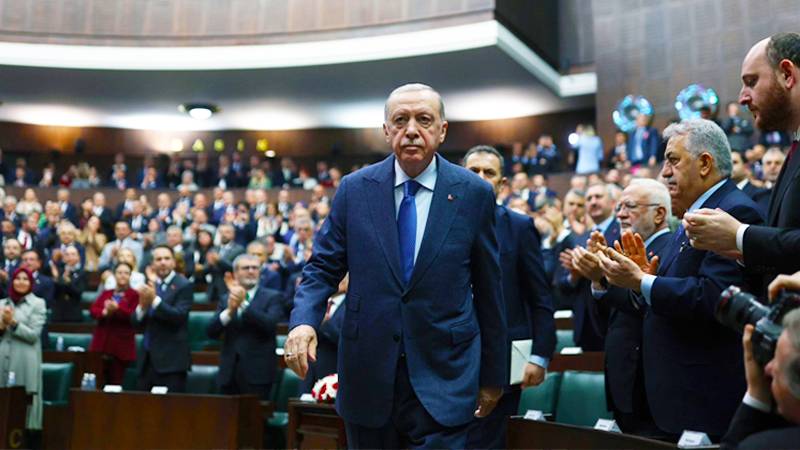
Political Landscape in Turkey: Erdoğan’s Path to Candidacy
The political climate in Turkey has taken a pivotal turn as discussions emerge around the potential presidential candidacy of Recep Tayyip Erdoğan. According to reports from AKP insiders, the party aims for the Grand National Assembly of Turkey (TBMM) to make a decision regarding early elections, which would allow Erdoğan to run for the presidency again.
A recent article from Türkiye Gazetesi sheds light on the tension between the government and opposition parties regarding the necessity of a new constitution. The opposition has framed the ongoing constitutional discussions in the context of Erdoğan’s potential candidacy, leading to a notable backlash from the ruling party. AKP officials emphasize that Erdoğan’s earlier statements, such as, “The aim of the new constitution is not to create space for ourselves,” signify their intent to approach candidacy through the TBMM rather than through constitutional amendments.
Constitutional Requirements for Erdoğan’s Candidacy
Under the Turkish Constitution, there are two routes for Erdoğan to secure his candidacy for a third term as president. The first option is for the TBMM to declare early elections, while the second involves amending Article 101, which states, “A person can be elected as president a maximum of two times.” AKP strategists consider it more pragmatic to seek a decision from the TBMM rather than attempting to amend the Constitution.
Despite Erdoğan’s earlier remarks like, “I have no intention of running again or seeking re-election,” AKP sources believe that this does not indicate a definitive departure from the race. They note that discussions regarding his candidacy are still premature and may not materialize until 2027, when the political landscape could shift.
Challenges Ahead: The Need for Parliamentary Support
Achieving a TBMM decision for early elections requires a supermajority of 360 votes, or two-thirds of the parliamentary members. According to the Constitution, either the President or the TBMM can initiate elections. If the Assembly votes for new elections to be held in 2028, Erdoğan retains the opportunity to run again. Conversely, should the President issue the call for elections, he would be ineligible for a third run.
The current seat distribution in the assembly complicates matters for the ruling coalition, known as the People’s Alliance. Presently, this coalition lacks sufficient votes to secure the necessary supermajority for calling early elections. Nevertheless, AKP officials express confidence that no party will evade the electoral process when the time comes. Furthermore, they highlight the significance of cooperative efforts with parties like DEVA in achieving goals such as a “terror-free Turkey,” which could help gain support for election calls.
Current and Future Political Implications
Despite the uncertainties, the groundwork for Erdoğan’s potential candidacy is underway. The notion that both intra-party and inter-party dynamics could ignite significant political changes looms large over the Turkish landscape. Should the TBMM decision come at a strategic time, it could pave the way not only for Erdoğan’s candidacy but also for a broader political strategy involving various parties.
The stakes are high as Turkey heads into an era that could redefine its political framework. As discussions regarding the new constitution, early elections, and Erdoğan’s candidacy unfold, public sentiment and party alliances will play a pivotal role in shaping the country’s political future.
In summary, while AKP strategies appear to favor leveraging TBMM for early elections to facilitate Erdoğan’s candidacy, several hurdles remain, including the intricate balance of parliamentary power. As Turkey continues to navigate these complexities, the dynamics surrounding Erdoğan’s potential run for a third term promise to keep citizens and analysts alike on edge, watchful of how the political narrative evolves in the coming years.