
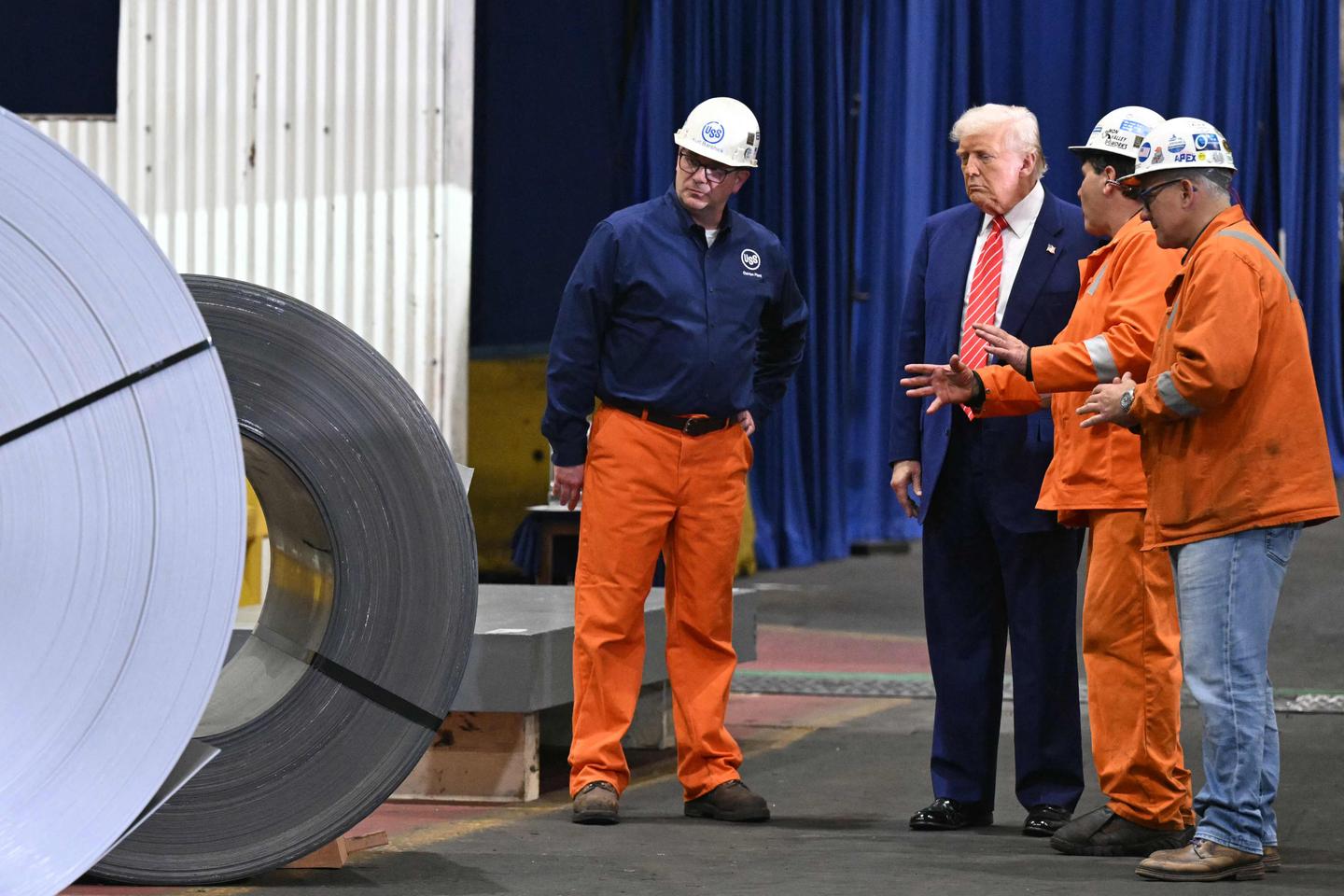

The latest judicial developments regarding tariffs have not dampened Donald Trump’s appetite for import taxes . During a visit to a steel mill in Pennsylvania on May 30, the American President announced plans to double the tariff on imported steel to 50% . He later clarified on his platform, Truth Social, that this measure would take effect on June 4 and would also apply to aluminum.
“We will increase the tariffs on steel from 25% to 50%, which will further protect the steel industry in the United States,” Trump stated from the podium at a US Steel facility in Pennsylvania.
“No one will be able to evade” these tariffs, he assured, as workers adorned in hard hats and reflective vests cheered in the background, chanting “USA, USA!” following his announcement of the new tariffs.
“Our steel and aluminum industries will be stronger than ever,” he later reiterated on Truth Social. The 25% tariff he had instituted in March on these metals also affected derivatives, such as cans .
Since his return to the White House , Donald Trump has made tariffs a cornerstone of his policy: a negotiating tool for securing concessions from abroad, a means to defend the domestic industry, and also a source of new public revenue.
Tariffs have been applied to certain sectors (steel, aluminum, automotive), specific countries (China, Canada, Mexico), and even universally—impacting products not found on American soil, such as cocoa . The President has erected a barrier of new taxes on products entering the country, though he has backed off somewhat.
Just last Wednesday, the International Trade Court annulled tariffs imposed by the Trump administration, asserting that the President did not have the authority to set such taxes, a power that belongs to Congress . A day later, a federal appeals court temporarily suspended this decision, pending further deliberations.
Nippon Steel to Acquire US Steel
The President also praised a recent agreement he himself approved between US Steel and its Japanese competitor Nippon Steel , although details about the deal remain sparse.
“The most important thing is that US Steel will continue to be controlled by America; otherwise, I wouldn’t have approved this deal,” Trump explained, assuring that Nippon Steel will inject $14 billion “into the future” of US Steel.
This operation, which Trump had opposed for a long time, has become central to the 2024 presidential campaign , as it directly affects Pennsylvania, a key electoral state and the birthplace of steel manufacturing in the United States.
In late 2023, the two industrial groups announced a $14.9 billion acquisition (including debt) of US Steel by Nippon Steel. Former President Joe Biden ultimately blocked this operation just weeks before he left the White House, citing security concerns. Trump then decided to reconsider the proposal.
“At Nippon Steel, they kept asking me [to approve the deal], and I continued to refuse, but eventually I thought these people genuinely wanted to do something great,” he recounted.
In the wake of this news, the USW union , representing metalworkers, expressed strong skepticism in a statement, explaining they had not been consulted or informed about the terms of the agreement.
“It’s easy to issue press releases and make political speeches. It’s hard to translate commitments into action. The devil is always in the details, and this is particularly true with a bad actor like Nippon Steel,” warned the union.