
Recent survey results from Yöneylem Araştırma have sparked discussions across Turkey’s political landscape. Conducted between May 19 and 22 , the survey utilized the Computer-Assisted Telephone Interviewing (CATI) method, gathering responses from 2,004 participants. Respondents were posed the question: “If parliamentary elections were held this Sunday, which party would you vote for?” The results, before addressing undecided voters, displayed the following distribution:
- CHP : 30.8%
- AKP : 26.1%
- MHP : 6.7%
- İYİ Parti : 3.3%
- DEM Party : 7.6%
- YRP : 2.7%
- Zafer Party : 3%
- TİP : 1.1%
- Others : 3.1%
- Undecided : 10.3%
- Won’t Vote : 5.3%
CHP Is the Leading Party
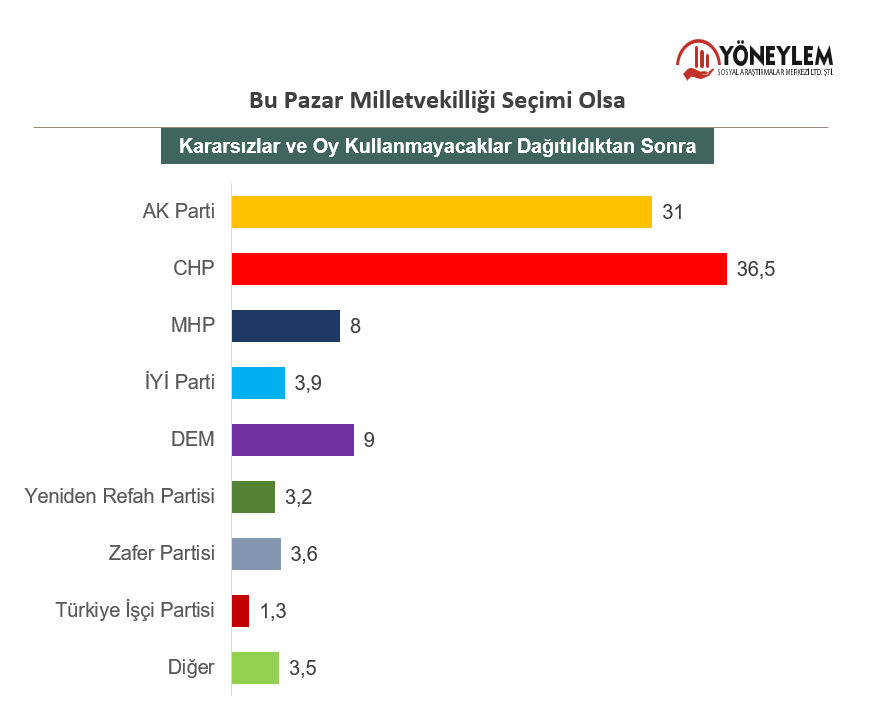
After redistributing undecided voters, it was revealed that CHP emerged as the leading party with 36.5% of the vote. The survey indicated that the AKP’s support decreased slightly to 31% . Furthermore, DEM Party garnered 9% , while MHP secured 8% of the supportive respondents.
The rankings for the remaining parties were as follows:
- İYİ Parti : 3.9%
- Zafer Party : 3.6%
- YRP : 3.2%
- TİP : 1.3%
- Others : 3.5%
AKP Continues to Decline
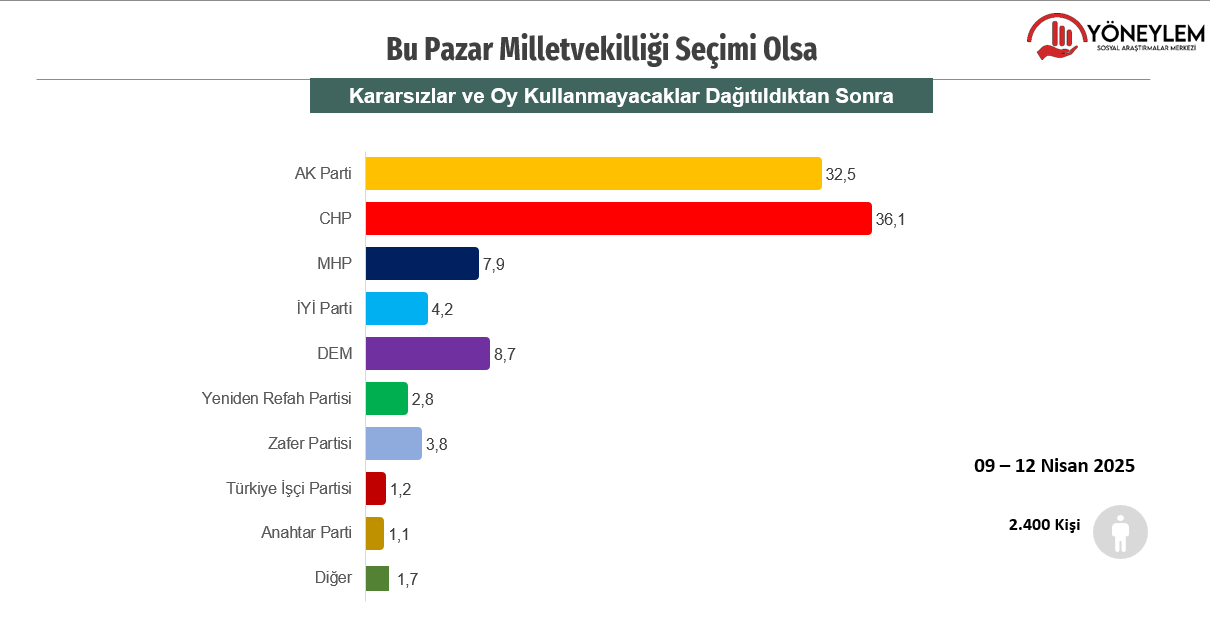
The survey findings suggest that the AKP continues to experience a downward trend. This follows a notable pattern observed in Yöneylem’s previous survey conducted in April . There, the party registered a support level of 32.5% , which has now decreased to 31% . This evidence suggests a continuous erosion of support for the ruling party.
The implications of these survey results are significant, highlighting shifting sentiment among Turkish voters. Particularly, CHP’s rise in support reflects a growing optimism among its base, which may lead to increased engagement as elections approach. Conversely, the AKP’s drop in voter approval raises questions about the party’s ability to maintain its voting bloc amid growing dissatisfaction among constituents. Additionally, the presence of undecided voters remains a crucial factor in this political equation, indicating a portion of the electorate is still influenced by evolving political dynamics.
It is imperative to monitor how the current political climate unfolds as the elections draw nearer. The results indicate potential volatility, and all parties must strategize effectively to capture the hearts and minds of the electorate. With the 2023 parliamentary elections looming, these findings serve as a wake-up call for the AKP and a beacon of hope for opposition parties.
As political campaigns intensify, engaging the undecided voters will be critical for any party’s success. The current landscape suggests that parties may need to reevaluate their platforms, outreach, and public relations strategies to resonate with the changing opinions of the Turkish electorate. The upcoming months will undoubtedly be pivotal for all involved in Turkish politics.
General News – 1