
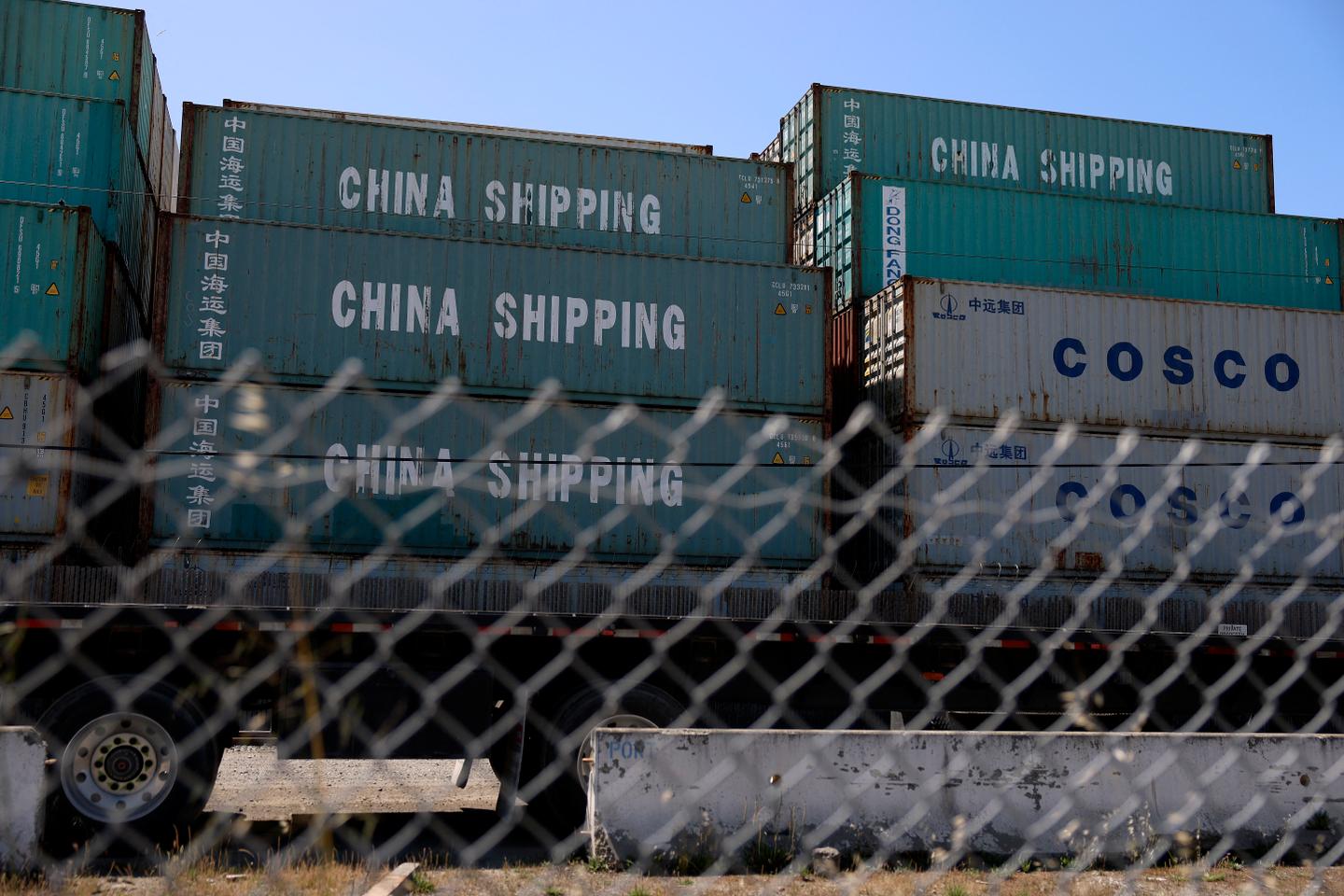

A federal appeals court has urgently upheld the tariff rights sought by President Donald Trump , which had been blocked the day prior by a U.S. court, pending a substantive ruling.
On Wednesday , the U.S. International Trade Commission (ITC) ruled that Mr. Trump had overstepped his powers by imposing und targeted tariffs, which is a prerogative of Congress. This decision blocked the tariffs imposed on Canada , Mexico , and China , accused of not doing enough to combat fentanyl trafficking , as well as the “reciprocal” tariffs instituted earlier in April, whose application was postponed beyond a 10% threshold until July.
The decision was denounced by the White House , however, it was welcomed by the U.S.’s main trading partners, with China even calling for the “total cancellation” of these tariffs.
Following this, the government filed for an emergency request, announcing its readiness to take the issue to the Supreme Court to obtain this temporary suspension as soon as Friday. However, an appeals court accepted the government’s request, consolidating the two lawsuits on the same subject—one initiated by small businesses and the other by a coalition of U.S. states—into a single case.
A “Manifestly Erroneous” Ruling
The decision made by the ITC sparked outrage from the White House , which described the ruling as “manifestly erroneous” and expressed confidence that “this decision will ultimately be overturned on appeal.”
Meanwhile, China urged the United States to “totally cancel the unjust unilateral tariffs,” following the ITC ruling, through a statement from a spokesperson for the Ministry of Commerce. “The government warmly welcomes yesterday’s decision,” Canadian Prime Minister Mark Carney stated in Parliament, noting that it confirms Canada’s long-standing position that these tariffs are illegal and unjustified.
However, Carney added, “We believe that our trade relationship with the United States is still profoundly threatened” by the persistent tariffs on steel, aluminum, and the automotive sector, expressing a desire to “enhance cooperation with reliable trading partners and allies around the world.”
Detailing the court’s reasoning, the judges contend that the President cannot invoke the Economic Emergency Act of 1977 (IEEPA) to implement “an unlimited tariff on products from nearly all countries,” according to the ruling consulted by Agence France-Presse.
Two Complaints Filed
The judges emphasized that the decrees adopted “exceed the powers granted to the president under the IEEPA to regulate imports,” as this law only permits “economic sanctions necessary in the case of an emergency to combat an ‘extraordinary and unusual’ threat.” Any interpretation that delegates “unlimited authority over tariffs” is unconstitutional, the judges stated.
Newsletter
“A la une”
Every morning, browse the essential news of the day with the latest headlines from “Le Monde.”
Sign Up
In a written opinion accompanying the decision, one unnamed judge stated that allowing such a scope would “constitute a renunciation of legislative power to benefit another branch of government,” violating the U.S. Constitution.
The court’s ruling stemmed from two lawsuits: one filed by a coalition of twelve U.S. states, including Arizona , Oregon , New York , and Minnesota , and the other by a group of U.S. businesses, who accused Mr. Trump of usurping powers belonging to Congress.
On April 2 , President Trump announced “reciprocal tariffs,” intended to cover all countries worldwide, but retreated in the face of plummeting financial markets, granting a 90-day pause while maintaining a base tariff of 10% to open the door for trade negotiations.
Following intense back-and-forth and escalating tariffs, Beijing and Washington eventually agreed in mid-May to revert to a 10% tariff on U.S. goods and a 30% tariff on Chinese products.
However, following the ITC ruling on Thursday, the spokesperson for the Chinese Ministry of Commerce condemned the American protectionism as “benefiting no one.”