
Racing Bulls’ Remarkable Strategy in Monaco
This season, the Formula 1 circuit has seen a series of ups and downs, and one team that has caught the attention of fans and critics alike is Racing Bulls. Despite facing skepticism surrounding their strategic decisions earlier in the season, particularly during the Australian and Chinese Grands Prix, the team made headlines with a surprising and effective approach during the Monaco Grand Prix.
Strategic Changes Bring Unexpected Success
The Monaco race was marked by new regulations that required all competitors to change their tires at least twice during the event’s 78 laps. Pirelli’s competition director, Mario Isola, remarked that understanding the implications of this rule required not just a strategist, but possibly a "genius." Racing Bulls proved they possessed both of these qualities by employing an innovative strategy that ultimately led them to success.
The team made a bold decision to utilize Liam Lawson’s car as a means to slow down the competition. This tactic was aimed at giving Isack Hadjar, who was fighting for a place in the top 6, the necessary space to make his pit stops without getting caught in the heavy traffic characteristic of Monaco. Though Hadjar was eventually outpaced by legendary driver Lewis Hamilton, the strategy paid off as Hadjar crossed the finish line in an impressive sixth place.
The Impact of Tactical Decisions
Hadjar’s success was further complemented by the subsequent actions taken by Williams, who implemented a similar strategy later in the race. This allowed Lawson to finish in eighth place, marking the first point-scoring result of his season. Such careful planning and execution by Racing Bulls demonstrated the importance of teamwork and strategic foresight in a high-stakes environment like Formula 1.
Peter Bayer, the Managing Director of Racing Bulls, expressed his excitement and gratitude to the team at the post-race interview. He praised the fantastic work done by the strategists and noted that their ability to overcome previous frustrations had culminated in this triumphant moment. Bayer commented, "The risk we took certainly paid off."
A Look Back at the Monaco Grand Prix
During the Monaco Grand Prix, Hadjar maintained a competitive position early on, even achieving a fifth-place standing at one point. Bayer analyzed their decision-making process, admitting that letting Hamilton pass was a calculated risk aimed at gaining better control of the race with both of their cars.
The team’s decision was well-timed, as they capitalized on the arrival of Hamilton’s attack. Bayer mentioned that this created an opportunity for them to adjust their strategy while adhering to the regulations governing tire changes. The team’s execution was stellar, and the resulting 12 points earned in the championship standings were vital, particularly as they now sit just behind Haas.
Team Dynamics and Future Prospects
Moving forward, the energy within Racing Bulls is palpable. Bayer articulated the positive atmosphere in the team, emphasizing that their recent performance felt like a turning point. The team is heading to Barcelona with newfound confidence and anticipation, looking to leverage their Monaco success as a motivational springboard for future races.
As the season progresses, the challenges of consecutive races and the need for constant adaptability will continue to test the resilience of all teams. For Racing Bulls, however, their recent success is a reminder of the critical role that strategic planning plays in achieving positive race outcomes.
The Future of Racing Bulls
The Monaco Grand Prix has set a precedent for Racing Bulls. Their blend of risk-taking and strategic ingenuity indicates a potential shift in their trajectory this season. As the paddock prepares for the next race in Barcelona, the team’s performance at Monaco underscores the value of thorough preparation and teamwork.
On a broader scale, the developments within Racing Bulls serve as a fascinating study in the interplay of risk and reward in Formula 1. By reflecting on their journey thus far, the team can continue to refine their strategies, aspiring toward further successes on the circuit.
In conclusion, Racing Bulls’ recent race has showcased not only their potential in navigating complex rules but also their capacity to embody the essence of Formula 1—excitement, strategy, and the relentless pursuit of success.
Since the beginning of the season, it has been clear that Racing Bulls hasn’t always excelled with their strategic approach. The Italian team has sometimes missed the mark, wasting certain potential, especially during the Australian and Chinese Grands Prix. However, this Sunday in Monaco, the opposite happened.
The introduction of a specific rule in the Principality that required competitors to change tires twice over the 78 laps created uncertainty before the race. Pirelli’s competition director, Mario Isola, suggested it would require a “genius” rather than a strategist to fully grasp the implications. Racing Bulls seems to have had both.
The team was the first to use one of its cars—specifically that of Liam Lawson—to slow the pack. The aim was clear: to give Isack Hadjar, who was vying for a top 6 finish, sufficient room to pit early—twice—without being caught in the notorious traffic of Monaco.
While Hadjar couldn’t fend off a faster Lewis Hamilton, he ultimately benefitted from the strategy, finishing the race in sixth place. Moreover, with Williams adopting the same tactic later, Lawson managed to succeed and finish eighth, scoring his first points of the season.
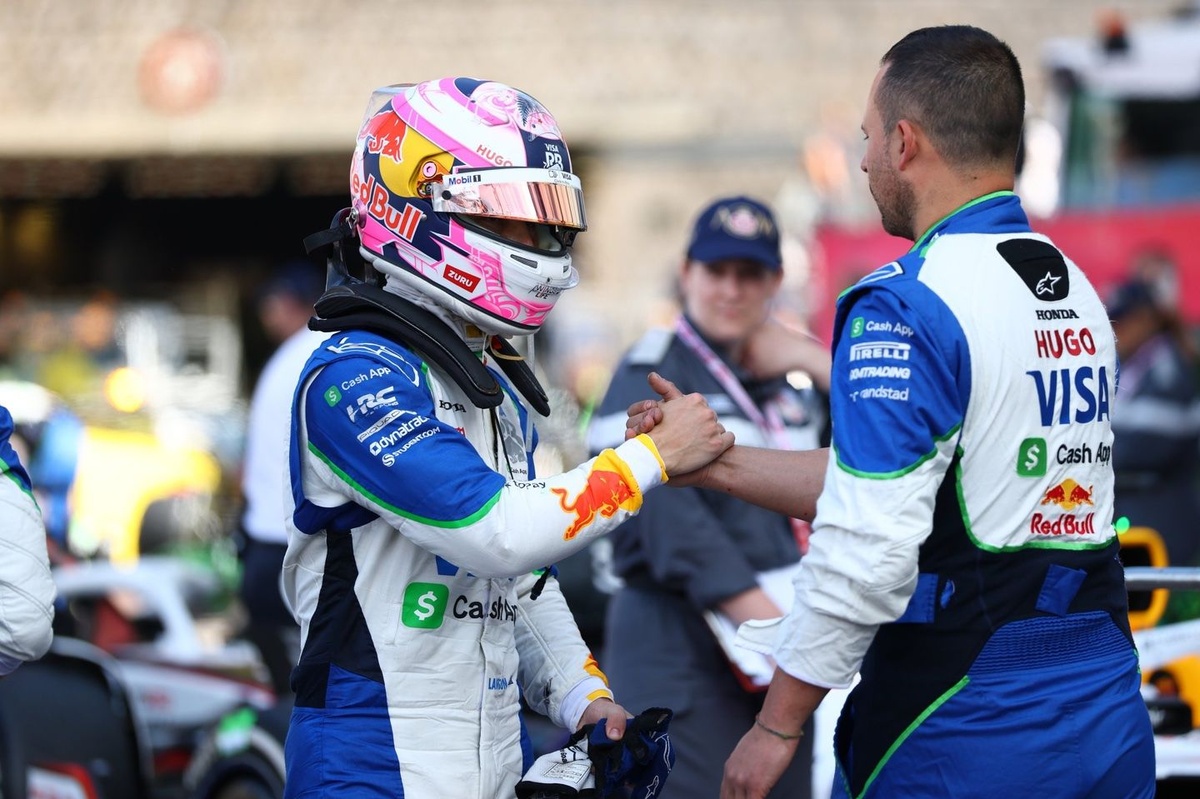
Photo by: Sam Bagnall / Motorsport Images via Getty Images
“You can see it: the whole team is gathered here in front of the garage, everyone is absolutely thrilled for the team, for Isack, for Liam,” Peter Bayer stated to ServusTV. “Excellent work by our strategists. With Laurent [Mekies, team director], we experienced our fair share of frustration regarding strategy, but today they really pulled off a stroke of genius. The small risk we took definitely paid off.”
“Theoretically, there was even more to gain,” Bayer added, referring to the fifth place Hadjar held at the start of the GP. “The risk was certainly high—’no risk, no fun,’ as they say—but we decided to let Lewis [Hamilton] pass so we could control the race with our two cars.”
“Carlos [Sainz] could have taken that position from us, but since he was attacking really hard, we thought, ‘OK, this opens a window for us.’ And as we had to use the soft tires, we tried to shorten that stint as much as possible because they simply wouldn’t perform on a long stint. And yes, the guys executed the strategy perfectly. We’re very, very happy that the risk paid off.”
“Of course, the 12 points in the championship are extremely important. I think that places us just behind Haas, but most importantly, the car is functioning, the team is functioning, and there’s harmony. You can really feel the energy within the team, the joy that their work brings. Yes, the three consecutive races are exhausting, but thanks to this, we are heading to Barcelona with a smile and anticipation.”
With Mark Mann-Bryans