
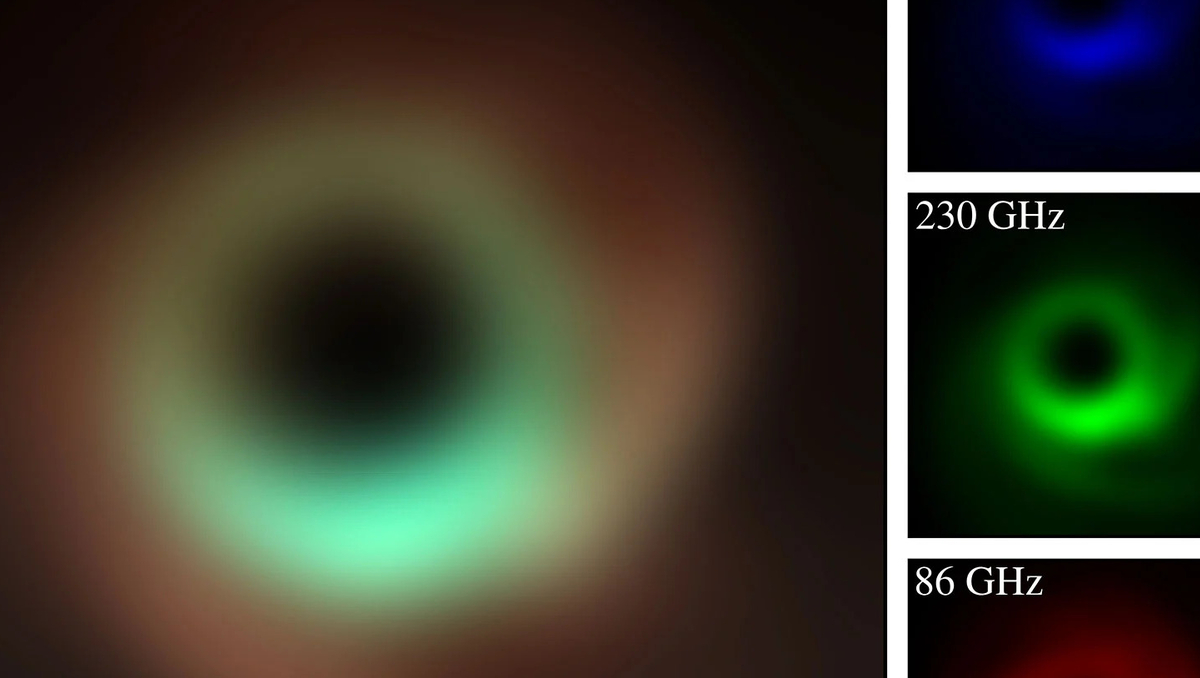
The Future of Black Hole Imaging: A Step Towards Color
Introduction to Black Hole Imaging
The groundbreaking revelation of the first direct image of a black hole was unveiled in 2019, thanks to the Event Horizon Telescope (EHT). This monumental achievement involved connecting eight radio telescopes across the globe, requiring the tireless efforts of around 200 scientists and processing petabytes of raw data. This pivotal moment in astronomy has opened new avenues for research, allowing us to explore the enigmatic nature of these cosmic giants.
The Next Frontier: Colored Images of Supermassive Black Holes
Following the success of the initial images, researchers are now focused on the possibility of creating colored images of supermassive black holes, which reside at the centers of galaxies. A recent study published in The Astronomical Journal provides insights and a framework for this ambitious endeavor. The potential for producing colored images could revolutionize our understanding of black holes, revealing the complex interactions that occur within their vicinity.
Understanding How Black Hole Images Are Created
To grasp the significance of colored images, one must understand that the visuals we have of black holes, like M87 and Sgr A, are not traditional photographs. They are reconstructed images derived from data received in microwave frequencies, similar to radar images. This means that the waves captured do not correspond to the light visible to the human eye, which fundamentally affects how we interpret these images.
The Challenge of Color in Physics
The Nature of Color Perception
In physics, color has an intricate definition. Human eyes perceive wavelengths ranging from 400 nm to 800 nm, which translates to the colors of the visible spectrum. Wave lengths outside this range, whether ultraviolet, X-rays, gamma rays, infrared, microwaves, or radio waves, do not correspond to perceivable colors. Consequently, when constructing an image from these wavelengths, it necessitates assigning arbitrary colors to visualize them effectively.
Frequency Bands and Data Collection
Moreover, radio telescopes often operate within specific frequency bands, leading them to collect data across varied frequencies. This introduces the challenge of atmospheric turbulence that affects terrestrial telescopes—causing images to have inconsistencies that hinder simple overlaying. Thus, precise imaging from the ground becomes a complex task.
Overcoming Atmospheric Distortions
The Role of Frequency Phase Transfer (FPT)
One proposed solution to mitigate the effects of atmospheric distortion is through the use of Frequency Phase Transfer (FPT), an innovative optical technique. This method operates similarly to adaptive optics, which has already demonstrated remarkable capabilities in terrestrial imaging. For instance, the Very Large Telescope (VLT) in Chile has produced impressive images of planets like Neptune, showcasing the difference adaptive optics can make in capturing clear images.
Testing on Upcoming Projects
FPT has shown promising results and may be integrated into the forthcoming Event Horizon Telescope New Generation (ngEHT). Observing black hole activity in color is set to be an extraordinary experience that will undoubtedly enhance our understanding of these majestic objects.
Conclusion
The journey from black hole imaging to the potential for colored visuals represents a transformative leap in astronomical studies. As researchers harness cutting-edge techniques like Frequency Phase Transfer, we may soon witness these enigmatic giants in stunning color, casting new light on the mysteries of the universe.
Looking to save even more? Check out our selected promo codes.