
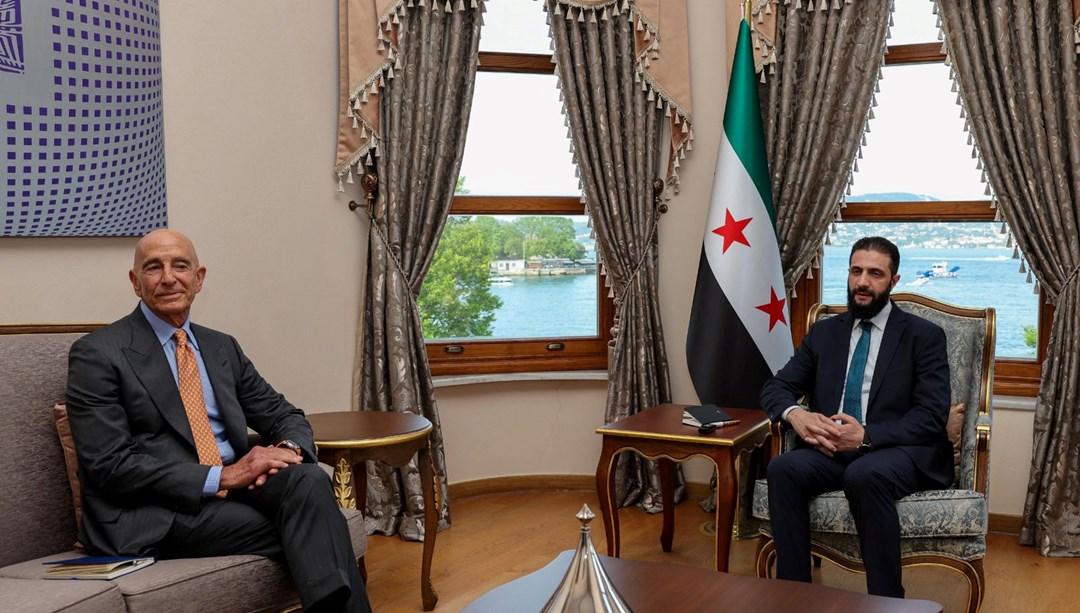
US Ambassador Tom Barrack’s Recent Meeting: A Step Toward Accountability
In a significant development, Tom Barrack , the US Ambassador to Turkey and Special Representative for Syria, held a meeting with the Syrian President Ahmed Shara . Following this discussion, Barrack took to social media to announce a pivotal agreement that could aid in locating lost American citizens within Syria.
Barrack emphasized, “This is a strong step forward,” as he revealed that the new Syrian government had agreed to assist in identifying the whereabouts of American citizens or their remains. He specifically mentioned the cases of Austin Tice , Majd Kamalmaz , and Kayla Mueller , whose fates have raised significant concern among their families and the US administration.
The Commitment to Locate Missing Americans
Barrack reiterated that President Donald Trump has clearly stated that bringing American citizens home or honoring their remains with dignity is a top priority . “The new Syrian government is poised to aid us in this commitment,” Barrack mentioned, showcasing a hope for collaboration between the two nations that have had a fraught relationship over the years.
This announcement came just a day after the US lifted some restrictions pertaining to Syrian trade, indicating a potential shift in diplomatic relations between Washington and Damascus. This change in attitude is a sensitive and complex issue, given the backdrop of Syria’s ongoing conflict and humanitarian crisis.
Background on Missing Americans
Among the missing individuals, Austin Tice is particularly noteworthy. According to reports, Tice, a freelance journalist working for AFP and The Washington Post , was abducted in 2012 while covering the Syrian conflict. His story highlights the risks journalists face while reporting in war zones.
Majd Kamalmaz , a US-Syrian physiotherapist, is believed to have been taken into custody during the Assad regime in 2017. Tragically, it is suspected that he lost his life during detention. His story is a reminder of the many hidden tragedies that occur amid international conflicts.
Lastly, Kayla Mueller, an aid worker kidnapped by ISIS, was reported dead in 2015. The circumstances surrounding her death remain murky, as ISIS claimed she was killed in a coalition airstrike. US authorities have disputed this claim, indicating the uncertainty faced by families of abducted individuals.
Exploring Additional Missing Persons
Further complicating the situation, a source familiar with the matter revealed to AFP that the US government possesses a list of eleven more individuals who are missing. All of these missing persons are believed to be US-Syrian nationals, highlighting the multifaceted nature of the issue where various identities are intertwined.
A Qatari delegation has reportedly initiated a search for the remains of American hostages killed by ISIS, acting on behalf of the US government. Such cooperation signifies a broader regional effort to address the humanitarian issues resulting from prolonged conflict.
Ongoing Search Efforts
The Syrian Observatory for Human Rights (SOHR) confirmed that the Qatari delegation is currently searching for the bodies of American citizens in Aleppo . This search underscores the humanitarian aspect of the crisis and the challenges intertwined with geopolitics.
Many individuals are still grappling with loss and uncertainty, as shown in the cases of James Foley and Stephen Sotloff , American journalists executed by ISIS in 2014. Their tragic deaths have led to a renewed focus on the safety of journalists and aid workers in conflict zones. Notably, El Shafee Elsheikh was found guilty in 2022 of conspiring to kill Foley and Sotloff, among others, emphasizing the ongoing legal implications tied to these events.
The Path Forward: Collaboration and Accountability
The recent developments highlight a potential thaw in US-Syrian relations, facilitated by mutual interests, especially concerning American citizens . However, achieving long-term accountability will require sustained dialogue and commitment from both parties. The international community continues to watch closely as these efforts unfold, emphasizing the critical nature of diplomacy in conflict resolution.
As the families of the missing remain hopeful, the commitment to locating their loved ones serves as a potent reminder of the human cost of war. The newly formed Syrian government’s willingness to cooperate could signal a new chapter in a long-standing and complex relationship.