
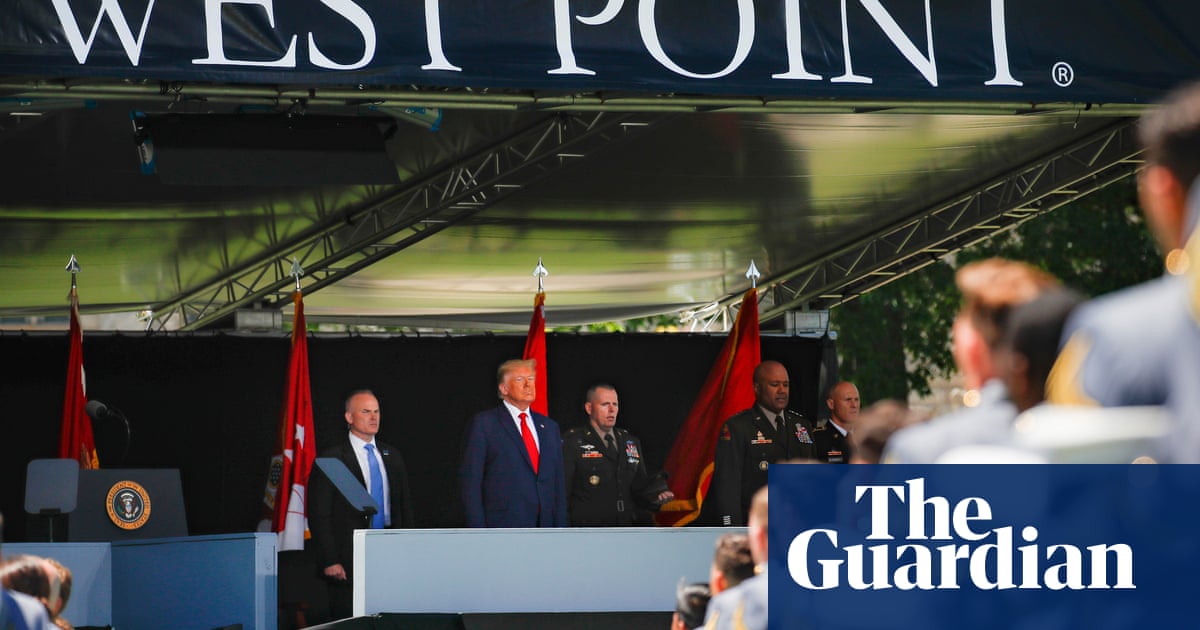
Trump’s Address to West Point Graduates: A Controversial Moment in Military Academia
On Saturday, Donald Trump will deliver a commencement address to the graduates of West Point , a prestigious military academy. This marks the second time he has spoken to the United States Military Academy (USMA) in upstate New York, where future army leaders are educated. The address not only offers Trump a platform to promote his defense policy but also coincides with significant changes imposed by his administration.
The Shift in Military Education Policies
Since taking office, Trump has implemented a series of executive orders that have dramatically changed policies at military service academies, particularly with regard to diversity, equity, and inclusion (DEI). His administration has pushed for a more right-wing agenda at these institutions, leading to several notable consequences.
Among these are the disbandment of various student clubs, including the Society of Women Engineers , the Latin Cultural Club , and a group that supports the LGBTQ+ community . These changes have sparked concern among many stakeholders about the future of inclusivity in military education.
Moreover, the Department of Defense has instructed West Point and other military schools to review their library collections and remove any materials that might be considered contrary to the newly established DEI policies. This move has raised significant controversy and prompted reactions from various faculty members.
Faculty Resignation and Concerns
One notable resignation from West Point was that of Graham Parsons , a philosophy professor who served for 13 years . He said, “I am ashamed to be associated with the academy in its current form,” highlighting the growing dissatisfaction among staff about the changes being forced upon the institution.
This alteration in the educational landscape of military academies reflects a broader trend within the federal government under Trump’s leadership. The focus on promoting traditional values often clashes with the principles of diversity and inclusion that many believe should be foundational in military training.
Upcoming Events: Army Parade and Trump’s Birthday
In conjunction with the graduation ceremony, the Army is planning a parade through the streets of Washington, D.C. This celebration is intended to commemorate the 250th birthday of the U.S. Army , coinciding with Trump’s own birthday on June 14 . This event will give the administration another opportunity to showcase its military prowess and, arguably, bolster national pride .
While Trump unsuccessfully attempted to organize a military parade during his first term, this event promises a grand display involving 6,600 soldiers and a budget estimated at $45 million . The potential for spectacle is significant, as it promises to merge military tradition with the robust nationalism that Trump represents.
Protests and Public Response
The president’s appearance at West Point has spurred various protests . As reported by the Times Herald-Record , at least one protest is planned on the Hudson River —a unique setting for those aiming to voice their dissent against Trump’s policies. Additionally, other demonstrations are expected to be held outside the academy’s campus, signaling the divided public opinion surrounding the former president and his political agenda.
Trump’s previous commencement address to West Point graduates during the COVID-19 pandemic in 2020 was attended under strict health protocols, with students wearing masks and maintaining social distance. This year’s event, expected to be larger and more vociferously attended, will serve as a bellwether for how the public perceives Trump’s ongoing influence on military and educational policies.
The Broader Military Context
Beyond the graduation ceremony and the recent controversies, Trump’s administration recently announced a plan to invest $540 billion over 20 years into a new missile defense system called the “Golden Dome.” This initiative aims to protect the U.S. against various threats, signifying an aggressive stance in defense spending and military advancement.
The funding for this project came from a comprehensive tax-and-spending bill—dubbed the “big beautiful bill” —that has been a point of contention in recent Congressional negotiations. The commitment to military spending showcases the administration’s priorities, particularly in light of rising global tensions.
Conclusion
Trump’s address to West Point graduates is not merely a ceremonial gesture; it encapsulates the broader ideological clash currently shaping military policies and education in the United States. As the nation braces for the impacts of his administration’s directives on diversity and inclusion , the implications will likely reverberate well beyond the academy and affect military operations for years to come.
This structured content is optimized for SEO, utilizing relevant keywords and ensuring clarity without any grammatical errors or narrative inconsistencies.