
The Launch of Trump’s Missile Defense Shield: A New Era in National Security
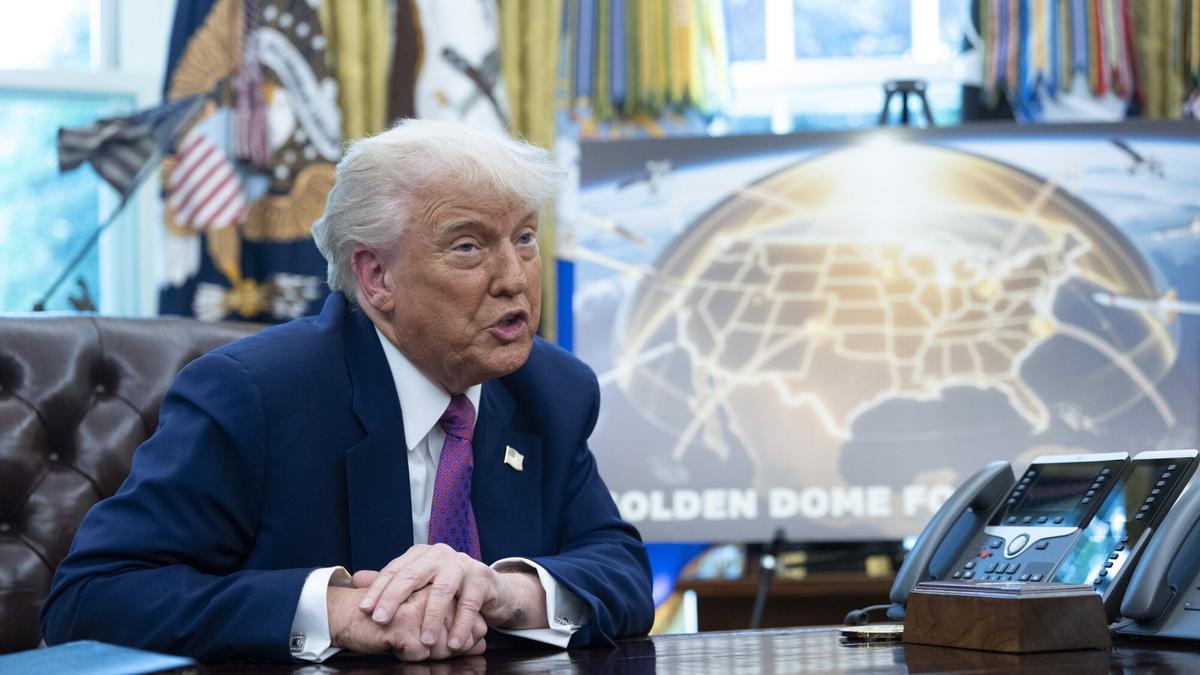
On a momentous Tuesday, President Donald Trump unveiled plans for a new missile defense initiative aptly named the "Golden Dome." This ambitious project aims to create a comprehensive shield for the United States to protect against increasingly advanced threats from nations such as China, Russia, Iran, and North Korea. The proposed system, which amalgamates sensors, satellites, and missile interceptors—including capabilities in space—promises to redefine national defense as we know it.
Financial Allocations and Budget Concerns
During a press conference at the White House alongside Secretary of Defense Pete Hegseth, Trump disclosed that he would earmark an initial $25 billion for the project. The total projected cost of the Golden Dome is estimated to be around $175 billion. However, projections from the Congressional Budget Office (CBO) suggest the overall expenditure could exceed $800 billion over two decades, with a staggering $500 billion anticipated for space capabilities alone.
This announcement comes at a crucial time when federal budgets face unprecedented scrutiny. While the $25 billion figure is part of Trump’s annual budget proposal, approval from Congress remains uncertain as some Republican lawmakers have raised objections, necessitating Trump’s recent visit to Capitol Hill to advocate for the spending plan.
Monitoring Adversaries and Strategic Threats
The former President has been dismissive of critiques regarding the potential escalation of an arms race that this program could provoke and has appointed General Michael Guetlein as the "czar" responsible for overseeing the Golden Dome initiative. Guetlein, currently the Deputy Commander of the U.S. Space Force, holds a wealth of experience in missile systems and emerging weapon capabilities and has consistently warned about the growing threats from adversaries determined to endanger U.S. territory.
In a statement from the Oval Office, Guetlein emphasized that U.S. adversaries have become increasingly capable and resolute, modernizing their nuclear forces and developing ballistic missiles that could potentially penetrate American defenses. He referred to hypersonic missiles, capable of reaching speeds up to 10,000 kilometers per hour and could reach American shores within an hour, as a prime example of the urgency for this initiative.
Lack of Specificity in Details
The specifics surrounding the implementation of this missile defense system remain vague. Earlier in January, Trump signed an executive order predicated on a rapid delivery of defense options, envisioning a system akin to Israel’s Iron Dome but of much larger scale. Although the 60-day deadline for proposals was surpassed back in March, three options have finally been presented, one of which has been selected as the middle-ground solution in terms of both cost and complexity.
Details shared with the press indicate that the Golden Dome will integrate existing Pentagon programs and other evolving technologies, including aerial and space-based systems. While the particulars are yet to be fully fleshed out, sources suggest that the initiative intends to cover four distinct phases of an impending missile attack: pre-launch, early flight, mid-flight, and terminal descent.
Profit Opportunities for the Private Sector
The development of the Golden Dome heralds a lucrative opportunity for the private sector, with companies like SpaceX, Palantir, and Anduril already presenting proposals for collaboration. Reports suggest that these firms are working on constructing a constellation of satellites—potentially between 400 and 1,000—that would track hostile missiles and support targeting efforts, contributing to what is being termed the "guardian layer" of the defense system.
Interest in this project is robust, with over 180 companies expressing a desire to work with the Pentagon on various facets of the Golden Dome. Major industry players such as Boeing are also likely to submit bids, creating a competitive landscape ripe with innovation.
A Return to "Star Wars" Initiatives
Trump’s missile defense proposal can be viewed as a modern-day revival of Ronald Reagan’s Strategic Defense Initiative (SDI) from the early 1980s. Reagan’s initiative aimed to create a missile shield against intercontinental ballistic missiles and became popularly known as the "Star Wars" program. Although that plan lost momentum following the dissolution of the Soviet Union, the allocation of $30 billion over six years laid the groundwork for contemporary defense technologies.
Trump has explicitly stated that he aims to complete the mission that Reagan began, asserting that this ambitious project would eliminate the threat of missile attacks on U.S. soil. In conversations with Russian President Vladimir Putin, Trump indicated that the topic of Russian advancements in space-based nuclear weapons has yet to be discussed but vowed it would be addressed "at the appropriate time."
While the Golden Dome may seem like a seismic shift in national security strategy, the challenges associated with its implementation, the financial implications, and the potential for geopolitical complexities remain to be evaluated. Whether this ambitious project ultimately comes to fruition and meets its intended goals will depend on a myriad of factors, including bipartisan support and technological advancements that align with the vision articulated by the Trump administration.