
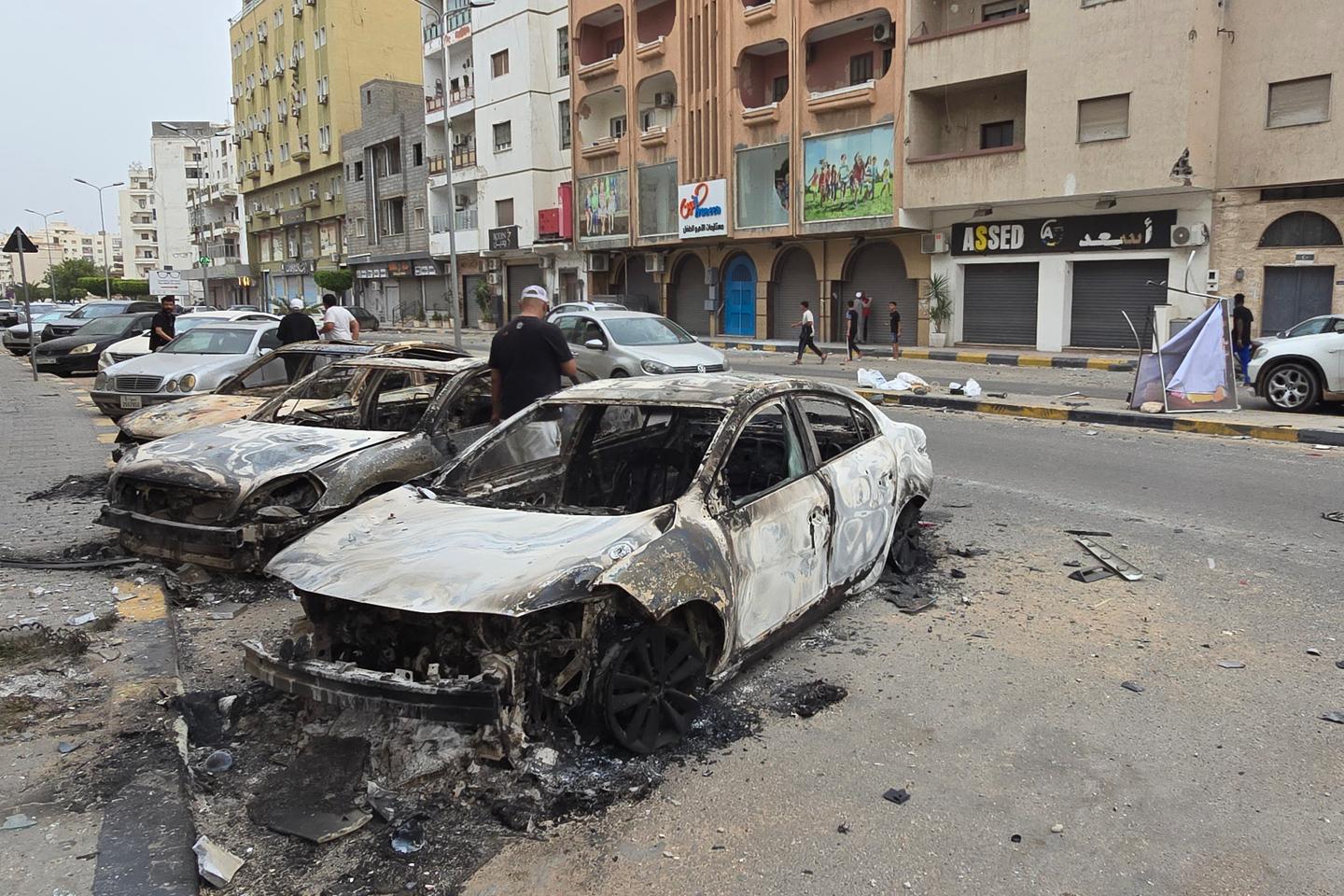
Recent Clashes in Tripoli
Violent **clashes** erupted once again among **rival armed groups** in Tripoli during the night of May 14, as intense fighting left a significant number of casualties in recent days. According to security sources, at least **six individuals** were reported dead due to these clashes. An official from the **Ministry of the Interior** described the situation to the France-Presse (AFP) agency, stating, “The clashes have resumed in Tripoli on a large scale, extending to several sectors, between the Radaa force and the 444 brigade,” adding that **heavy weapons** such as **machine guns** and **rocket launchers** were utilized. As of now, no concrete assessment of the casualties has been disclosed from these renewed confrontations.
The **Radaa Force** operates outside the control of Prime Minister **Abdel Hamid Dbeibah’s** government, with brigade 444 being supported by the Ministry of Defense. Following the announcement of the **dissolution of Radaa**, which occurred simultaneously with the disbandment of security groups managed by another influential militia, the **Stability Support Device (SSA)**, recent escalations have raised concerns. The SSA’s leader, Abdel Ghani “Ghnewa” al-Kikli, was killed in an incident shortly before this escalation.
International Concern
The **United Nations Support Mission in Libya (UNSMIL)** expressed alarm over reports indicating **civilian casualties**. On May 14, they urged the involved parties to halt the fighting to facilitate “the implementation of safe corridors for the evacuation of civilians trapped in intense conflict zones.” The mission voiced its deep concern regarding the resurgence of violence in **Tripoli**, calling for an “immediate and unconditional ceasefire.” They cautioned that the situation could escalate to an unmanageable level very quickly.
The Impact of Violence
Throughout the city, **strong explosions** reverberated, particularly around the port area and in western and southern **Tripoli**. According to security sources, groups aligned with Radaa have brought reinforcements to support their forces against brigade 444. Additionally, reports indicated that an armed group from **Zawiya**, located 45 kilometers west of the capital, entered a **district of western Tripoli** to support the Radaa forces. Eyewitnesses shared images across social media, showcasing **burning vehicles** and buildings damaged by the ongoing firefight.
Historical Context
The violence in Libya is not a new phenomenon. Since the overthrow of dictator **Muammar Gaddafi** in 2011, the country has been mired in **divisions** and power struggles. Currently, Libya is under the administration of two competing governments: one recognized by the United Nations, led by Prime Minister **Abdel Hamid Dbeibah**, and another based in the eastern part of the country, controlled by **Marshal Khalifa Haftar**. Despite a semblance of stability in previous years, rival factions continue to clash over territory and influence, especially in **Tripoli** and the western regions of Libya.
Reactions to the Violence
In response to the **rising violence**, various international organizations are calling for immediate action to **protect civilians**. Many humanitarian groups are deeply concerned about the potential for large-scale civilian displacement, as the conflict intensifies in this densely populated area. The ongoing battles highlight the urgent need for a comprehensive approach to peace and reconciliation in Libya, aiming to heal the divisions that have plagued this North African nation.