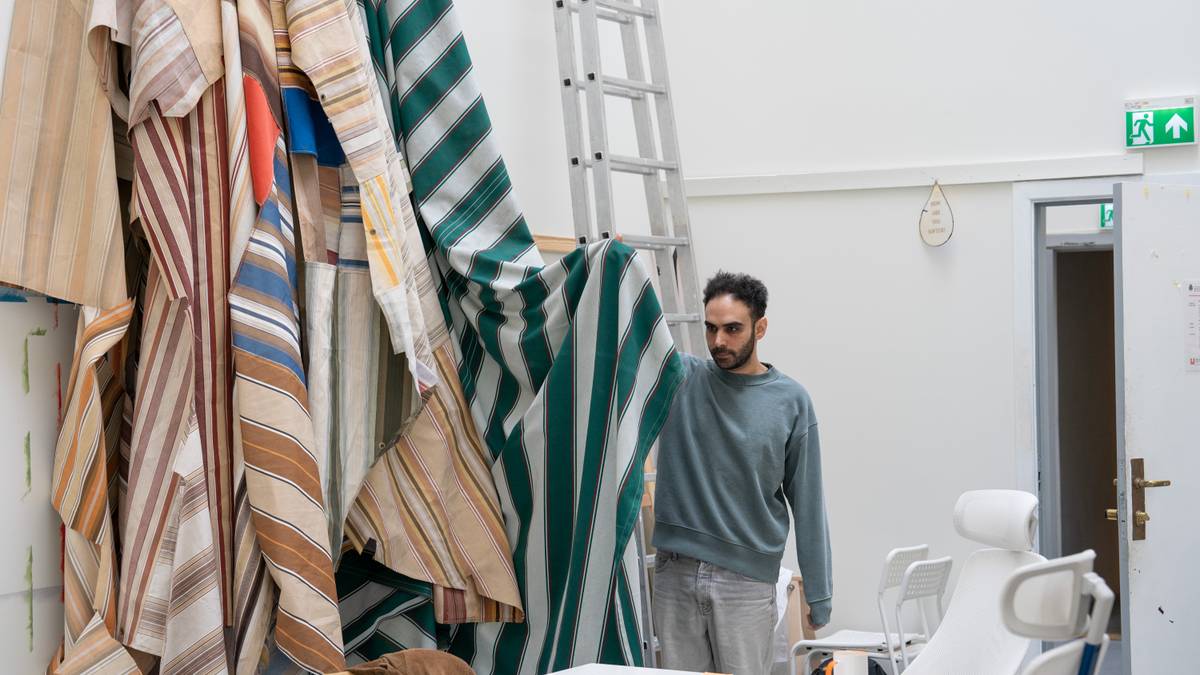
66 meters above the ground, in the western tower of Oslo City Hall lies perhaps the most sought after art studio. Here, Jad El Khoury, along with two others, has had the opportunity to fully focus on art in recent years. Their living period is now nearing the end, and Jad has started to pack the art in the studio. Including a few more meters long curtains, which have traveled far. Jad wanted to tell the stories from the neighborhoods hardest hit by the harbor explosion. Photo: Sara Guldmyr – I bought these pieces of cloth in exchange for installing new curtains for the residents. Photo: Sara Guldmyr Jad could see that the awning that hung from the balconies still scars from the explosion. Photo: Sara Guldmyr in 2023 was jad on the walk around the neighborhoods around the port of the hometown of Beirut. The area was severely affected by a huge explosion a few years earlier, when the whole world witnessed almost 3,000 tonnes of artificial fertilizer exploded in the middle of the city. Curtains and awnings that usually protect people from weather and wind were brutally torn. The artist remembers the incident well, because he himself was present that day. He would like to tell the stories of those who knew the tragedy on the body, but first managed three years after creating something himself. – I offered to replace the broken pieces of cloth with new ones. – Jad an important young voice with an artist that reflects society, says curator Ingunn Svanes Almeda. Photo: The Artists ‘Association The iced materials he packed with him in the suitcase, and now they have become the installation “Soft Shields,” which will be shown for the first time in Norway during the June exhibition of the Artists’ Association. – Jad’s works are clear artistic expressions of his experiences, says curator Ingunn Svanes Almeda. The Civil War memories Jad El Khoury live and work today, but he was born in Beirut in 1988. Two years before the Civil War in the country ended. Growing up, the hometown was characterized by war -damaged buildings, and already in childhood a fascination for this formed at Jad. – What should really be a cinema, a hotel, or an office building was left behind only by the Civil War, says Jad. – The ruins were not only physical traces, but they also included in our everyday life as social, political, and economic traces. Photo: Mohammed-Tayyeb Ahmad A deep desire stuck early on Jad to reshape these war memories in some way. With a clear goal, I worked for three years as an architect while setting aside money to finance the dream of art. – All the money went to “art interventions” in the city. Hanging from the ceiling he began to draw simple graffiti art around missile damage to buildings. – This was an extension of thoughtless dodies I used to do at school to find peace. Photo: Eli Abou Jaudeh But the response to graffiti art was not as positive as Jad had expected, which made him rethink public art. – This was my style and my thoughts that I in many ways forced in a common room, regardless of others. For JAD, it became important to respect everyone who uses the urban space. Therefore, he became more subtle and less permanent in the expression. Modern Ruin The Lebanese artist put his eyes on an abandoned office building in the center of Beirut. The building had largely been empty for several years, but when it was erected in 1974 it was a symbol of stability and future optimism in the country. The following year, the civil war in Lebanon broke out, and the building remained as a modern ruin in the middle of the city. Due to its height and location, the building was used by snipers, and later as a prison. In 2018, the inhabitants of Beirut suddenly saw the torture prison in a new suit. Jad had spent six days installing curtains from the local community in about 400 windows. In the otherwise lifeless windows of one of the city’s tallest buildings, colorful curtains danced. Jad El Khoury used curtains with colors and patterns well known to the city’s citizens. Photo: Eli Abou Jaudeh The idea of the art project was to show that the dark past, just like Lebanons, does not need to define the future. Jad baptized the installation “Burj al-Hawa”, the wind’s tower. – It was about seeing our surroundings in new light. In 40 floors, the curtains fluttered as a deadline for a few days. Photo: Eli Abou Jaudeh Burj-Al Hawa was also a protest against the developers of Beirut who owns the building. Jad’s curtains were freely fluttered for ten days before he was notified of the owners to dismantle the installation. The intention was to let them hang for a month. – The notice completed the artwork in many ways. The owners think more about short -term profits than the best of the city. “Burj al-Hawa” received good criticism both at home and internationally. Over time, JAD has repeated the success of temporary curtain installations in a variety of places. The national museum in Beirut with the peace organization Offre Joi. Photo: Danielle Karam Halle Aux Sucre’s Art Center in Dunkirk. Photo: Jad El Khoury Pergola Installation at Corsica. Photo: Elodie Pinet Beirut Pavilion in Farm Cultural Park in Sicily. Photo: Danielle Karam more than just curtains – even though I use curtains a lot, I do not want to be known as the “curtain man”, smiles Jad El Khoury. For the artist, curtains are not only an aesthetic grip, but also a very good mirror on a society. Curtains are part of our identity and say a lot about ourselves. – Norwegians, for example, use curtains the two days the sun shines, jokes Jad. In Beirut, the balcony curtains are typical of poor neighborhoods, and in “Burj al-Hawa”, Jad highlighted this. In the ten days the curtains fluttered over the capital, ordinary people gained ownership of the city. Curtains usually distinguish the private from the public, but in some places they can distinguish between life and death. Photo: Mohammed-Tayyeb Ahmad curtains will protect us from weather and wind, but simply places they also give shelter from the rain. During the Civil War in Syria, curtains were used as an effective way for civilians to hide from snipers, Jad knows. – The photographs of Franco Pagetti from Aleppo show just that. The sheet, blankets and curtains cover the sight lines of the snipers in the Salah Al-Din neighborhood in Aleppo, Syria. Photo: Franco Pagetti / VII / Redux curator Ingunn Svanes Almeda believes that the way Jad reuses well -known materials, such as curtains and awnings, to show a greater seriousness, lifts the textile to a medium that manages to speak for itself, also to a Norwegian audience. – Jad revoles up very cruel events in a very humane way, says Almeda. She also thinks that Jad’s great strength is that he is a socially engaged artist, and therefore is highlighted by the Artists’ Association for the June exhibition. But it was not always in the cards for Jad to end up in Norway. A worthy way out – in 1990, the Civil War in Lebanon ended, but even though the acts of war ceased, the conflict has continued, explains Jad El Khoury. The policy in Lebanon is therefore very heavy and the opportunities for people who jad are few. – If you are not loyal to a particular group, party, or militia you have in fact no possibilities. Basic human rights are given away in exchange for loyalty. Therefore, since he turned 18, had a desire to leave the country. – It’s not easy. You want to travel with a certain dignity and not become a helpless refugee. Jad wanted to develop as an artist, trying the happiness of a variety of art schools around the world. He got a nap at the Oslo Academy of the Arts. – I took the first opportunity I got, and I was very lucky because then it was still free for foreign students. From farewell to burial in the summer of 2020, Jad El Khoury turned 32 and was ready to start a new chapter. Two days before he was to get on the plane to Oslo to start the art study, it narrowed at the port of Beirut. – The building I was shook violently. A high bang followed the next second, the glass cracked, and the pressure wave threw me through the room. Over 200 people lost their lives and thousands of wound when almost 3,000 tonnes of ammonium nitrate, which had been unattended in the harbor, caught fire and exploded. – At first I was grateful to be alive, so shocked and scared. Finally, I saw the destruction and death, and felt guilt for surviving. What was supposed to be a time of farewell parties was filled with one funeral after another. – I was very angry in the time afterwards. It was as if I had boiling water in me. It took two years for one day to go without thinking about the harbor explosion despite all, I went to Oslo. In his luggage he brought his mother’s food, some clothes and curtains. – I have a lot to thank Oslo for recent years, some of the curtains have hung on the studio on the 13th floor of Oslo City Hall, but they will soon find a new home. Jad El Khoury will now give his place to another lucky artist, and he himself will continue to work from the Intercultural Museum in Greenland in the future. In the studio there is plenty of space and high under the ceiling with diffuse light from the skylights. Photo: Mohammed-Tayyeb Ahmad The walls are covered with drawings and Norwegian words with translations. Jad’s favorite word in Norwegian is “married”. Photo: Mohammed-Tayyeb Ahmad It all is an organized root that belongs to an art studio. Photo: Mohammed-Tayyeb Ahmad Jad says that the studio at the top of the town hall has given him plenty of room to explore the curtain art, and the location comes along well, but it took a good while before he got used to it. – It took me six months not to be overwhelmed by the entrance to the town hall, and realize that I actually had a studio here. The studios in Oslo City Hall Oslo City Hall disposes of three artistranships of different sizes at the top of the western tower. The studios are awarded three artists after three criteria: an established visual artist with a permanent residence in Oslo. A young visual artist who has just completed his art education. A foreign visual artist. Atelier is awarded through the Oslo Municipality’s allocation committees for the City Hall ate. The committee consists of representatives of visual artist organizations and the City of Oslo at the Cultural Agency and the City Hall’s management service The artist has also been given the opportunity to breathe new life in the curtains from the hometown in Norway. After the Leireret at Gjerdrum in 2020, JAD contributed an art installation in the form of a temporary meeting place for the affected and rescue workers at Asbjørnsen-Eika. The well -known striped curtains were sewn together into a dynamic picnic blanket. Photo: Eivind Lauritzen “Healing Blanket” became the name of the meeting place for all those who would need it at Gjerdrum. Photo: Frank Holtschlag Even though the project was short -lived left the picnic blanket visible traces on the grassy plain. Photo: Eivind Lauritzen The 37-year-old was also one of the ten finalists in the competition for a July 22 memorial. – There is a big difference between Norway and Lebanon, but the need to treat trauma just as necessary. You can see “Soft Shields” by Jad El Khoury in Oslo at the June exhibition of the Artists’ Association. Photo: Mohammed-Tayyeb Ahmad
ttn-69