

What factors have contributed to Bitcoin’s surge to $102,758? How does Ethereum’s performance impact the overall cryptocurrency market? What are the critical support and resistance levels for Bitcoin in the coming months? What role does institutional interest play in the current crypto market dynamics? How does the fixed supply of Bitcoin affect its price predictions?
The global cryptocurrency market has reached a staggering $3.22 trillion, driven by Bitcoin (BTC) rally to $102,758 and Ethereum’s sharp 16.84% climb to $2,213.99. Bitcoin, the largest digital asset by market cap, has surged 3.81% in the last 24 hours, pushing its valuation past $2.04 trillion. 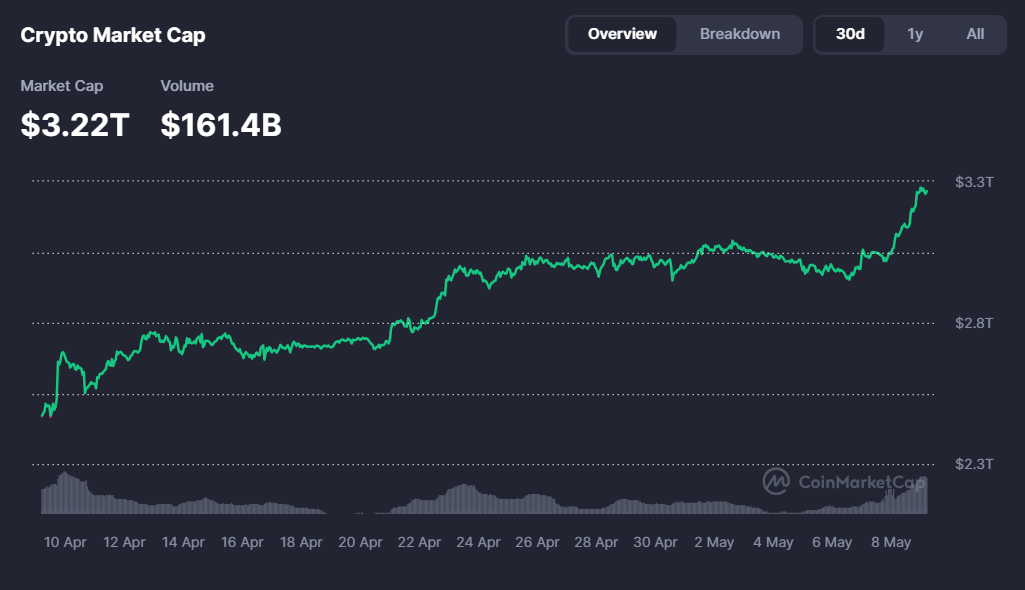 With a circulating supply of 19.86 million BTC and a fixed cap of 21 million, Bitcoin remains the dominant force in the crypto sector, setting the tone for broader market sentiment.
As the global market cap climbs, Bitcoin is well-positioned to lead the next phase of the crypto bull run. Here’s why:
- Institutional Momentum: With firms like BlackRock and Fidelity expanding their Bitcoin holdings, institutional interest remains a key driver.
- Regulatory Clarity: Recent ETF approvals and favorable regulatory shifts in major markets like the U.S. and Europe are boosting investor confidence.
- Supply Dynamics: With only a small fraction of Bitcoin left to be mined, the fixed supply and increasing demand are creating a classic supply squeeze.
Bitcoin’s technical outlook remains bullish, with critical support around $100,000 and resistance near $110,000.
- Immediate Support: $100,000 – a psychological level and former resistance turned support.
- Major Resistance: $110,000 – the next key hurdle for bulls, reflecting Fibonacci extensions and historical price patterns.
- Long-Term Target: $120,000 – a potential upside target if bullish momentum continues.
With the crypto market now worth over $3.22 trillion, Bitcoin’s path to $110,000 seems increasingly likely. Institutional inflows, regulatory clarity, and fixed supply dynamics could fuel the next major breakout, positioning Bitcoin as the centerpiece of the digital asset revolution.
Key Takeaways:
- Bitcoin leads the $3.22T crypto market surge, eyeing $110K next.
- Institutional adoption, regulatory clarity, and fixed supply are key drivers.
- Key levels to watch: $100K support, $110K resistance, $120K long-term target.
BTC Bull Token ($BTCBULL) continues to gain traction, crossing $5.47 million in funds raised as it nears its $6.14 million presale cap. Priced at $0.002495, the token has positioned itself as more than just a meme coin—offering real utility through flexible, high-yield staking.
Unlike typical meme tokens, BTCBULL blends crypto culture appeal with tangible staking rewards. Investors can currently earn an estimated 78% APY while keeping their tokens fully liquid—unstaking is allowed at any time without penalties or lockup periods.
Current Presale Stats:
- USDT Raised: $5,471,430 of $6,149,555
- Current Price: $0.0025 per BTCBULL
- Staking Pool Total: 1,342,549,903 BTCBULL
- Estimated Yield: 78% annually
With less than $678K left before the next milestone, the presale window is narrowing fast. For investors chasing high yields with exit flexibility, BTCBULL is becoming an increasingly compelling contender in the 2025 crypto cycle.
The post Bitcoin Price Prediction: Market Cap Hits $3.22 Trillion – What’s Next for BTC? appeared first on Cryptonews.
Bitcoin Price Prediction: Market Cap Hits $3.22 Trillion – What’s Next for BTC?
Bitcoin, the pioneering cryptocurrency, has long been at the forefront of discussions surrounding alternative currencies and decentralized finance. As of late, Bitcoin’s market cap has surged to an astounding $3.22 trillion, raising pertinent questions about its future trajectory and the factors driving this unprecedented growth.
Historical Context of Bitcoin’s Growth
Since its inception in 2009, Bitcoin has undergone numerous phases of volatility, often characterized by dramatic price swings. From its first recorded price of less than a cent to its all-time high in late 2021 of nearly $69,000, Bitcoin’s history is a rollercoaster ride of hype, skepticism, and seismic shifts in market sentiment. The rise to a $3.22 trillion market cap marks another significant milestone in Bitcoin’s evolution as it captures the attention of institutional investors, retail traders, and mainstream media alike.
Driving Forces Behind the Surge
Institutional Adoption
One of the primary catalysts for Bitcoin’s recent rally has been increased institutional adoption. Major financial institutions and corporations are no longer sitting on the sidelines. Companies like Tesla, Square, and MicroStrategy have prominently included Bitcoin in their balance sheets, lending legitimacy to the asset class. Additionally, various asset managers have begun offering Bitcoin exposure through investment products, showcasing institutional confidence in Bitcoin as a store of value.
Regulatory Developments
The regulatory landscape for cryptocurrencies has evolved significantly over the past year. Increased clarity from various governing bodies has alleviated some previous fears surrounding potential bans or crackdowns. Notably, a more structured regulatory approach could pave the way for broader adoption, allowing more investors to engage with Bitcoin without fear of sudden regulatory shifts.
Scarcity and Halving Events
Bitcoin’s supply mechanism is inherently deflationary, capped at 21 million coins. The halving events, occurring approximately every four years, reduce the rate at which new Bitcoins are generated, adding another layer of scarcity. This built-in scarcity, combined with increasing demand, potentially sets the stage for substantial price appreciation, as has been illustrated in previous bull markets.
Decentralized Finance (DeFi) and NFTs
The meteoric rise of the decentralized finance (DeFi) and non-fungible token (NFT) sectors has contributed to an overall bullish sentiment in the cryptocurrency space. As more users engage with various blockchain applications, Bitcoin often serves as the "gateway" asset, driving interest in other cryptocurrencies. Increased transaction volumes and engagement in crypto markets can create a positive feedback loop, further fueling Bitcoin’s price.
Analyzing Market Sentiment
To predict the future of Bitcoin, analyzing market sentiment is critical. Sentiment often drives price action, and the ongoing bullish attitude among traders, driven by recent price increases, could sustain momentum. However, it is essential to remain cautious of extreme euphoria, as it can lead to corrections.
Indicators to Watch
Several indicators are essential for gauging potential price movements:
On-chain Analysis: Metrics involving wallet activity, transaction volumes, and exchange inflows/outflows can provide invaluable insights into the health of the Bitcoin market. A rise in wallets holding Bitcoin could suggest accumulating interest from investors.
Market Dominance: Bitcoin’s market dominance percentage can indicate its relative strength against alternative cryptocurrencies. A decrease in dominance could signal capital rotation into altcoins, but a strong dominance will likely maintain its price momentum.
- Global Economic Factors: Bitcoin often acts as a hedge against economic uncertainty. Factors like inflation rates, geopolitical tensions, and monetary policy shifts can significantly influence investor sentiment towards Bitcoin. In times of economic instability, Bitcoin could be viewed as a safe haven, driving demand and, consequently, price upwards.
Price Predictions: Bullish vs. Bearish Scenarios
While predicting Bitcoin’s price with accuracy is notoriously difficult, some analysts are suggesting varying scenarios based on current trends.
Bullish Predictions
Many optimistic analysts believe that Bitcoin could reach new all-time highs, fueled by continued institutional investment and broader adoption. Price targets range from $100,000 to potentially $250,000 in the next cycle, contingent upon sustained demand and favorable market conditions. The argument is supported by historical patterns; previous bull markets have often seen parabolic growth.
Bearish Considerations
Conversely, skeptics warn of the potential for correction. Price corrections in crypto markets can be swift and severe, and market cycles may lead to significant downturns. Factors such as increased regulatory scrutiny, high inflation affecting disposable income, or macroeconomic headwinds could trigger a bearish sentiment, bringing Bitcoin’s price down significantly.
Conclusion: What’s Next for Bitcoin?
Bitcoin’s market cap hitting $3.22 trillion is a testament to its maturation and growing acceptance in the financial ecosystem. However, with price predictions varying widely, uncertainty remains the only constant in the crypto space. Investors should remain vigilant, conduct thorough research, and consider both market conditions and psychological factors that influence price. While Bitcoin’s future is promising, the risks are equally pronounced, signaling that the journey ahead will be anything but predictable. As always, due diligence and a comprehensive understanding of market dynamics will be crucial for anyone looking to invest in this rapidly evolving landscape.
Bitcoin has been making headlines recently, with its market cap reaching an impressive $3.22 trillion. This surge has raised questions about the future trajectory of BTC. Analysts are closely monitoring several key factors that could influence Bitcoin’s price moving forward.
### Market Trends
The overall sentiment in the cryptocurrency market plays a significant role. As institutional interest grows and regulatory frameworks become clearer, more investors are likely to enter the space, potentially driving prices higher.
### Technological Developments
Innovations such as scalability improvements and increased integration into traditional financial systems could also positively impact BTC’s price. Features like the Lightning Network aim to enhance transaction speed and efficiency, making Bitcoin more user-friendly.
### Economic Factors
Global economic conditions, including inflation rates and fiscal policies, might sway investor behavior. As people seek alternative stores of value, Bitcoin could be viewed as a hedge against inflation.
### Community and Adoption
The ongoing adoption of Bitcoin for everyday transactions, as well as in retail, is crucial. Partnerships with major companies can enhance legitimacy and drive more users to the platform.
### Market Dynamics
Price corrections are not uncommon in crypto markets. Investors should be prepared for volatility. Historical data suggests that while short-term fluctuations can be intense, long-term growth is still a possibility.
In summary, numerous factors will shape Bitcoin’s future, and its recent market cap increase highlights the potential for further growth. The landscape remains dynamic, with opportunities and risks that investors must navigate.