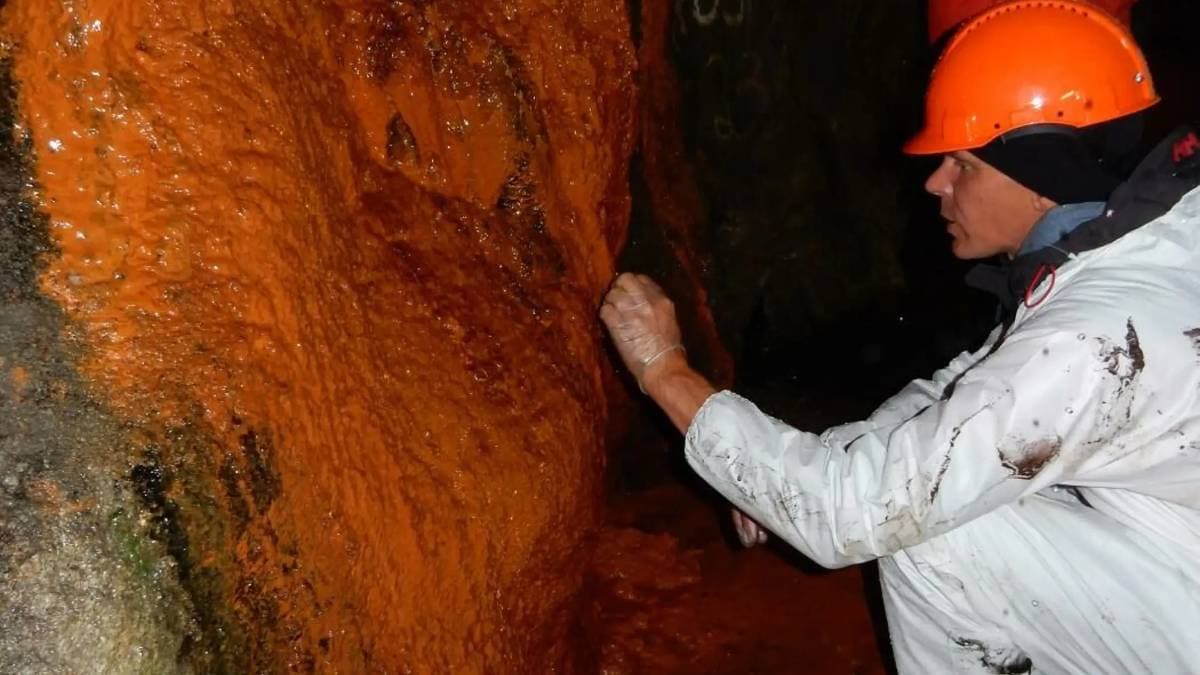
The tunnel under the Oslofjord has a bacterial problem. It shows new research. Bacteria from the salty groundwater enter through cracks in the mountain. They get their “food” from, among other things, reinforcing iron in the concrete, and merges in colonies. It makes the concrete in the tunnel porous and slowly breaks it down. But there is no danger to those who drive through the tunnel, assures the Norwegian Public Roads Administration. The Oslofjord tunnel is 7306 meters long, and is 130 meters below the sea surface at its deepest. Photo: Berit Roald / NTB forms the mucosa in the tunnel it was research.no that mentioned the case first. The Norwegian Public Roads Administration has long suspected that bacteria are merging in colonies and “eating” of the concrete. But few scientific studies have been done in the field until now. The researchers have shown that the bacteria form what is called a biofilm on the tunnel walls. The biofilm consists of bacteria that have joined forces, and these colonies supply substances in the concrete. For almost ten years, the Roads Administration and Swedish researchers have followed extra well on the concrete in selected areas of the Oslofjord tunnel. The findings surprised them. – This was extreme. In some places there were maybe three inches of thick biofilm, Britt-Marie Wilén tells news. She is a professor of environmental and sewerage technique at the University of Chalmers in Gothenburg, who has conducted the study. Saltwater that penetrates the concrete brings bacteria that form colonies, according to the researchers. Photo: Britt-Marie Wilén / Chalmers Elsewhere in the tunnel, the biofilm was only two millimeters thick. The researchers were also surprised at how quickly the bacteria eat into the concrete. “The bacteria eat into the concrete surface with up to one centimeters a year,” says Professor Frank Persson in a press release from the university. Unknown bacteria in the ceiling Since the 1990s, it has been very common to spray walls and ceilings with concrete when tunnels are built in the mountains. This spray concrete is reinforced with steel reinforcement. In this way, water is kept away, and stones from ceilings and walls are prevented from falling down. If there is a lot of water in the mountains, more spray concrete is laid. Under -sea tunnels such as the Oslofjord Tunnel have salty groundwater. It presses on the concrete from above. In extreme conditions, the bacteria can penetrate the concrete with as much as ten centimeters a year, according to the researchers. Photo: Britt-Marie Wilén / Chalmers / Britt-Marie Wilén / Chalmers The researchers have now seen how this creates growth conditions for several quite special bacteria on the visible part of the tunnel walls. Some of these bacteria have previously been unknown. No danger to motorists but you don’t have to worry about the bacteria if you have a trip under the Drøbaksundet. – The Oslofjord tunnel is absolutely safe for motorists with regard to this bacterial activity. This is stated by Lise Bathen, who is the chief engineer of the Norwegian Public Roads Administration. The bacteria do not break down the concrete near quickly enough to create insecurity, she assures. Furthermore, underwater tunnels are made with thicker walls than regular tunnels, precisely to take into account that the concrete breaks down faster where water penetrates. Bathen says that the concrete in the Oslofjord tunnel has 100 years of life. Now it’s 25 years. -The concrete is cast and stands for 100 years, but not without being influenced by the environment in which it is in. In order to stand for a 100 year period, it must be perfectly normal maintenance. Published 08.05.2025, at. 12.08
ttn-69