

What factors contributed to Fartcoin’s impressive 145% price increase in April? How does Bitcoin’s performance impact altcoin behavior in the current market? What potential risks might Sui face despite its strong growth indicators? What role does real-world adoption play in sustaining the momentum of AI tokens?
Key Takeaways:
- Fartcoin led April’s meme coin rally with a 145% price jump, but experts caution that the sector remains fragile and heavily dependent on Bitcoin’s performance.
- Sui stood out among L1s with a 56% gain, supported by strong DeFi metrics and stablecoin integration, though token unlocks could bring near-term volatility.
- AI tokens continued to gain traction, with Bittensor and Virtual Protocol among April’s top performers, but analysts warn that sustained growth will depend on real-world adoption.
The last days of April gave traders reason to be hopeful. Bitcoin (BTC) climbed back above $90,000, helping lift sentiment across the broader crypto market. As BTC rebounded, altcoins followed.
Among the top 100 tokens by market capitalization, Fartcoin (FARTCOIN) led the monthly gains with a 145% increase in April. Another meme coin, Bonk (BONK), also made the top three with an 80% rise. The renewed interest in such high-risk assets may signal that traders are again willing to take on more exposure after steep losses in March and April.
The Artificial Intelligence (AI) sector also saw strong momentum. Three AI-related tokens, Virtuals Protocol (VIRTUAL), Bittensor (TAO), and Artificial Superintelligence Alliance (FET), all landed in the top 10 monthly performers.
Sui (SUI), a Layer 1 blockchain token, also stood out with a 56% gain. For this April altcoin recap, Cryptonews spoke with experts about what might shape the market in May.
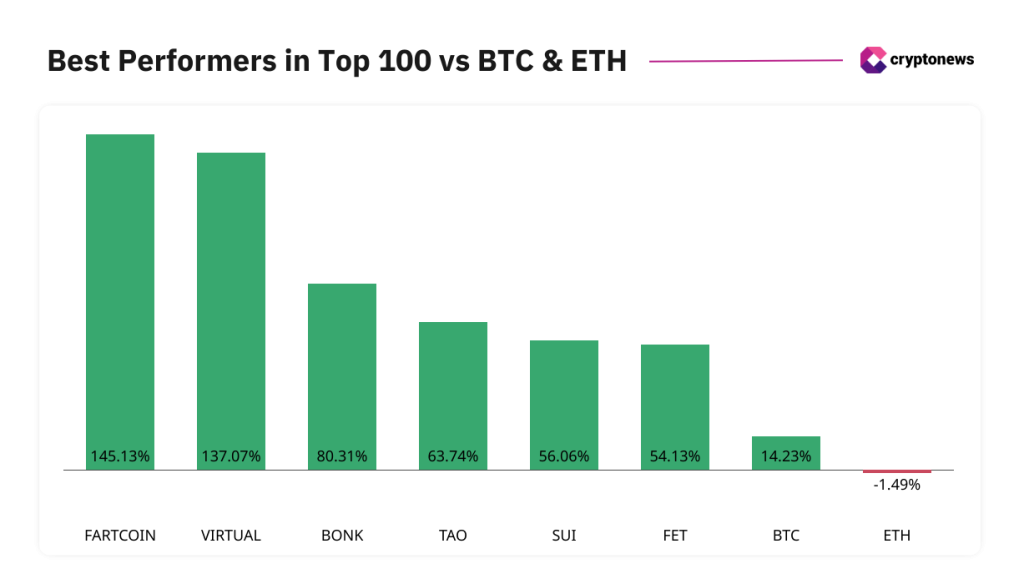
Meme Coins Back in Play? FARTCOIN Leads with 145% Jump
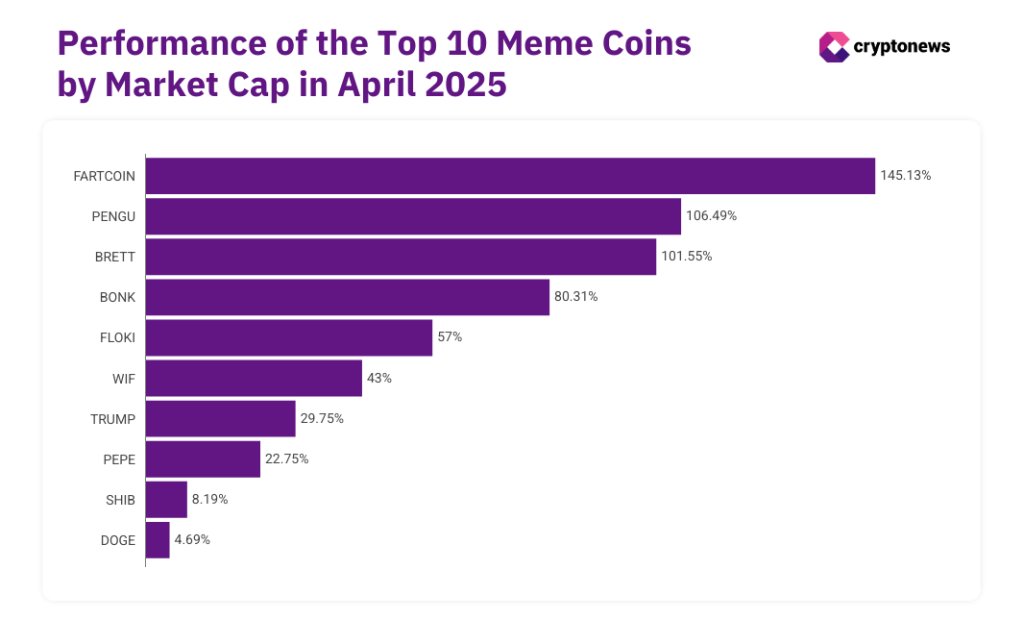
April brought a wave of excitement to the meme coin market. Fartcoin surged by 145% and quickly became one of the most talked-about tokens of the month. But while some traders see this as a sign of revival, experts say it’s still too early to call it a full comeback.
Matas Čepulis, Founder & CEO of LuvKaizen, told Cryptonews that the sector is showing signs of life, but overall, “it is far from recovery still.” While a few projects like FARTCOIN are gaining traction, many popular tokens, including Pepe (PEPE), remain well below their all-time highs.
Čepulis attributes FARTCOIN’s breakout performance to its fast-growing social media presence and strategic execution:
Fartcoin got insane traction and flooded social media instantly while creating FOMO. The team played very well on the execution, market making, listings — and got instant traction.
However, the expert notes that most other meme coins failed to show any meaningful recovery in April:
Unfortunately, Murad’s tokens like SPX6900, Retardio, Sigma and others are still down hard with zero to no positive recovery in the last month.
The overall picture remains complicated by Bitcoin’s dominance. According to Čepulis, when BTC is climbing, altcoins often struggle to keep up, and when it drops, they tend to fall even harder. “Memes are the ones who get the biggest red candle,” Čepulis said.
‘Indicators Suggest Sui Is on the Verge of Inflection Point’
Among Layer-1 protocols, Sui emerged as an unexpected leader in April. It outperformed both Solana (SOL) and Ethereum (ETH) in price gains, despite lingering market volatility. However, some experts caution against premature optimism.
Jason Tucker-Feltham, CEO of the Stablepor platform, told Cryptonews that Sui’s recent rally may be partly due to timing, and not just fundamentals. The broader market hasn’t seen a strong altcoin season yet, and global economic uncertainty continues to weigh on sentiment:
The market has still yet to see a convincing altcoin season, and with unstable macro trends, we could continue to see volatility across the entire crypto market.
Still, Tucker-Feltham sees positive signals in Sui’s development strategy. He believes stablecoins will be a key theme for 2025 and sees their integration on Sui as a growth catalyst:
Integration of Circle’s USDC on Sui sets the stage for real-world payments. Stablecoins on Sui, coupled with the cross-chain capabilities enabled by Sui Bridge, could see it take a more meaningful bite out of the global stablecoin opportunity.
Kelghe D’Cruz, CEO of Pairs, points to encouraging on-chain data:
Key indicators would suggest that Sui is on the verge of an inflection point. Transaction counts and wallet growth signal rising user engagement, while increasing DeFi TVL translates into more assets, more trades, and more demand.
He also highlights the importance of strategic partnerships that help strengthen the broader Sui ecosystem. But despite these positives, D’Cruz warns of several risks that could slow down momentum:
Still, it’s not all smooth sailing. The Move language, while innovative, carries security risks due to its relative newness. Regulatory pressure on DeFi’s yield mechanics could also slow momentum. And liquidity fragmentation across chains might dilute capital efficiency.
What Are the Price Predictions for AI Tokens After Their April Boom?
April was a strong month for the AI token sector. Three artificial intelligence-linked projects landed in the top 10 gainers across the crypto market. Virtuals Protocol led the surge with a 137.07% gain. TAO followed with nearly 64%, helping lift the entire segment. Given that TAO remains the largest AI-focused token by market cap, its growth likely played a key role in driving the sector forward.
In a conversation with Cryptonews, Abbas Abdul Sater, Head of Sales at Capital.com, pointed to TAO’s limited supply as a major factor behind its appeal:
There’s only 21 million TAO tokens in total. That kind of hard cap naturally creates scarcity — and in crypto, scarcity can be a powerful driver of price.
He noted that TAO currently holds a market cap of around $3 billion, with a fully diluted valuation of $6.8 billion. A sharp uptick in trading volume suggests growing investor interest, but Abdul Sater also urged caution:
It’s not yet clear if this is just a hype-driven rally or something more fundamental. We’re watching closely to see if this momentum holds.
Abdul Sater added that TAO’s recent growth may have been supported by the launch of a new system known as the SN44 Score. This tool expands TAO’s utility by introducing real-world video data integration, and something investors are starting to notice:
Integrating real-world video data is a big step. It’s opened up a new use case for TAO, and investors are paying attention.
While the tech is still in its early stages, Abdul Sater says many players are already “taking positions in advance,” betting on long-term potential. Still, the sustainability of the trend will depend on how real-world adoption unfolds. If demand for applied AI use cases continues, TAO could strengthen its lead in the sector.
Other AI tokens, outside of VIRTUAL TAO and FET, also posted gains in April. Meanwhile, among the top AI tokens by market cap, only Internet Computer and Story posted negative returns. NEAR Protocol (NEAR), which has positioned itself as AI-compatible, ended April with a modest 0.65% increase.
What to Expect in May
May has started with signs of cooling after a turbulent April. The meme coin market still attracts attention, particularly following the surge in Fartcoin. However, the lack of strong fundamentals and continued reliance on Bitcoin may limit further upside.
In the Layer-1 sector, Sui continues to stand out thanks to improving DeFi metrics and an expanding stablecoin ecosystem. The risk of a sell-off following its May 1 token unlock remains a concern.
AI tokens are also holding the spotlight. Sustained demand for TAO and technical updates like the SN44 Score could support the current uptrend. Still, much will depend on whether short-term hype turns into lasting momentum.
Key Altcoin Events to Watch in May 2025
- May 5: Hyperliquid Fee & Staking Tier Update. New structure for fees and staking goes live, potentially affecting liquidity on the platform.
- May 6: Aave aUSDC MetaMask Card Discussion. Governance debate on whether aUSDC should be integrated as a spendable token for MetaMask Card users.
- May 7: Puppy.fun Launch. A new meme coin-focused launchpad expected to attract speculative interest and test meme market momentum.
- May 22: SEC Altcoin ETF Decision Deadlines. Critical rulings expected on ETF filings tied to XRP and other altcoins — potential market mover depending on outcome.
The post “We’re Imagining a World of Tokenized Everything”: Fireblocks Policy Director Dea Markova appeared first on Cryptonews.
We’re Imagining a World of Tokenized Everything: Insights from Fireblocks Policy Director Dea Markova
In the rapidly evolving landscape of blockchain technology and digital assets, the concept of tokenization has emerged as a revolutionary force, transforming everything from traditional finance to real estate and beyond. At the forefront of advocating for this transformation is Dea Markova, Policy Director at Fireblocks. Markova’s insights into the future of tokenization provide a compelling vision of how digital assets can reshape our economic and social frameworks.
The Concept of Tokenization
Tokenization refers to the process of representing real-world assets—be it physical property, digital art, or even financial instruments—on a blockchain. By converting these assets into tokens, we can increase transparency, security, and efficiency in transactions. Every tokenized asset has the potential to democratize access, allowing a broader range of individuals and institutions to participate in ownership and investment.
In her role at Fireblocks, Markova emphasizes the transformative power of tokenization. "Tokenization isn’t just a trend; it’s a fundamental shift in how we think about ownership and value," she argues. "Imagine a world where your house, stocks, or even art can be easily traded, financed, and owned through a digital token. It is a profound way of enabling liquidity and inclusivity in markets that have historically been illiquid or exclusive."
The Role of Blockchain Technology
Central to Markova’s vision is the blockchain technology that underpins tokenization. By using decentralized ledgers, blockchain offers a transparent and secure method for tracking ownership and transactions. This transparency is vital in building trust, particularly in sectors where fraud and inefficiencies have traditionally posed significant barriers.
Markova highlights that "blockchain’s immutability ensures that once a transaction is recorded, it cannot be altered or deleted. This gives users confidence that their assets are secure and verifiable." The impact of this technological assurance can extend far beyond mere ownership; it can foster trust in entire markets, making them more attractive to both retail and institutional investors.
Regulatory Landscape and Challenges
While the benefits of tokenization are clear, Markova does not shy away from discussing the regulatory challenges that accompany it. As governments and regulatory bodies scramble to keep pace with the rapid advancements in technology, there exists a pressing need for a regulatory framework that both protects consumers and encourages innovation.
"The regulatory environment is in flux," Markova notes. "Our goal at Fireblocks is to work with regulators to shape policies that not only protect users but also enable innovation in tokenization." She emphasizes a collaborative approach, advocating for a dialogue between technology providers and regulators to foster an ecosystem that supports the growth of digital assets while ensuring consumer safety.
Bridging the Gap Between Traditional Finance and Digital Assets
Dea Markova also envisions a future where the boundaries between traditional finance and the burgeoning world of digital assets blur. Financial institutions recognize the importance of adapting to this new reality, creating opportunities for synergies between conventional banking and tokenized assets.
"Financial institutions have an essential role to play as custodians of digital assets," she explains. "By integrating tokenization into their existing frameworks, they can offer new products and services, reaching untapped markets." This hybrid approach has the potential to enhance liquidity in traditional markets while providing the security and efficiency that blockchain technology offers.
Markova believes that partnerships between fintech companies and traditional banks can accelerate the acceptance and integration of tokenization in mainstream finance. As these entities collaborate, they can create products that allow consumers to trade tokenized assets seamlessly, demystifying the space for mainstream users.
Expanding Access and Inclusivity
One of the most compelling aspects of tokenization is its potential to broaden access. By lowering entry barriers, tokenized assets can provide investment opportunities to individuals who may have been excluded from traditional financial systems. Markova highlights various sectors, such as real estate and art, where tokenization can democratize ownership.
"Consider real estate," she says. "Typically, investing in property requires significant capital. However, with tokenization, fractional ownership becomes a reality. This means that more people can invest in properties and diversify their portfolios without needing substantial upfront capital."
This democratization of access aligns with global trends toward financial inclusivity, positioning tokenization as a key driver for economic equality. It has implications for wealth generation and financial literacy, particularly in underserved communities.
The Future of Tokenization
As Markova looks toward the future, she remains optimistic about what lies ahead. "We are just scratching the surface of what tokenization can achieve," she contends. Whether it’s through creating new forms of asset ownership, enhancing liquidity, or fostering wider financial inclusion, the implications of tokenization are vast.
In a world increasingly defined by digital interactions, tokenization may well redefine how we perceive value, ownership, and investment. As Dea Markova and Fireblocks lead the charge in advocating for a tokenized future, it’s clear that this vision has the potential to reshape our economy in profound ways.
As we stand on the precipice of this financial revolution, the call for collaboration—between technologists, regulators, and traditional institutions—is louder than ever. In the end, tokenization isn’t just about technology; it’s about reimagining how we interact with the world around us, empowering individuals, and unlocking new possibilities for generations to come.
Got it! If you’d like a summary or specific insights from the discussion with Dea Markova on tokenization and its implications, feel free to share what aspects you’re interested in!