

What factors contributed to Robinhood’s impressive revenue growth in Q1? How did cryptocurrency trading impact Robinhood’s overall financial performance? In what ways does Robinhood plan to diversify its business beyond crypto? What trends were observed in options and equities trading during the same period? How has the current market volatility influenced Robinhood’s success?
Robinhood had a strong start to the year, posting a 50% jump in revenue for the first quarter, with much of that growth coming from its cryptocurrency business. The surge in trading volumes, as investors looked to hedge their positions in a volatile market, helped the platform’s profits more than double, surpassing analysts’ expectations. The company’s transaction-based revenue, which includes income from options, crypto, and equities trading, shot up by 77% this quarter. A significant chunk of this came from crypto, which brought in $252 million in revenue, marking a 100% jump from the same time last year. That figure slightly exceeded the $247 million that analysts had predicted, underscoring the strength of Robinhood’s crypto business.
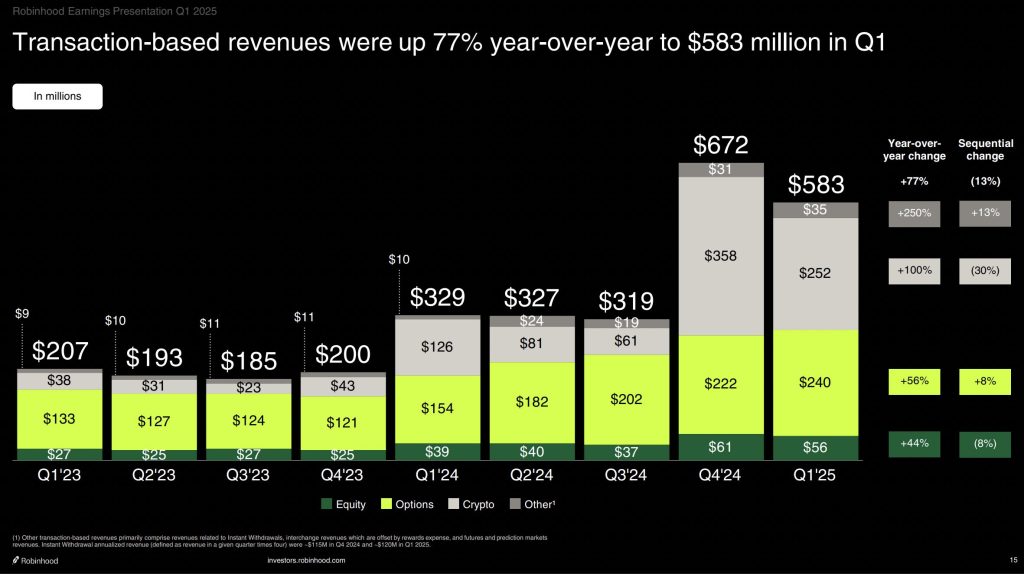
Crypto trading, particularly Bitcoin, was a big driver of growth. Despite market volatility, crypto transactions remained strong—a trend that’s been crucial for Robinhood’s success. CEO Vlad Tenev said that while the company continues to rely on crypto volumes, it’s working to diversify beyond that. Over time, Robinhood plans to make the crypto side of its business less dependent on transaction volumes. “We’re focused on diversifying the business outside of crypto,” Tenev said during the earnings call. “This will make us less reliant on crypto transaction volumes in the future.”
But it wasn’t just crypto that fueled Robinhood’s success. The company also saw impressive growth in options and equities trading. Revenue from options jumped 56%, while equities grew by 44%. Net interest revenue, which mainly comes from margin investing, jumped 14% to $290 million. Robinhood’s platform assets rose by 70% year-over-year, reaching $221 billion, with record net deposits of $18 billion. Tenev pointed out that customers are not only trading more, but they’re also entrusting Robinhood with more of their assets. The company’s net income for the quarter hit $336 million, or 37 cents per share, compared to $157 million, or 18 cents per share, last year. Analysts had forecasted a profit of 33 cents per share.
This strong performance came despite the ongoing trade tensions between the US and China, which kept markets on edge. The first quarter was marked by significant swings in both stocks and crypto prices, largely due to President Donald Trump’s trade policies. While some markets have started to recover from the losses in April, the uncertainty continues, creating opportunities for platforms like Robinhood to succeed in the current volatile environment.
Robinhood Posts 50% Jump in Q1 Revenue as Crypto Business Doubles from Last Year
In a notable development in the financial sector, Robinhood, the popular trading platform known for its commission-free trading model, has reported a staggering 50% increase in revenue for the first quarter of the fiscal year. This surge in earnings can be largely attributed to a remarkable doubling of its cryptocurrency business when compared to the previous year. As digital assets continue to gain traction among investors, Robinhood is positioned to capitalize on this trend, reshaping its market strategy and expanding its user base.
Robust Q1 Performance
The first quarter results showcased Robinhood’s ability to navigate the choppy waters of the financial landscape, showcasing resilience amidst broader economic uncertainties. The company posted revenues of $441 million, significantly up from $294 million reported in the same quarter last year. Analysts had expected a more modest growth rate, but Robinhood exceeded these predictions, demonstrating the strength of its business model and the increasing appetite for both traditional and digital assets.
The key driver of this growth was undoubtedly the company’s burgeoning cryptocurrency segment. While Robinhood has long been associated with stock trading, its foray into the cryptocurrency market has proven to be a game-changer. The platform reported a significant rise in user engagement and trading volumes in cryptocurrencies, reflecting a broader trend as retail investors show heightened interest in digital currencies.
Doubling Down on Cryptocurrency
Cryptocurrency trading on Robinhood has been nothing short of explosive. The platform’s revenue from cryptocurrencies surged to $54 million, doubling from the same quarter in the prior year. This impressive growth underscores a significant cultural shift among investors, particularly younger millennials and Generation Z, who are increasingly looking to diversifiable portfolios that include digital assets.
The appeal of cryptocurrencies can be attributed to various factors, including the decentralized nature of digital currencies and the potential for high returns. Additionally, with Bitcoin and Ethereum continuing to hold their ground as the leading cryptocurrencies, more investors are eager to explore these assets. Robinhood’s seamless integration of cryptocurrencies into its existing trading ecosystem has simplified access for many individuals who might have otherwise faced barriers when looking to invest in digital currencies.
User Engagement and Market Trends
Robinhood’s user engagement metrics also paint a promising picture. The platform reported an increase in monthly active users, hitting 20 million, a notable rise from 17.3 million in the same period last year. This increase signifies not just an uptick in trading frequency, but also a growing community of retail investors who are increasingly becoming more involved in their financial futures.
One of the driving forces behind this growth has been Robinhood’s continuous emphasis on user experience. The platform has made substantial investments in educating its users about both traditional stock investments and cryptocurrencies. By creating an intuitive mobile interface, Robinhood has appealed to a demographic that values simplicity and accessibility. Features like instant deposits and user-friendly tutorials have lowered the entry barriers for novice investors, making the transition into both stock and crypto trading smoother.
With the increasing popularity of non-fungible tokens (NFTs) and decentralized finance (DeFi) platforms, Robinhood is also reportedly exploring new features that could cater to these growing segments. By potentially embracing these innovations, Robinhood could further solidify its position as a leader in the fintech space.
Competitive Landscape
Despite its success, Robinhood faces fierce competition in both the stock and cryptocurrency markets. Traditional brokerage firms and fintech disruptors are constantly evolving their platforms to attract retail investors. Platforms such as Coinbase, Binance, and traditional brokerages like Charles Schwab and Fidelity have made significant inroads in the cryptocurrency space, offering their users a suite of trading tools and features that could lure investors away from Robinhood.
To maintain its competitive edge, Robinhood will need to continuously innovate and respond to market demands. This includes expanding its cryptocurrency offerings, enhancing educational resources, and continuously improving customer service. The ongoing regulatory discussions also pose risks, as Robinhood must navigate the ever-evolving landscape of compliance in both stock and cryptocurrency trading.
Future Outlook
Looking ahead, Robinhood’s strong Q1 revenue growth bodes well for the company’s future trajectory. The increased consumer demand for cryptocurrencies is likely to persist, supplemented by increased mainstream adoption as institutional players continue to enter the market. If Robinhood can sustain its momentum and strategically adapt to emerging trends, the company may further solidify its position as a frontrunner in the financial technology space.
In conclusion, Robinhood’s significant revenue boost in Q1, fueled by its booming cryptocurrency business, serves as a testament to the changing landscape of retail investing. With the accessible and innovative nature of its platform, Robinhood is well-positioned to respond to market demands while continually enhancing its offerings. As the intersection of technology and finance grows increasingly intricate, Robinhood’s performance may serve as a bellwether for the broader trends shaping the future of investing. The road ahead promises both challenges and exciting opportunities for the company as it seeks to redefine the investment landscape.
Robinhood reported a 50% increase in Q1 revenue, driven by a significant surge in its crypto business, which has doubled compared to the previous year. This strong performance highlights the growing interest in cryptocurrency trading among retail investors, contributing to the platform’s overall revenue growth. The company’s continued focus on expanding its crypto offerings appears to be paying off, reflecting a positive shift in the trading landscape.