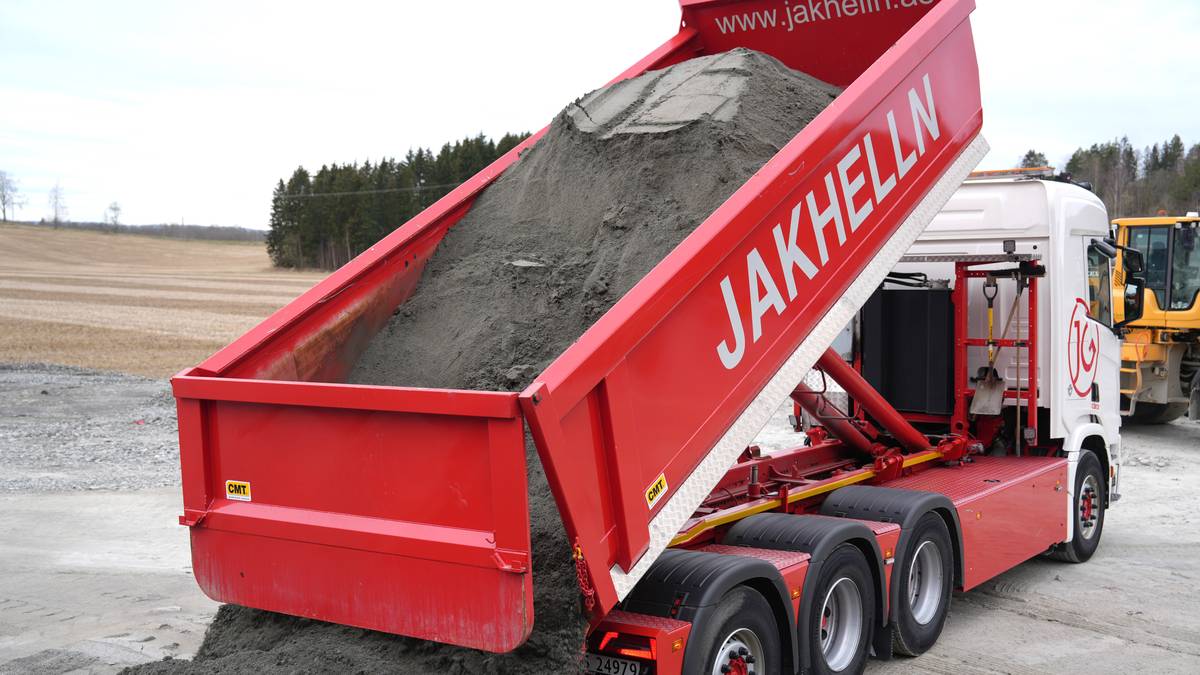
The case summarized: The Norwegian Truck Owners Association wants to increase the load volume of trucks, which they believe can reduce CO2 emissions by 170,000 tonnes annually. The Road Directorate is against the proposal, as they believe many bridges do not withstand increased weight. The Road Directorate also believes that increased load will slow down the phasing in of zero emission cars. A new transport regulation is expected after Easter, and the truck owners’ association hopes the Road Directorate will change its attitude. The summary is made by a Ki service from Openai. The content is quality assured by news’s journalists before publishing. The wheel loader dumps another drawer with sand on the loading plane. Then the truck drives off. But the Norwegian Truck Owners Association will increase the size of the cargo. Specifically with one and a half drawers mass more on each load. Knut Gravråk is the CEO of the Norwegian Truck Owners Association. Here in conversation with truck owner Nikolai Jakhelln. Photo: Eirik Thormodsrud Koren / news If they had been allowed to do so, CO₂ emissions could have been reduced by 170,000 tonnes, which corresponds to 85,000 cars a year, the association believes. – It is without spending a single penny. It is socio -economically and business -economically profitable, states the CEO of the Association, Knut Gravråk, stated. Think the bridges do not tolerate the weight but then the rules must be changed. However, the Road Directorate does not want it. They think too many bridges are simply not strong enough to withstand the weight. Haaken Gran, senior advisor in the Road Directorate. Photo: Eirik Thormodsrud Koren / news – Should we update the road lists and allow all desired combinations on roads except the bridges that do not withstand the wagon weight, this will mean that they will have to drive outside all the bridges in BK10 / 60 road network, Haaken Gran, Gran, Senior Advisor in the Road Directorate. He says that if you give higher weights, or it must be reconsidered or repaired, it will amount to large costs. The truck owner Nikolai Jakhelln understands little about it. – We are pretty much used to run after what is called road list. Today, the truck drivers have a habit – and are familiar with – driving around bridges that cannot withstand the weight of the car and the cargo, the driver points out. – On the road list there are restrictions on tonnage around the different roads. So I also don’t see that there will be a big problem, Jakhelln points out. The truck owners’ association says it is socially economically profitable to increase the load. Photo: Eirik Thormodsrud Koren / news For this, Gravråk says in the Road Directorate: – Regardless of the alternative, this will make the regulations unclear and provide a little appropriate breakdown of the road network. Besides, it is not certain that there will always be suitable detours. – Biogas, biodiesel or electricity do not matter in 2030, all new trucks will be electric. 50 per cent of the transport industry will be emission-free in 2030-so they will reach the target in Klimaplan for 2021-2030 (Meld. In addition, a number of target figures have been set for new zero -emission vehicles, see, among other things, the government’s climate status and plan. These say that: New passenger cars and light vans should be zero -emission vehicles in 2025. New city buses will be zero -emission vehicles or use biogas in 2025. By 2030, new heavier vans, 75 per cent of new long -distance buses and 50 per cent of new trucks are zero -emission vehicles. By 2030, the distribution of goods in the largest urban centers will be almost zero emissions. Improvements of technological maturity in the vehicle segments, so that zero -emission vehicles become competitive with conventional solutions are the basis for the targets. The government presented climate status and plan for the first time in the fall of 2022 together with the state budget for 2023. This is a plan that will be updated annually. The purpose of presenting a climate status and plan with the state budget is to connect the emission budget with the state budget, so that we can control more efficiently against the climate goals in 2030. Source: The Government in a few weeks will be the new transport regulations. And although increased cargo could result in an immediate CO₂ reduction, the Road Directorate believes that it will slow down the phasing in of zero -emission vehicles in the future. Nikolai Jakhelln says they drive around the bridges that cannot withstand the weight of the vehicles. Photo: Eirik Thormodsrud Koren / news – That’s what we assume based on the figures available and the assessments given, explains Haaken Gran in the Road Directorate. Jakhelln does not see how increased loads for all trucks will slow down the phasing in of zero -emission cars. – We want to use the vehicle we have available. Whether it goes on biogas, biodiesel or electricity does not matter to us, he says. Expect results Recently, there was a seminar on increased weights, with broad representation from the industry and the authorities. The case is described in this note on the Roads Administration’s website. The regulations are expected shortly. The truck owners’ association still hopes that the Road Directorate is turning. – It is incomprehensible if you do not grab the opportunity when you now have it. We expect this to produce results when the Roads Administration has finished processing the consultation, concludes Knut Gravråk. Published 28.04.2025, at. 17.29
ttn-69