

What factors are contributing to the renewed relevance of Bitcoin as digital gold? How has the correlation between Bitcoin and traditional equities changed recently? In what ways are current economic conditions influencing investor behavior toward Bitcoin and gold? What does Cathie Wood mean when she describes Bitcoin as a ‘much bigger idea than gold’? How are cryptocurrencies like Bitcoin distinct from gold in terms of usability for transactions?
Once a dominant theme in the early years of Bitcoin, the digital gold thesis had faded—but current market conditions may be giving it renewed relevance. The US-China trade war, coupled with rising recession odds in the US, is fueling a shift in sentiment as investors look to hedge against economic uncertainty. BTC displays growing maturity as a global asset, becoming “less Nasdaq—more gold” over the past two weeks, according to Nansen CEO Alex Svanevik.
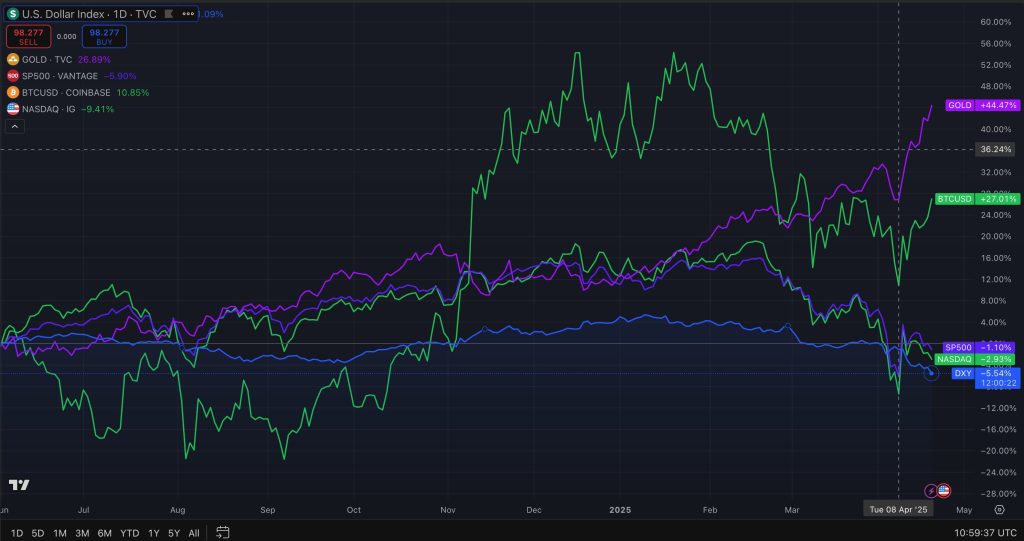
Bitcoin staged a 20% recovery in the two weeks leading up to April 22, closely mirroring gold’s rise to $3,500 despite ongoing tariff escalation between the world’s largest trading nations. Bitcoin’s historic correlation with U.S. equities may be loosening, replaced by a stronger alignment with gold.
Why BTC is Gaining Safe-Haven Appeal
The tariff-driven trade wars have sparked fears of inflation and currency devaluation, prompting investors to pivot toward alternative stores of value like gold and Bitcoin. These concerns have deepened as the U.S. dollar faces downward pressure amid growing expectations for interest rate cuts. Corporations and consumers generally favor low interest rates for their borrowing advantages, but there’s a tradeoff. As U.S. President Donald Trump continues to push for aggressive rate cuts from Fed Chair Jerome Powell, inflation risks are resurfacing.
While such policies may stimulate short-term growth and market enthusiasm, they come at the potential cost of unchecked inflation and long-term currency weakness. The result? A wave of capital flight out of U.S. dollars and Treasuries and into global safe havens like gold, European bonds—and increasingly, Bitcoin.
Bitcoin’s emerging role in this rotation shows its evolution into a macro hedge, as global capital begins to treat it more like digital gold than a speculative tech play.
Bitcoin is a ‘Much Bigger Idea Than Gold’
In January, ARK Invest founder Cathie Wood described Bitcoin as a “much bigger idea than gold,” citing its potential to gain from gold’s $23 trillion market. Others believe that gold and Bitcoin should not be seen as competitors because the assets are different in their nature and have different missions.
Unlike gold, cryptocurrencies like Bitcoin can be used for payments. The post Is Bitcoin the New Gold? 20% Surge Breaks Its Nasdaq Ties appeared first on Cryptonews.
Is Bitcoin the New Gold? A 20% Surge Breaks Its Nasdaq Ties
In recent years, Bitcoin has been the subject of intense debate among investors, analysts, and financial institutions. Often dubbed "digital gold," Bitcoin has emerged as a potential alternative to traditional safe-haven assets like gold. The discussion has gained even greater traction following a notable 20% surge in Bitcoin’s price, a movement that analysts suggest could signify a broader separation from its historical correlation with tech stocks represented by indices like Nasdaq. This article delves into the ongoing debate of whether Bitcoin is indeed the new gold and examines the implications of its recent price surge.
Bitcoin’s Unique Position in the Market
Bitcoin was introduced to the world in 2009 as an innovative digital currency designed to operate outside the traditional banking system. It is decentralized, secured by cryptography, and exists on a blockchain, a public ledger that logs every transaction. Its finite supply of 21 million coins sets it apart from fiat currencies, which can be printed at will by central banks. This scarcity contributes to its appeal as a store of value, akin to gold.
The similarities between Bitcoin and gold extend beyond scarcity. Historically, when economic uncertainty or geopolitical tensions arise, investors tend to flock to gold as a safe asset, leading to price surges. This characteristic has led many to believe that Bitcoin could fulfill a similar role—serving as a hedge against inflation and economic instability. Yet, the cryptocurrency’s volatility poses a significant hurdle for its recognition as a stable asset.
The Stirrings of Separation
In recent months, Bitcoin’s dramatic price movements have prompted analysts to reconsider its correlation with technology stocks. When considering Bitcoin’s historical trajectory, it often exhibited a close relationship with the Nasdaq Composite Index. However, the recent price surge, compounded by institutional adoption and increased interest from retail investors, signals a potential shift in this dynamic.
On [insert specific date], Bitcoin experienced a remarkable 20% price surge, breaking away from its previous correlation with Nasdaq. This spike was attributed to several factors, including favorable regulatory news in the cryptocurrency space, increased acceptance from major financial institutions, and a growing sentiment among investors that digital assets hold the potential for long-term growth. Such movements have led some analysts to propose that Bitcoin is evolving toward becoming a distinct asset class rather than merely an extension of technology stocks.
Bitcoin vs. Gold: Similarities and Differences
While comparing Bitcoin to gold, it’s essential to appreciate both the strengths and weaknesses of each asset. On one hand, Bitcoin offers advantages such as portability, divisibility, and ease of storage, making it more accessible for everyday transactions compared to physical gold. Additionally, Bitcoin operates on a decentralized network that enables peer-to-peer transactions without the need for intermediaries.
On the other hand, gold benefits from a long-standing history as a reliable safe-haven asset. For centuries, it has been a store of value and a medium of exchange, deeply rooted in nearly every culture. Gold’s established status lends it a level of trust and stability that Bitcoin has yet to fully achieve. Moreover, gold is less volatile than Bitcoin, which has experienced dramatic price fluctuations, leading some investors to consider it a risky investment.
The Broader Implications of Bitcoin’s Surge
The recent surge in Bitcoin’s price could represent several broader trends in the market. For one, it suggests a greater acceptance of cryptocurrencies among investors, as both retail and institutional players increasingly consider digital assets part of their portfolios. The rise of Bitcoin ETFs (exchange-traded funds) and other investment vehicles that facilitate exposure to cryptocurrencies further solidifies this trend.
Moreover, the surge could pave the way for Bitcoin’s integration into the traditional financial system. As regulatory frameworks become clearer and more supportive of cryptocurrencies, an increasing number of financial institutions are likely to seek ways to incorporate Bitcoin and other digital assets. In this context, Bitcoin’s distinction from tech stocks may enhance its appeal to investors seeking diversification.
Conclusion: Bitcoin’s Future as Digital Gold
The ongoing debate regarding Bitcoin as the new gold encapsulates the complexities of modern financial markets. While the recent 20% surge shows promise for Bitcoin’s evolution, it remains to be seen if it can fully establish itself as a stable store of value. As more investors look to diversify their portfolios and hedge against inflation, will Bitcoin solidify its position alongside gold, or will it continue being viewed as a speculative investment?
In the end, Bitcoin’s ascent seems inevitable, but its journey will not be without challenges. Its current separation from the Nasdaq may signal a turning point, but whether it can uphold the stature of being the new gold will depend on acceptance, regulation, and stability in the evolving financial landscape. For now, the world watches closely as Bitcoin continues to navigate its path and shape the future of investments.
The recent surge in Bitcoin’s value, marked by a 20% increase, has reignited discussions about its status as a digital asset comparable to gold. Historically viewed as a safe-haven investment, gold has long been the go-to asset during times of economic uncertainty. However, Bitcoin’s rising popularity and perceived value have led many to draw parallels between the two.
This spike in Bitcoin’s price coincides with various factors, including increased institutional investment, favorable regulatory developments, and a growing acceptance among the general public. Additionally, as central banks around the world continue to implement expansive monetary policies, concerns about inflation have prompted investors to seek alternative stores of value.
The correlation between Bitcoin and traditional assets like those in the Nasdaq has been noteworthy, but the recent break in this relationship suggests a potential shift in market dynamics. If Bitcoin continues to establish itself as a viable alternative to gold, it could redefine investment strategies and the landscape of asset allocation.
In conclusion, while Bitcoin’s rise raises intriguing questions about its role in the financial ecosystem, its future as the “new gold” remains to be seen. Ongoing market developments and investor sentiment will play crucial roles in determining whether Bitcoin can sustain its newfound status or if it will revert to being viewed strictly as a speculative asset.