

What specific strategies are UK authorities implementing to combat crypto-related crimes? How significant is the £1.5 million freezing order in the context of overall crypto seizures? What impact might the proposed Crime and Policing Bill have on future law enforcement actions against illicit crypto activities? How have law enforcement’s capabilities evolved since April last year regarding suspicious crypto wallets? What insights does legal expert Nick Barnard provide on the financial figures related to crypto freezing orders?
UK police and other authorities have frozen about £6 million ($7.76 million) in crypto obtained from ill-gotten gains since 2024. Per an investigation by MailOnline, these cryptos have been frozen by the court since the new enforcement powers last year. The UK police, ministers, law enforcement, and the HMRC launched a crackdown on the ‘emerging threat’ last April. This led to the freeze of suspicious crypto wallets.
Largest Single Freezing Order of $1.94M Worth Crypto
Per the new enforcement rules, suspicious crypto wallets can be frozen for a period of up to three years. Further, court documents revealed that in the last six months, the largest single freezing order was for £1.5 million ($1.94 million) worth of cryptos held in a Coinbase-hosted single wallet.
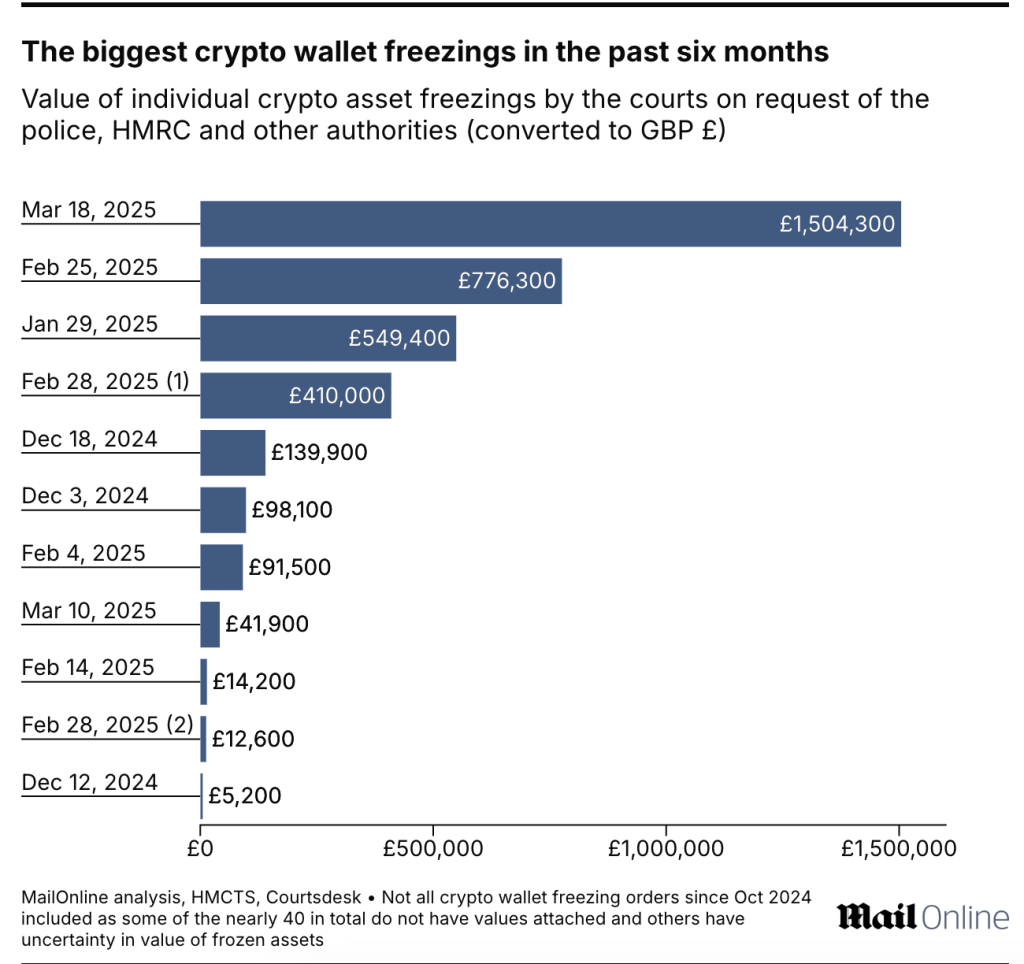
The UK HMRC filed the order on March 18 at the Newcastle Upon Tyne Magistrates’ Court.
According to crypto legal expert Nick Barnard, partner at Corker Binning, the figures are not that big “in the grand scheme.” He added that last April, the new regime came from a “standing start” and it would require time to “get up to speed.”
The UK government has been directing more resources into freezing crypto. It is “aggressively” combating money laundering, lawyer Siobhain Egan, director of Lewis Nedas Law, told MailOnline. “We are fully expecting for a tsunami of crypto freezing orders down the track,” the lawyer added. “If [police] have a major investigation into organised criminals laundering money through crypto, they will go in and seize the assets before they finalise the investigation.”
Last week, the UK proposed the Crime and Policing Bill, a legislative proposal designed to strengthen law enforcement’s ability to confiscate illicit crypto proceeds. Further, the country has been tightening its oversight of digital assets over the past year. The Financial Conduct Authority (FCA) proposed stricter crypto regulations in December 2024, to mitigate risks within the sector.
Lawyer Egan noted that the UK authorities took “a little while to catch up” in the fast-moving area. “HMRC is very keen on it for tackling tax evasion and are getting their act together pretty well,” she added. “The National Crime Agency (NCA) has also been very aggressive.”
The post UK Authorities Have Frozen $7.7M in Crypto from Ill-Gotten Profits Since Last Year: Report appeared first on Cryptonews.
UK Authorities Have Frozen $7.7M in Crypto from Ill-Gotten Profits Since Last Year: Report
In a notable advancement in the fight against financial crimes, UK authorities have frozen approximately $7.7 million in cryptocurrency linked to illicit activities over the course of the past year. This move underscores the growing sophistication of law enforcement agencies in adapting to the rapidly evolving world of digital assets, which has increasingly become a playground for money laundering, fraud, and other criminal activities.
The Rise of Cryptocurrency and Financial Crime
Since the advent of Bitcoin in 2009, cryptocurrency has garnered significant attention not only for its potential to revolutionize traditional financial systems but also for its allure to criminals. The anonymity and decentralization inherent in many digital currencies have rendered them attractive for various illicit transactions, from drug trafficking to ransomware attacks. According to reports, criminals are increasingly utilizing cryptocurrency due to its perceived obscurity and the challenges law enforcement faces in tracing such digital assets.
In embracing cryptocurrencies, the UK has emerged as a leading global financial hub, promoting financial technology and innovation. However, this growth has also seen a corresponding rise in financial crimes involving cryptocurrencies. Hence, UK authorities have come under additional pressure to address and mitigate these risks while ensuring that legitimate users can reap the benefits of innovation in digital finance.
How the Freeze Operates
The freezing of funds by UK authorities is achieved through a combination of legislation, sophisticated technological tools, and cross-border cooperation with other law enforcement agencies. The Proceeds of Crime Act (POCA) is often invoked, allowing for the seizure of assets deemed to be connected to criminal activities. Once authorities identify suspicious activities or transactions involving cryptocurrencies, they can act quickly to freeze these assets, preventing their movement and potential conversion to fiat currencies.
One key aspect of this process lies in blockchain’s transparency—the foundation of most cryptocurrencies. While the identities of individuals may remain pseudonymous, every transaction is logged on a public ledger. This allows for forensic analysis and, ultimately, the tracing of funds back to their illicit origins. By working closely with blockchain analytics firms, UK law enforcement can leverage advanced tools to scrutinize cryptocurrency transactions, identify patterns of criminal behavior, and establish a comprehensive understanding of how funds are being laundered or utilized in illegal activities.
Case Studies: Major Operations and Outcomes
Over the past year, several significant operations conducted by UK law enforcement agencies have highlighted the effectiveness of cryptocurrency tracking and freezing illicit profits. For example, one high-profile case involved a group allegedly engaged in a multi-million-pound fraud scheme that exploited victims through phishing attacks and online scams. Utilizing blockchain tracking technology, investigators were able to trace the flow of funds and ultimately freeze a substantial amount of the fraudulently obtained cryptocurrency.
Additionally, partnerships with international enforcement agencies enabled UK authorities to recover and freeze assets that crossed borders, implementing a collaborative approach essential in combating global financial crime. These operations demonstrate how digital enforcement strategies can be effective, with authorities not only freezing assets but taking steps toward convicting offenders and retrieving funds for victims.
Legislative and Regulatory Framework
The freezing of $7.7 million in crypto by UK authorities has spurred discussions around the need for robust legislation and regulatory policies in the ever-evolving crypto landscape. The UK government has been proactive in establishing a framework that offers clarity and guidance for businesses and consumers while ensuring the financial system remains safe from criminal infiltration.
The recent implementation of the Financial Action Task Force (FATF) recommendations on anti-money laundering (AML) practices for digital assets has further propelled the need for stringent regulations. The UK’s proactive measures to incorporate these guidelines into their legislation aim to mitigate risks associated with cryptocurrency while allowing legitimate use cases to flourish.
Moreover, the recent "Online Safety Bill" debates underscore the importance of companies maintaining strong compliance measures and ensuring they have adequate systems in place to monitor transactions and report suspicious activities to authorities. This development reflects the dynamic nature of regulatory approaches to technology-driven financial systems and the increasing obligations placed on firms operating within these spaces.
Looking Ahead: The Future of Cryptocurrency Regulation
As cryptocurrency continues to grow both as an asset class and a method for illicit financial activity, the role of UK authorities in addressing these issues will be paramount. The frozen $7.7 million serves as a warning to potential offenders that authorities are not only tracking illicit funds but are ready to act decisively.
It is essential that as regulations evolve, they strike a balance between fostering innovation while effectively controlling potential misuse. Transparency, cooperation, and technological advancement will be key ingredients to combat financial crime in the cryptocurrency space—a challenge that UK authorities are meeting head-on with their recent actions. As the world of digital finance continues to develop, the outcomes of these regulatory frameworks will reshape the future of both cryptocurrency and financial compliance globally.
UK authorities have reportedly frozen $7.7 million in cryptocurrency linked to profits gained through illegal activities since the previous year. This action is part of a broader effort by law enforcement to combat crypto-related crime and ensure that illicit gains are not easily converted into legitimate assets. The move highlights the increasing scrutiny and regulatory measures being applied to the cryptocurrency sector as authorities seek to crack down on money laundering, fraud, and other unlawful activities facilitated by digital currencies. The frozen assets represent a significant step toward holding individuals accountable and safeguarding the integrity of financial systems.