
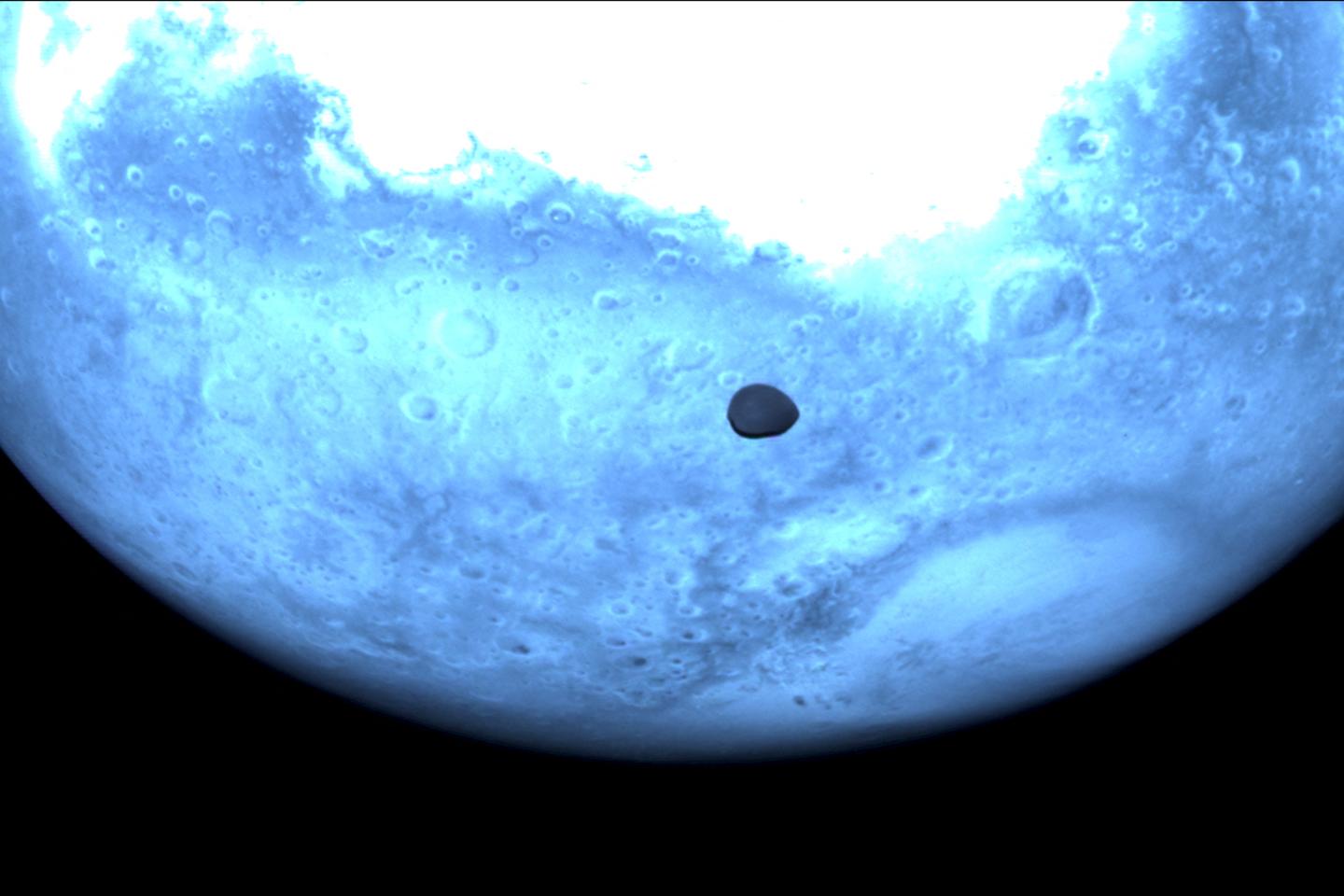
On the way to the asteroid Dimorphos, the Hera probe carried out a close -up of Mars, capturing rare images of its moon Deimos, the European Space Agency (ESA) announced on Thursday March 13. Launched in October, Hera will not reach its final objective – located 11 million kilometers from the earth, in the asteroid belt located between March and Jupiter – that at the end of 2026. In the meantime, it came close to the Red Planet on Wednesday to benefit from gravitational assistance.
Using the severity of the planet, “We have given an acceleration to the probe, thus modifying its trajectory while saving a lot of fuel”explained Pablo Munoz, analyst of the mission, at a press conference.
The probe approached up to 5,600 kilometers from the Martian surface at dizzying speed of 33,480 kilometers per hour for about sixty minutes. Which also allowed him to test his instruments. And in particular to take some 600 photos, including rare images of the face opposite to Mars of one of his two moons, Deimos. The small satellite with irregular shapes, about 12.5 kilometers in diameter, appears dark, contrasting strongly with the appearance of its planet.
The origin of Martian moons
The origin of the Martian moons, Deimos and Phobos, remains subject to debate. Some scientists argue that these are captured asteroids, “But it’s difficult to explain from a dynamic point of view”recalled Stephan Ulamec from the German aerospace center. Others think they come from a massive impact, “But that does not agree with the observed spectra either”.
Before the launch of specific missions to study them, the images taken by Hera will allow“Add a new piece to the puzzle”according to Marcel Popescu, of the University of Craiova, in Romania. In particular those taken thanks to the Tiri infrared imaging and Hyperscout, a spectrograph in the near infrared – which explains that Mars appears blue there. They will allow you to better understand the thermophysical properties and the composition of Deimos … before unraveling the mysteries of Dimorphos.
Study the mysteries of the Dimorphos asteroid
Hera’s mission is to study this little asteroid, deliberately struck in 2022 by a NASA vessel to deflect its trajectory. The probe will observe the consequences of the impact, which has reduced the orbit of this body of 160 meters in diameter by thirty-three minutes which forms a binary system with a larger asteroid called Didymos.
The objective is to assess whether such a technique would be effective in the future to divert an asteroid that would threaten the earth. Faced with this natural risk, space agencies are working to set up a system of “Planetary defense”one of the other aspects of which is a global follow -up, coordinated to detect as soon as the asteroids may be dangerous.
The world purchasing guides
Robot vacuum cleaners
The best robot vacuum cleaners
Read
This is what happened last December with the discovery of YR4, whose probability of collision with Earth in 2032 briefly reached 3.1 % before falling back to zero.
“It is a scheme that we will see more and more often in the future”warned Richard Moissl, chief of the planetary defense office of ESA. “With the increase in surveys, we will discover more asteroids”which will lead to more cases in which the probability of impact will climb, before falling from zero with more precise observations.
The ESA develops a second planetary defense mission in order to observe Apophis, an asteroid 350 meters in diameter, which will pass only 32,000 kilometers from the earth on April 13, 2029 and will then be visible to the naked eye.
Subject to approval by the ESA ministerial council, Ramses should take off in 2028 to reach the asteroid two months before his approach to the earth and observe the effects that earthly attraction exerts on him.