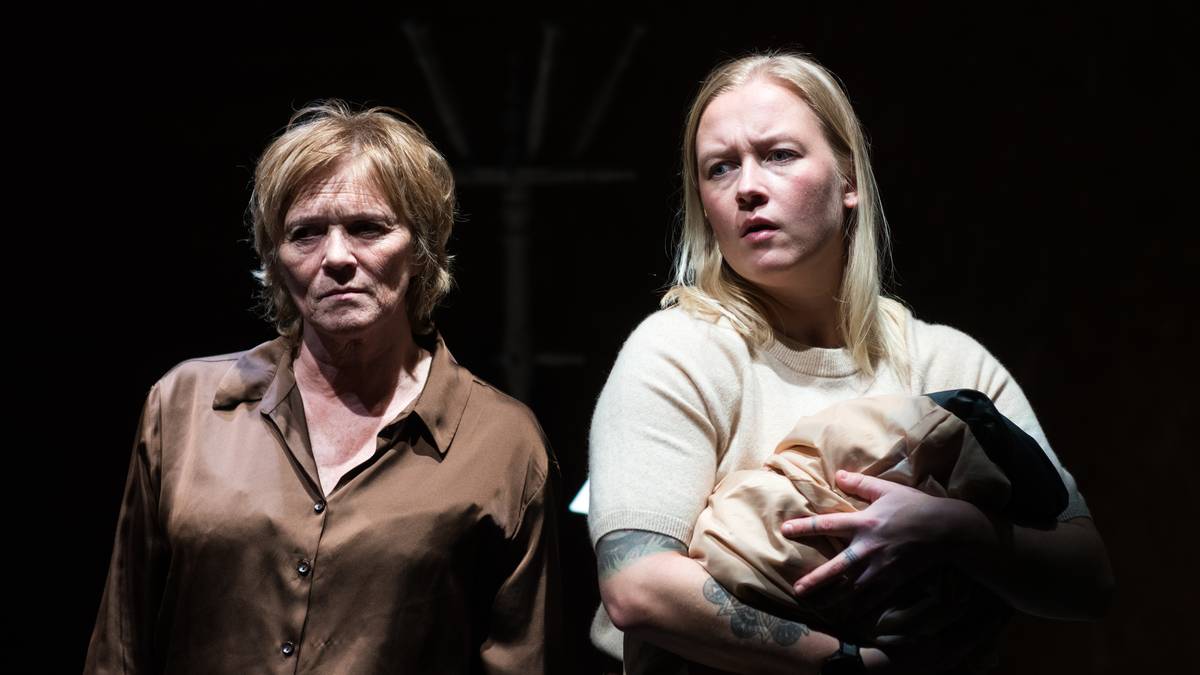
Luje Teksti Kvääniksi. It is historical when an entire theater performance in Kven for the first time is set up in Norway. The premiere of the National Theater was guest playing by Kväänitatteri, who will now in March tour theater scenes in Troms and Finnmark. The newly written performance – the Sallikaa cargo Tulla Minun Tykö “, or” let the young children come to me ” – is about a woman’s connection to and detachment from the northern fundamentalist religion Leststadianism. Leststadianism Conservative Christian movement that started around the Swedish-Sami priest Lars Levi Læstadius in the mid-1800s. Pietist rules with a ban on smoking, alcohol, dance etc. in Norway particularly widespread in Northern Norway and in many Sami communities. Many Kven were also active Leststadians, and emphasis was placed on using the mother tongue when preaching and prayer. Belongs to the church, but in some places have their own communion, baptism and confirmation. Sources: UiT, large Norwegian lexicon, Wikipedia It is no coincidence that the play has its premiere on women’s day. Here is portrayed a woman who has lost her famous fellowship and been sentenced to eternal perdition, and still stands straight in the back. A women’s life in the play we follow this woman, from the age of 13 and at the Leststadian big collection alone for the first time, until she as an adult is in bed next to her nineteen -year -old pregnant daughter. It alternates between the present, where the woman, played by Inger Birkelund, looks back on her life. And past, where as a young woman, she played excellent by Frida Lydia Hansen Virtanen, goes through both love, despair, liberation and grief. Symbol-heavy shot: Already when the girl (here played by Frida Lydia Hansen Virtanen) as a 13-year-old refuses to use the shot when she goes to the Leststadian collection, we see that this is a woman who will go her own way. Ørjan Steinsvik plays aunt in this scene. Photo: Ola Solvang together with her on stage they have Ørjan Steinsvik. With the help of simple costume concepts, he convinces, among other things, cold and damn mother -in -law, cool guy with leather jacket and sulfur preacher. Much to flap the almost crowded hall on the National Theater’s Amphiscene calms down when the play begins with Frida Lydia Hansen Virtanen (the young woman) calm climate on one of the two pianos on stage. Inger Birkelund (the elderly woman) starts on her monologue and Ørjan Steinsvik sits in an armchair from the seventies on the opposite side of the virtuese stage. Well -functioning alternations: the older woman (Birkeland) alternates between observing the younger version of herself, being involved in the scenes and in monologues look back on their lives. Photo: Ola Solvang The first thing that strikes me is that the scene seems so big. I don’t quite understand how to deal with all the elements: the actors so far apart, the scenography, the monologue, the piano game, and the texting to Norwegian on the black wall behind the stage. With both Kven, Sami and Norwegian relatives, where the Kven is what has gained the least space in my life, this stirs the historical play in my own thoughts on identity as well. I want to know more of the language, but despite school hours and studies in both Finnish and Kven cultural knowledge, I have to realize my own limitations, set aside the language care aside, and keep up with the Norwegian texting. When the monologue is over and the actors begin to interact with each other, the stage floor feels less. My gaze now switches automatically between what is happening on the stage floor and the Norwegian text, I only needed for a moment to get into it. The role of Inger Birkelund (who is also a screenwriter) is text -heavy, and it feels like it lugs a bit in the monologues. Is it premier reserves, or is it the woman’s uncertainty about the life choices portrayed? Whatever the cause, it gives a depth where she stands straight and looks back on the difficult. Let the young children come to me, just not the sinful in the play we see how a young, unmarried couple meets by family and congregation when they become pregnant and have children, and how this affects their lives. The title of the play, which is also words from the Bible, let the young children come to me, are in stark contrast to how the newborn child is welcomed by his own grandparents and the congregation. SHAME AND SIME: The young couple, played by Ørjan Steinsvik and Frida Lydia Hansen Virtanen, try to stick together, but Børa and the shame will be too heavy to carry. It is a pity to have children out of wedlock, it is a pity to divorce, and an even greater sin to remarry. With the divorce comes the shame, and the loss of something greater than the marriage itself, the loss of the unity congregation gives and missed after the fine hymn song. Photo: Ola Solvang stage where the young mother, played by the virtan, stands with her three -week -old child in the embrace and is thrown to the door of her permanent mother -in -law, without the support of her silent cohabitant, is heartbreaking. Both because you feel with the young couple, but also because you understand that the in -laws – who genuinely fear that living in sin leads to you hell – even risks being ostracized from the congregation if they house sinners. This will be a decisive moment in the community of the young couple. And shows how the man’s emotional absence, effectively shown with an empty chair on the stage, has consequences for the relationship. Humor as a protective factor The exchanges are often made with a comic expression, which when Ørjan Steinsvik demonstratively pulls the shawl down his shoulders as an ice -cold mother -in -law. These moments dissolve in the seriousness. I recognize this from the fact that there can be an extra need for humor when living as a minority, with all the challenges it entails. The fact that humor is used in the treatment of a topic such as social control does not weaken the seriousness behind it. It is rather a strength. Hymn song that touches: You do not have to be believed to be affected by the hymns and piano playing in the play, it is beautiful, it brings memories and works very well to set the mood. From left: Inger Birkelund, Frida Lydia Hansen Virtanen and Ørjan Steinsvik. Photo: Ola Solvang locally and universally Although history is added to Yykeänperä/Ivgobahta/Skibotn and a Leststadian environment, the topic is universal: having to make a choice that makes you lose the unity of the community you belong to is difficult – whether it is to leave a religious community or a local environment or a breakup. The divorce is so well written and played that I recommend you bring a handkerchief, if you do not want to do like me and wipe the snot and tears on your blouse. This is a painful and realistic theater piece, with fun comical liberating moments, about freeing yourself from society’s expectations. You do not need a minority, understand Kven, have left a religious community or become a teenage mother to be moved by the “Sallikaa cargo Tulla Minun Tykö”. If you are not the type that is emotionally moved, then the performance will at least give you an important piece of cultural knowledge about one of the country’s national minorities. The piece concludes with the virtue, which plays the young version of the woman, sings one of the most beautiful hymns I know of, “My Heart Always Work,” with an incredible presence. I leave the National Theater emotionally battered. Tour dates March 15: Halti Kulturscene, Storslett 18 March: Hålogaland Theater, Scene Øst – Tromsø 19 March: Hålogaland, Scene East – Tromsø 20 March: Solhov, Lyngen 21 March: Center for northern people, Manndalen 27 March 27 March: Flerbrukshuset, Burfjord 28 March: The Sami National Theater Beaivváš, Galba – Kautokeino about the performance Title: “Sallikaa Lasten Tulla Minun Tykö” Title in Norwegian: “Let the little children come to me” is played in Kven. Text to Norwegian. Premiere: The National Theater, Oslo 8 March 2025 Duration: 1 hour and 10 minutes contributing: Inger Birkelund, Ørjan Steinsvik, Frida Lydia Hansen Virtanen. Manus: Inger Birkelund Directed by: Wessel de Vries Dramaturgy: Teodor Janson Music: Frida Lydia Hansen Virtan Costume Design: Nora Furuholmen Light Design: Hendrik Walther Language Consultant: Anna-Kaisa Raisinen “Sallikaa Lasten Tulla Tulla” Minority Languages A Voice »Published 12.03.2025, at. 16.50
ttn-69