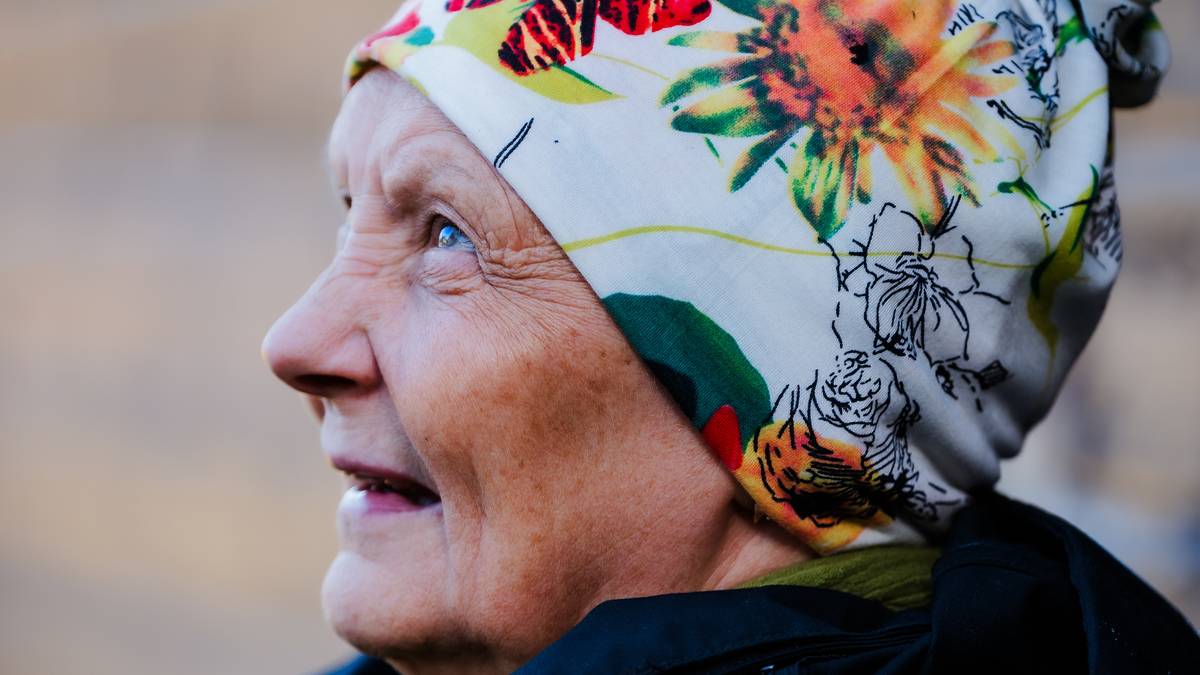
Loga sámegillii. Inga Ravna sits bare-chested in front of the photographer. This should be a tribute to a part of her femininity. The photographer is a dear family member. Her sister’s grandson. In Sami culture, it means that she is also his grandmother. He takes pictures, while she cries and feels the sadness of what lies ahead. She has her boyfriend with her as support. She wonders what her boyfriend and the photographer are thinking, while she cries through the session. Then she gets to see the pictures. They are exactly how she wants them to be. Like a 75-year-old woman’s relationship with her own breasts. One last time. Soon the breasts will be cut away. Grateful Dánil Røkke is the photographer behind the picture. He grew up as Inga Ravna’s grandson, or “áhkkuba” as it is called in Sami. He himself refers to her as “Inga-áhku/grandmother Inga”. When he was asked if he could photograph “Inga-áhku’s” breasts, he understood that it meant a lot to her. – For me it was a “no-brainer” to say yes, I thought that it might be easier for her when it is a close person who takes the photos, says Dánil. news spoke to Dánil in his own photo studio in Alta, where he photographed Inga Ravna. Photo: June Grønnvoll Bjørnback / news He understands that it was a difficult thing to ask, and does not think he would be able to do the same. – I think it was very hard done by her. It was an important matter for her to overcome her situation, he says. He describes the photography as a strong and beautiful experience. – It was important to me that she should get this, so I am very grateful that she asked me. Dánil Røkke Grandchild/photographerPhoto: June Grønnvoll BjørnbackPhoto: June Grønnvoll Bjørnback Break in self-esteem If Inga Ravna is to have a chance to live, her breasts must away. – You have no idea how much I cried on behalf of my breasts, she says. She has breast cancer. It not only creates a fear of dying, it gives an enormous spectrum of bad thoughts and feelings. – I felt a great sadness. The breasts are an important part of the female body, and important for a woman’s self-esteem, she explains. Who would have thought that removing the breasts in favor of a hope of life would be so difficult. Photo: June Grønnvoll Bjørnback / news The psychological burden is tough, and the sense of self takes a hit. “Is my boyfriend going to leave me now?” she wonders. – These are the kinds of thoughts you get, says Inga Ravna. Then comes the day she has been dreading. The terrible day when she will lose a part of her womanhood. Too old for silicone When Inga Ravna wakes up in hospital, she is flat-chested. She can hardly believe it. But yes. The breasts are cut away. She has not had high thoughts about silicone and plastic surgery. – I have been against it in the first place. And now I’m there myself, she says. She meets herself at the door, because she wants to feel at home in her own body. – When you lose both breasts and then lose your hair, the visible part of being a woman – it’s very tough, she emphasizes. During the Pink Bow campaign in October, Inga Ravna received a Pink Bow designed by Sami artist Brita Marakatt-Labba. She is happy that the breast cancer case is well highlighted. Photo: June Grønnvoll Bjørnback / news Already before the operation, Inga Ravna asked that she should get silicone. The first response she received was that she is too old. She did not agree to that. “For all these years I have had these breasts. And for the rest of their lives, there must be something to replace them. If I only live another month,” she said. So then there were new breasts, in the form of silicone. Common symptoms of breast cancer Coolness or swelling in the breast Coolness or swelling in the armpit Indentation or indentation of the skin on the breasts Nipple that pulls in or points in a different direction than usual Redness or other discoloration of the skin on the breasts Rash-like changes in the skin on the breasts or nipples Thickening of the skin or orange skin Cloudy or blood in fluid from the nipple New onset pain in the breasts from menopause Men can also get breast cancer. Symptoms and treatment are similar to women. Important to get to know your own breasts Getting to know your own breasts can help detect breast cancer early. By knowing your breasts, how they look and how they feel, it is easier to distinguish between natural changes and changes that should be investigated further by a doctor. Source: The Breast Cancer Association Important for sexual life – A woman’s breast is more than just a body part, says the Breast Cancer Association’s chairman, Astrid Langeby Kolbekk. She believes that it is understandable that women can feel that they are losing something important when one or both breasts are operated on. – For many people, the breasts are linked to their own experience of self-confidence and self-esteem. This is largely independent of the woman’s age, she explains. She says that the breasts play an important role in sexual life and intimacy with a partner, both physically and psychologically. Astrid Langeby Kolbekk is chairperson of the Breast Cancer Association. She says that it can be more difficult to come to terms with the disease, when the traces are so clear. This concerns self-confidence and self-esteem, but also mental health. Photo: Gry Traaen / Breast Cancer Association Many people who have their breasts removed without being able to get reconstruction struggle with a negative body image afterwards. – Some will also think that it is not allowed to be sad about losing the breast, since they will most likely survive by undergoing surgery, Kolbekk continues. Chaos in the head Inga Ravna has previously fought colon cancer. Shortly after, she was diagnosed with breast cancer. She has been in the basement, planned her own funeral, and experienced a train of thought that creates chaos in her head. A train of thought that made her depressed. – In the end I had to go to a psychologist, because I couldn’t get my thoughts in order, she says. Heavy thoughts and feelings gathered like a painful and disgusting lump Inga Ravna was unable to process on her own. Then it helped to go to a psychologist. Photo: June Grønnvoll Bjørnback / news All she managed to focus on was the death toll. About 600 people die from breast cancer each year, according to the Breast Cancer Association. And last year, 4,076 women were diagnosed with breast cancer. The psychologist helped her to turn her mind around and focus on the number that deals with life. In addition, her boyfriend Rolf has been an important support. He who has stood by her side during the major life crisis she is in. – It would have been very painful if he had left, she acknowledges. Topics such as the body, emotions and illness have long been taboo in her culture – in the Sami culture. Something Bufdir also highlights. – Some people are shocked that I tell. But it’s much better now than when I was young. Then you shouldn’t talk about that, she says. Inga Ravna is not afraid to be open about how the disease has affected her psychologically. – It’s nice when you can put it into words. Then you will have peace. You also think “maybe it will help someone else”, says Inga Ravna. In Sami society it has been taboo to talk about what is intimate and personal. Inga Ravna is happy that things are changing. Photo: June Grønnvoll Bjørnback / news “Pretty, pretty breasts” While the body struggles through illness and strong medication, nature nourishes the soul. It fills the mind with texts that need to be written down on paper. Inga Ravna is a writer. And even though cancer has slowed down creativity and the life of a writer, nature still provides a little refill. All impressions affect her much more strongly. Walks along the Kárášjohka river, good conversations, and what used to be mundane – has become intense and beautiful. – All experiences are enhanced. It’s like my head wants to preserve everything. I think it’s because I’ve been afraid of dying, she says. The head absorbs all impressions, and everything becomes so much bigger than it was before. It has been good for Inga Ravna to go for walks along the river at her hometown Karasjok. Photo: June Grønnvoll Bjørnback / news She doesn’t know how it would have gone if she hadn’t been able to put into words all the difficult things she carries inside. – When you’re that bad, you have to get it out in one way or another – whether it’s being very ill. It has been a great help to me, she explains. She has written a poem titled “Pretty Pretty Breasts” to honor her breasts. She does not know if the writing will lead to publication. – Maybe something will come out of this disease, she says wonderingly. Read the poem here: Pretty pretty breasts my beautiful dear breasts adorned me I was proud of my pretty beautiful dear breasts Pretty pretty breasts my beautiful dear breasts got dangerous tumors Got scared screamed felt after hugged my pretty beautiful dear breasts Pretty pretty breasts my beautiful dear breasts had to cut away Grieving screamed crying missing my pretty beautiful dear breasts Pretty pretty breasts my beautiful dear breasts Famous on the breasts completely flat chested empty artificial body part and gauze where my pretty beautiful dear breasts were Pretty new breasts fittingly beautiful breasts pretty water breasts temporarily Now I decorate myself with new breasts new pretty breasts fittingly beautiful breasts But I remember my own breasts Pretty pretty breasts my beautiful lovely breasts In my dreams I mirror my pretty breasts Strokes hugs caresses look at my pretty beautiful dear breasts Death asks no questions After she became seriously ill, she thought a lot about the question “is there anything after death?” – If there is, then I have to sort out my relationship with my god, or my gods. First, for me to have a good death. Cancer has forced Inga Ravna to think about her spiritual life. She grew up with Christianity, and customs from the old Sami nature religion. One foot in each camp. Still, she’s not quite sure what she believes in. Photo: June Grønnvoll Bjørnback / news But Inga Ravna has enormous amounts of spark of life left. She wants to live to see her young relatives grow and develop. – Especially my son. So it would be nice if I get a few more years. – I’m not ready to die yet. I have so much to do. But death does not ask. Death doesn’t care about that. Inga Ravna EiraPhoto: June Grønnvoll Bjørnback / NRKPhoto: June Grønnvoll Bjørnback / news Hello! Do you have thoughts about the case you just read or do you have tips for other cases we should talk about? Send me an email.
ttn-69