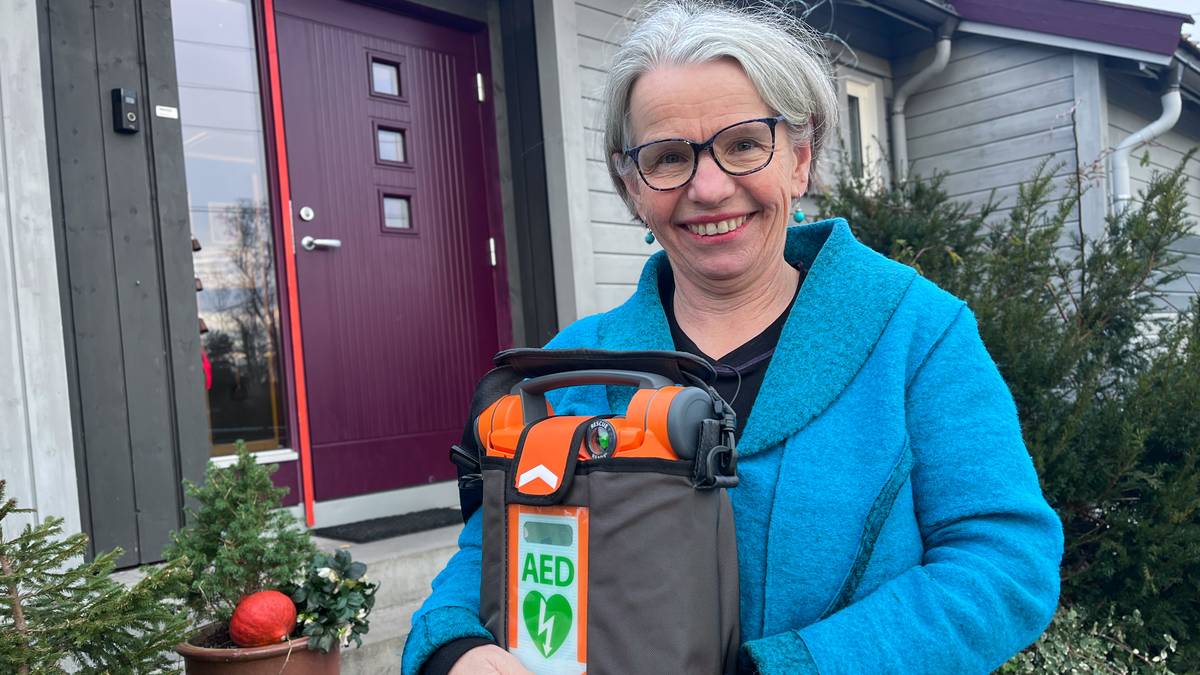
The case in summary In the event of a cardiac arrest, it is important to quickly start cardiopulmonary resuscitation, even if the person is still breathing. For every minute that passes without cardiopulmonary resuscitation, the chance of survival decreases. Mariann Bekkevold Hovda, course leader in cardiopulmonary resuscitation, has bought a defibrillator that is available to everyone in the neighbourhood. It is important to register defibrillators in the public defibrillator register, so that they are easily accessible in emergency situations. Many people do not start CPR because they do not understand that a person with abnormal breathing may be in cardiac arrest. It is better to start cardiopulmonary resuscitation even if you are unsure, as it cannot cause damage. The summary is made by an AI service from OpenAI. The content is quality assured by news’s journalists before publication. – You must shake, shout, call and rescue. Resuscitate the person, call for help, call 113 and start cardiopulmonary resuscitation. Then someone has to find the nearest defibrillator. That’s what Mariann Bekkevold Hovda says. She is a course leader in cardiopulmonary resuscitation at Østfold University College. Because imagine this situation: You are walking down the street and see a person lying on the ground. The person is unconscious but still breathing. You place the person in a stable side position. Then you might spend a minute calling for help. That minute can cost the person dearly. Around half of those who have a cardiac arrest are still breathing. Even when the heart has stopped. Then it can be difficult to understand that the heart is not beating. As a result, cardiopulmonary resuscitation is not started in time. What do you do if someone has had a cardiac arrest? The chain that saves lives: Look for signs of life: Is the person breathing evenly and normally? Call 113 immediately if you are in doubt. Early cardiopulmonary resuscitation (30:2): Compress the chest approximately five centimeters, at a rate of 100 compressions per minute. 30 pressures, then 2 calm breaths until the chest rises. Early defibrillation: Stop cardiopulmonary resuscitation only when the defibrillator analyzes, charges and delivers a shock. Medical treatment: Continue until the ambulance arrives. Source: hjertestarterregister.113.no Bought my own defibrillator – With every minute that passes, the chance of saving someone with a cardiac arrest decreases, so you don’t have enough time, says Hovda. Therefore, on her own initiative, she has bought a defibrillator with money from her own pocket. It hangs in the window by her front door, clearly visible to anyone passing by. Hovda wants to help save lives, with an easily accessible defibrillator. Photo: Odd Skjerdal / news – If someone were to have a cardiac arrest, either us or neighbours, I would like to be there and contribute to saving lives. It cost NOK 19,000, but I thought we could afford that, says Hovda when news visits her. And the neighbors? They have been told where to find the key to the house, should the accident happen. If you are not one of Hovda’s neighbours, the emergency center also knows where the key is. Hovda’s defibrillator hangs in the window by the door. Photo: Odd Skjerdal / news – You can possibly break the window. Breaking the window to save lives is nothing, says Hovda. But the biggest problem, according to Hovda, is that people often do not start CPR at all. – Must assume cardiac arrest – Those who are still breathing have the best chance of survival. Then it is very unfortunate that they are the ones who do not receive the right treatment. That’s what Camilla Hardeland says, who is an associate professor at the department of nursing, health and bioengineering at Østfold University College. Camilla Hardeland has a PhD in emergency medical communication centers (AMK) and their management of patients with cardiac arrest outside hospital. Photo: Odd Skjerdal / news She has researched cardiac arrest, and says that what you should look for is abnormal breathing, i.e. gasping, snoring or slow and shallow breathing. Because around half of those who have a cardiac arrest are still breathing when the heart has stopped. – If you see someone who is unconscious and not breathing normally, then you have to assume that it is a cardiac arrest. And should you be unsure of what to do, Hardeland believes it is better to start cardiopulmonary resuscitation than to do nothing. – You can’t do anything wrong. The patient may experience some pain, or in the worst case break a rib, but you do not cause any damage, she emphasizes. How to use a defibrillator Turn on the defibrillator. Remove the clothing from the patient’s chest. Attach the defibrillator’s electrodes to the patient’s chest as described. Most defibrillators have drawings of where on the body they should be attached. The machine registers that there is contact between the electrodes, and you are told not to touch the patient – no one should be in contact with the patient. The defibrillator analyzes the heart rhythm and determines whether it can shock the rhythm. The defibrillator performs a new analysis approximately every three minutes. If a shock is recommended, keep your distance from the patient and let the defibrillator deliver shocks – fully automatic defibrillators deliver shocks automatically. Continue CPR until medical personnel arrive. Source: Norwegian Air Ambulance Two different registers Mariann Bekkevold Hovda wants both she, her husband and the neighbors to survive should the accident happen. That is why she has also registered her defibrillator in the public defibrillator register. But if you have also gone to purchase a defibrillator recently, it may be good to know that there are two different registers. One is private, the other public. Hovda shows that in the Hjelp113 app you can easily find the nearest defibrillator. Photo: Odd Skjerdal / news – Many defibrillators in the country may be registered in the wrong place, says Hovda, who himself missed the first time. The public register is linked to both AMK and the Hjelp113 app. Here everyone can find their nearest defibrillator. – The defibrillators mean nothing if we can’t find them, says Hovda. And should you find an unconscious person who is not breathing normally, Hovda reminds you of the simple rule of thumb for how best to help someone with a cardiac arrest: – Shake, shout, call, save! Find your nearest defibrillator in the public defibrillator register: Published 13.12.2024, at 11.45
ttn-69