
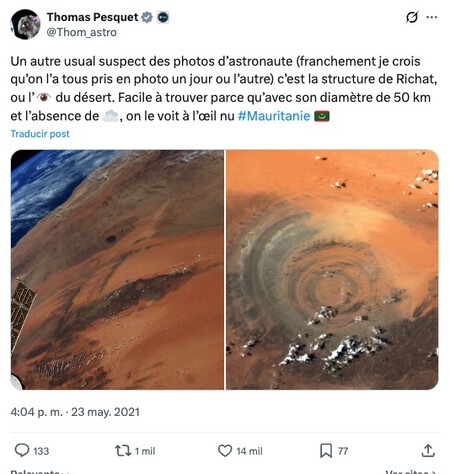
The Mysterious Eye of the Sahara
While we often focus our searches on the cosmic expanses beyond Earth, our planet continuously reveals its own mysteries. Among these is the fascinating structure known as the Eye of the Sahara, or the Richat Structure, a phenomenon that captivates not just geologists, but also astronauts and explorers.
A Geological Enigma
The Richat Structure resembles a colossal eye etched into the Sahara’s rock, with a diameter of nearly 50 kilometers. Visible from space, it cannot be fully appreciated from the ground. According to French astronaut Thomas Pesquet, it’s an unmissable sight for anyone aboard the International Space Station—the “eye” is significant enough that World War II pilots utilized it as a reference point during missions.
Location and Discovery
Situated in Mauritania on the Adrar plateau, this enigmatic formation rises about 500 meters above sea level, nestled away in a harsh landscape. The nearest settlement, Ouadane, is 17 kilometers from its perimeter and holds historical significance, being established in 1147 and recognized as a UNESCO World Heritage Site since 1996.
The Rise of the Structure
The first recorded observations of the Richat Structure date back to the 1930s and 1940s, with significant studies conducted by French geographer Jacques Richard-Molard. It wasn’t until 1965 that astronauts James McDivitt and Ed White captured its image during the Gemini IV mission. More recently, on July 10, 2020, an astronaut aboard the International Space Station photographed the “eye” with a Nikon D5 camera.
Formation of the Richat Structure
From space, the Richat Structure showcases a series of concentric rings reminiscent of ripples produced by a stone splashing into water. These rings, colored in ochre, bluish gray, pristine white, and rusty red, reveal the geological history of the area, with each hue indicating different rock types from various geological eras.
Nature’s Slow Craftsmanship
Contrary to some theories that suggest it could be the remnant of a dried-up lake, a volcano, or a meteorite impact, the Richat Structure is more the result of geological forces acting over millions of years. Formed about 100 million years ago, its rocks date back up to 2.5 billion years, predating even the earliest animals.
Geological Processes at Work
The structure itself is a deeply eroded geological anticline dome, resulting from subsurface igneous intrusions. Over time, these forces have altered the sedimentary rock layers, exposing concentric rings with the oldest rocks at the center. Essentially, the formation is akin to a bubble of rock that has gradually been stripped away, revealing each layer like the peeling of an onion.
The Complexity of Formation
Recent studies suggest that hot water circulation also influenced the Richat Structure’s final form, adding another layer of complexity to its genesis. The resilience of harder rocks shaped the relief, while softer materials eroded away, giving rise to the stunning visual features that can be seen today.
The Richat Structure remains one of Earth’s most captivating geological formations, challenging our understanding of natural history and geologic processes. As satellite technology and exploration continue to evolve, it is likely that this enigmatic eye will keep revealing new secrets.